
The all-party group of MPs representing the East of England risks being seen as a voice only for controversial corporate interests if it does not broaden the range of people and institutions involved in it
You can see the East of England APPG website here
“What is an APPG?”
You can see the explanation from Parliament here. At their best, ‘All Party Parliamentary Groups’ are campaigning alliances that bring to the fore important political issues and social causes that might otherwise not get coverage from existing select committees. At their worst, they are opportunities for politicians to get above-board freebies from corporations, wealthy interests, and foreign governments.
The register of APPGs on Parliament’s website is here. Back in 2021 Labour MP and now Minister for Culture, Sir Chris Bryant, commented that APPGs were the next lobbying scandal waiting to happen.
“According to BBC research, an estimated £30.7m – as published on the APPG register – has been funnelled into the groups since 2017. Of that total, an estimated £6.4m was donated by companies registered as lobbyists.”
“So who pays for the expenses of the APPG for the East of England?”
This group of organisations
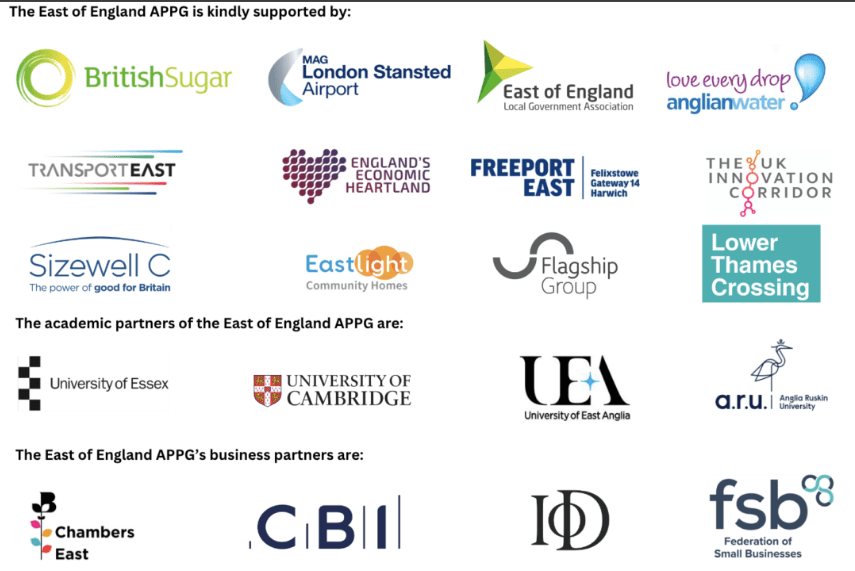
More than a few of these organisations will raise eyebrows with various campaign groups (although note this is not an accusation of impropriety against any individual or organisation)
- British Sugar – food health / obesity, agriculture / soil damage
- London Stansted – aviation pollution (noise, emissions)
- Anglian Water – sewage scandal, water extraction, leaks
- Freeports – tax breaks, maritime pollution
- Flagship Group – house-building
- Sizewell C – nuclear power (and thus nuclear waste)
- Lower Thames (Essex-Kent) Crossing – motor vehicle pollution
- University of Cambridge – Investments, local expansion vs environmental limits to growth, local/regional inequalities
- CBI – recovering from corporate scandal
…to name but a few off the top of my head.
Taking the top three institutions, they have a strong commercial and financial incentive to influence public policy to the extent that regulations do not negatively impact on their bottom line. These can cover things like:
- Taxation
- Regulatory regime including fines & penalties for non-compliance/law-breaking
- Regulatory regime – being compelled to do things that involve spending money that they may want to give to their executives or shareholders
“Who should hold them accountable and how?”
It’s not so much holding the firms accountable, rather ensuring they do not get the freedom to make claims to audiences of MPs and their staff without some push-back or scrutiny from people who have a level of knowledge/expertise to do that. That’s not to say that every other campaigner or group automatically gets a seat at the table. After all – who decides? What are the criteria?
“Actually, who does decide?”
The secretariat – the day-to-day running of the group appears to be undertaken by a specialist consultant, whose services are covered by the sponsoring organisations listed above. For those of you interested in lobbying generally, see this book. I don’t know who makes the judgement calls for who is and is not appropriate as a sponsor or supporter for the APPG – I assume it depends on the MPs involved, subject to the existing rules of Parliament – and also the Committee for Standards in Public Life.
But my point remains that in meetings within the APPG – especially when representatives from the funding organisations are there, there need to be people with the knowledge (of the subject area) and expertise (in public policy) to scrutinise and call out the corporate representatives when they over-step the mark. MPs’ offices are surprisingly under-funded and under-resourced when it comes to having the in-house expertise to do this.
Without having diverse expert voices willing and able to call out corporate interests, you risk ending up in a situation that the Grenfell Inquiry exposed – where the entire political and public policy structure along with the industry had been completely captured by industrial and corporate interests. With devastating consequences. No one seemed able to question the mass outsourcing of expertise to the private sector and the hollowing-out of the civil service’s in-house expertise. (It’s a logical extension of the Thatcher Government’s programme of outsourcing and privatisation in the 1980s, where instead of maintaining an in-house expert function, you ‘go out to tender’ every few years for someone else to ‘provide those services’ because market disciplines mean it is cost-effective. Or so the business-school-proponents said).
The problem is corporate interests don’t like being called out – especially in public
Which is why in the meetings that happen behind closed doors (I went to more than a few of them myself in my civil service days) it’s all the more important to have those independent minds and voices who can challenge them in those private forums.
One of the things I found fascinating when working in housing policy was watching the pro-sustainability lobbyists going head-to-head with the pro-cost-reduction/minimal regulations lobbyists. This was nearly 20 years ago but at a time where some firms were establishing a competitive advantage in sustainable materials, components, and construction techniques over the mainstream builders. As a result, they were more than happy for sustainability standards to be tightened because they knew they would be able to survive and thrive in that new regulatory environment, whereas the bulk of the industry opposed tougher standards. These are the sorts of debates that MPs and their staff need to observe – let the different sides debate each other and judge accordingly.
And at the same time, ensure that summaries of such meetings are not only published, but publicised too. Because you never know which constituents might show an interest.
If you are interested in the longer term future of Cambridge, and on what happens at the local democracy meetings where decisions are made, feel free to:
- Follow me on BSky <- A critical mass of public policy people seem to have moved here (and we could do with more local Cambridge/Cambs people on there!)
- Like my Facebook page
- Consider a small donation to help fund my continued research and reporting on local democracy in and around Cambridge.

 The Cambridge Town Owl