Some lessons learnt from the East West Rail Debate hosted by Cambridge Young Greens at Emmanuel College, Cambridge on 06 Nov 2024
TL/DR? We’ve got to produce materials and content that can enable students to get up to speed as quickly as possible on whatever issue they are being invited to campaign on. Especially one as important as the Future of Cambridge where their colleges and university are making decisions on their behalf and in their name – but not perhaps with the full informed knowledge of the members of those institutions.
Amongst other things, local democracy can be a useful distraction from the rolling-disaster-p-0-r-n that counts for news and current affairs programming these days. For those of you who missed it, the Hobson Street Cinema has had a temporary reprieve as councillors threw out the ‘worse than communism’ design earlier on.
The speakers were
- Jim Chisholm – Longtime CamCycle legend
- Miranda Fyfe – MP-candidate for The Green Party in South Cambridgeshire in 2024
- William Harrold – member of Cambridge Approaches campaign group
- Sean Huang – President of the Cambridge University Railway Club
Jim and Sean were speaking in favour of East West Rail, and Miranda and William were speaking against – or rather the latter two were speaking against the proposals as they are, not the principle of increasing and improving rail travel over motor transport.
I took some print outs of maps and diagrams from Cambridge Connect Light Rail, and from Rail Future East’s campaigns for an improved rail network, which I handed out at the end.
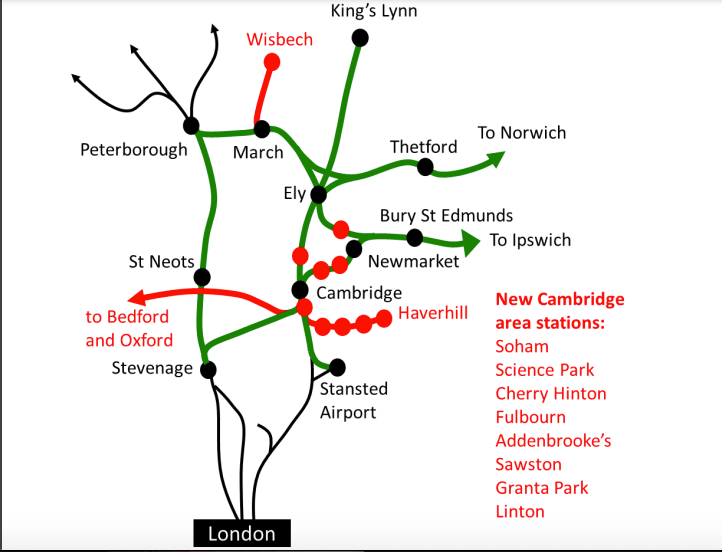
Above – one of the Rail Future handouts (note their Cambridge annual meeting on Saturday 7th December 2024 at 14:00 at The Signal Box Community Centre, Glenalmond Avenue, Cambridge CB2 8DB) showing how East West Rail might link in with proposed new stations in and around Cambridge and Peterborough.
The buzz of conversation as they looked at the light rail proposals from Dr Colin Harris and team told me that as campaigners resident in and around the city, we need to get our materials – in particular the maps and diagrams, into the hands of the students so that they can debate for themselves and come to their own conclusions in their own time. Furthermore, once they’ve familiarised themselves with the background reading and browsing, the city should provide them (and any other young people in/around our city interested) with the opportunity to put questions to those of us proposing/supporting the alternative plans, and to councillors/local politicians as well.
As long-standing campaigners, we sometimes forget how much information we’ve absorbed over the years/decades.
I think one of the students mentioned that they were at primary school when I started following the Greater Cambridge Partnership back in 2014 – here’s a video of me and Jim way back in 2015 discussing the north-south Cambridge cycleway named after Jim as he was the person who came up with the concept. While the first phase has been completed – incorporating a new bridge over the River Cam linking Abbey Ward and East Chesterton, Phase II is still in the planning stages. So much so that the GCP Board will be debating it on 07 Nov 2024 (later today!) at The Guildhall!
Not surprisingly, there were some things that the students had to pull the panellists up on as they went into the detail – such as ‘What is a local plan?’
I’m not sure that the answers the students received made much sense to them or whether it simply led to more questions. This is why I keep going on about the essentials of citizenship education because without knowing the essentials of parliamentary sovereignty, the rule of law, and where local government sits within the structure of the state, it’s not easy to explain who gets to decide what goes where. (Which is why I like books from the olden days such as this from 1968 on town planning that explain such things without being a heavy tome)
Party politics vs public policy
Talking to Miranda and her party colleague Kathryn Fisher (who stood in St Neots & Mid Cambs in 2024) they reminded me of the importance of having party political alternatives to whatever it was the party in government was proposing – noting that East West Rail (now on FB here) is a piece of major piece of sub-national transport infrastructure, the completion of which is now the policy of the Labour Government. Hence as part of the scrutiny process, opposition politicians can take a look at the proposals and decide that there is so much wrong with them or a specific section (eg the Bedford-Cambridge section) that they are opposing the proposals as they stand.
From a public policy/non-party-political perspective, generally you take the big picture decision as a given, and try to influence it so that it is the ‘least worst’ option that goes ahead if they cannot go ahead with the best one. Which is what one of the students said to be about the CSET busway: better to build it now and get it done quickly rather than wait for the light rail. It’s easy for us older campaigners to say: “Well, they started this whole thing a decade ago and they are still squabbling!” Things like that are ancient history if you were still at school when it started – something I continually remind myself when looking through the history of Cambridge in the 1990s when I was a teenager.

Above – car culture. Christopher South’s old column from 1994 featured in a Lost Cambridge Blogpost on motor traffic here
The importance of the Cambridge Room
Supported by the Department of Architecture at the University of Cambridge, This soon-to-be-opened community space in The Grafton Centre will need to have some display materials for people and students to browse so they can work out for themselves ‘how Cambridge got to here’.
Furthermore, for large developments such as the Cambridge Biomedical Campus – front and centre of the case for a southern approach for East West Rail, the assumptions that ministers and investors have made need to be prominent so that students and the wider public can question and test those assumptions – not least on the issues around water supplies.
Housing and Transport Planning – East West Rail cannot be looked at in isolation
One big error the last Labour Government made (in my opinion) was to separate local transport planning from local development planning (ie buildings). One of the reasons why it’s all a big mess in and around Cambridge is that there are multiple councils and organisations with various partial responsibilities that seem to end abruptly somewhere, leaving them unable to influence a crucial part of their proposals. In South Cambridgeshire it might be the towns of Royston (Hertfordshire) and Haverhill (Suffolk) that sit over the county boundary. Likewise the county councils there cannot influence Cambridgeshire’s transport policies – not least because neither of them have the equivalent of a Combined Authority with a Mayor at the top. In Cambridgeshire & Peterborough’s case, Nik Johnson’s profile has been raised considerably as a Labour Mayor now supported by a Labour Government. Hence Cambridge seeing more of Greater Manchester Mayor Andy Burnham (a former Health Secretary, and also a former Cambridge student in the early 1990s) around these parts.
What made things tricky to explain for the panel were the telephone-number figures involved in the spending on housing and infrastructure – along with the environmental impact. This is where summaries or key facts made available and accessible earlier might have been helpful. Again, this isn’t the fault of the organisers or panellists; public policy is fiendishly complex at the best of times. Which is why I liked what the long-lost BBC Three series Free Speech did prior to their debates.
That was back in 2013. Fast forward to 2024 and Labour included Votes at 16 into its manifesto. Having been elected, ministers confirmed that they would legislate to extend the vote to 16-17 year olds in time for the next general election. (There is a very strong ‘no taxation without representation’ theme as well – 16/17 year olds can be taxed on their earned income from employment. I got taxed back in the day as a 17 year old supermarket assistant when working overtime and going over the thresholds where National Insurance Contributions could not be claimed back. That stuck with me!)
Local councils using short video clips to explain decisions
It’s worth noting that Cambridgeshire County Council have also started creating video summaries of their meetings – such as the one below on Highways and Transport with Queen Edith’s Councillor Alex Beckett (Lib Dems).
Above – Cllr Alex Beckett (LibDems – Queen Edith’s) with a two-minute summary of what his committee debated and voted upon
 The Cambridge Town Owl