
This was for non-devolved parts of England that have not had their budgets devolved to Combined Authorities, picked up by FE Week. I dread to think what it’s like when you include the Combined Authorities
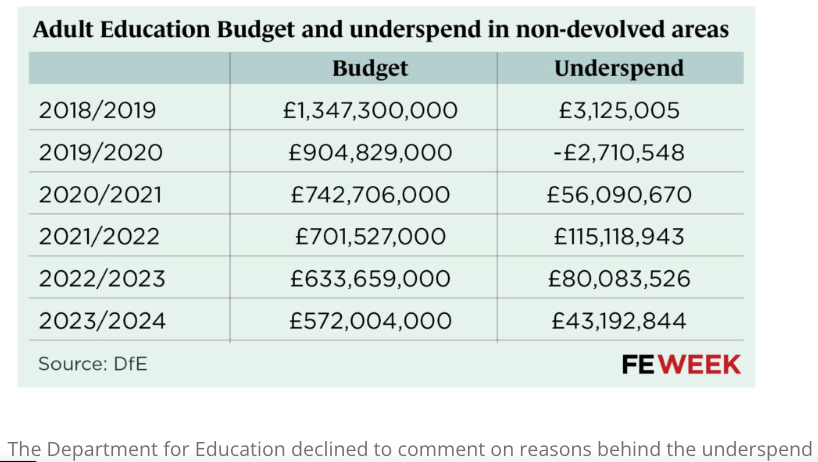
Above – Josh Meoor for FE Week 08 Nov 2024
The data comes from a written Parliamentary Question response from the Department for Education to Jo White MP.
“Julian Gravatt, deputy chief executive at the Association of Colleges, said “complexity and underfunding” of adult education budgets had been a longstanding problem that contributed to underspends in the 2010s.”
Why do institutions underspend on training and development? (Or do they? Question for all of you in employment to ask your employers: how much did you budget for spending on skills and staff development? How much was spent?)
Back to Dorothy Enright’s first principles?
If anyone should have a learning institution named after them in Cambridge, it’s Dorothy Enright, the first woman principal of a technical college in England when she was appointed to the institute that is now Anglia Ruskin University on East Road in 1925. (It’s her centenary year next year!!!)

Above – Dorothy Enright of the Cambridge School of Arts, Crafts & Technology, from the Cambs Collection / Tony Kirby
Miss Enright made it her business to speak to every major employer in Cambridge and ask them what their training needs were. Then she designed a programme of courses and workshops to meet the needs of employers while building a wider programme of literacy, numeracy, and lifelong learning courses around their needs. Her legacy was the programme of courses as illustrated in the 1954-55 prospectus digitised here.
One of the other things she ensured was that the East Road site had new facilities to enable that learning to take place.
“Among the developments in the school which have taken place during the last five or six years have been the provision of a new building with modern technical equipment, the appointment of highly qualified teachers and the starting of progressive schemes of instruction. Employers of labour have extended help and encouragement and co-operated with Miss Enright’s efforts for the further instruction of their employees.”
From the Saffron Walden Weekly News – Fri 06 March 1931, transcribed from the British Newspaper Archive. See also Lost Cambridge here on Dorothy Enright.
Adult education getting caught up in machinery of local/regional government changes
Mark Freeman (who some of you will know via the Cambridge CVS) wrote up his research on continuing education provision by the University of Cambridge between 1945-1990 – you can buy his book here, along with Peter Cunningham’s review (Formerly of Homerton College) here

Above – some of you may want to buy the print issue of this. (Combined Authority staff, this includes you – evidence-based policy-making and all that)
The disagreements I have with the CPCA (or rather, with the ministers that control the macro-policies and the purse strings.) revolve around how narrow their definition is of adult education. Furthermore, I don’t think an underfunded local operation crushed by austerity over the past decade-and-a-half is in any position to be talking about a ‘world class offer’. Which is why I pulled up the CPCA over this.
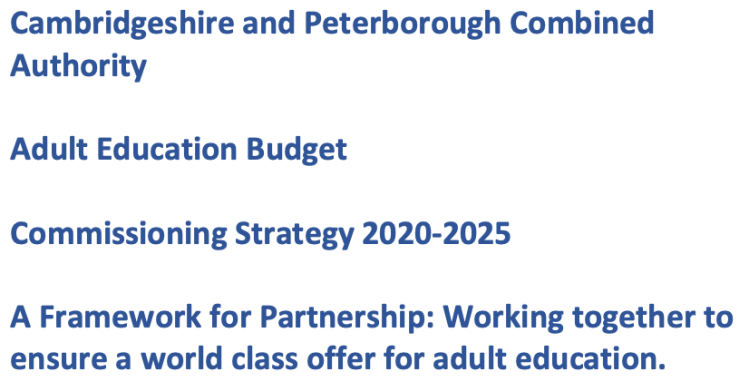
Above – asking what a ‘world class offer for adult education’ looks like here, in response to the above publication included in the CPCA Board Meeting Papers for next week.
Because if you don’t have a properly-designed institutions that is affordable, accessible, more than meets the needs of the learners to the extent it is a place that they would like to be at, (which Cambridge does not have), then we don’t have the moral right to even think about calling our offer ‘world class’.
Adult education was also covered in pre-general election policy papers
“Skills 2030” was one such paper recommending:
- “Reshaping Skills Policy Decision-making,
- Investing in the Future of Further Education and Skills,
- Removing Barriers for Young Learners,
- Maximising Employer Investment in Skills, and
- Making Lifelong Learning a Reality.”
You can see the press release and the report from May 2024 here.
Nothing however, has convinced me that we will see a significant shift on skills locally or nationally until we get a new generation of institutions and facilities that meet the needs of both the learners and the places they live in. (That includes economies, societies, and the local environment too – it’s not all about increasing GDP!)
Additionally, until senior politicians and ‘the business community’ (whoever you want to call them) are willing to accept that maintenance grants for the many have to be part of the offer to encourage people to switch careers and upskill/retrain in sectors that have chronic skills shortages, they’ll carry on experiencing the same problems.
And I can’t help them with that.
If you are interested in the longer term future of Cambridge, and on what happens at the local democracy meetings where decisions are made, feel free to:
- Follow me on BSky <- A critical mass of public policy people seem to have moved here
- Like my Facebook page
- Consider a small donation to help fund my continued research and reporting on local democracy in and around Cambridge.
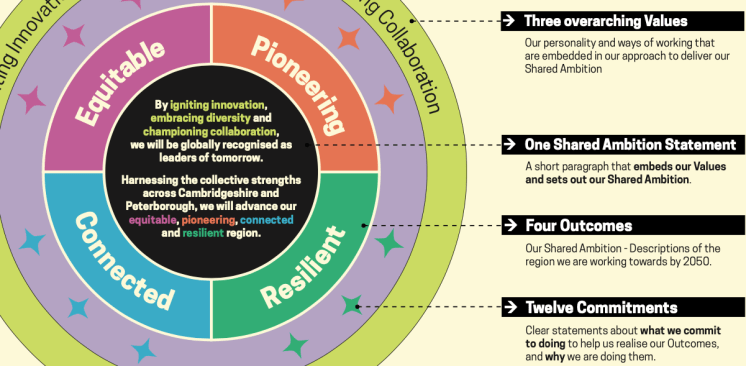
A reminder of the CPCA’s Shared Ambition consultation – which must include lifelong learning – surely?
 The Cambridge Town Owl