
Jen Williams’ article on the late Sir Howard Bernstein, the former Chief Executive of Manchester City Council from 1998-2017 provides much food for thought
You can follow her on Bsky Here
I’ve been following Jen Williams’ posts on birdsite for years and strongly recommend her writing on all things politics and public policy in local and regional government outside of London.
“Hang on – What’s the difference between a Council Leader, a Mayor, and a Chief Executive?”
And this is why political and democracy education is important. A critical mass of the general public should be educated and aware enough to know the difference between the Political leadership and the Officer leadership – the latter serving whoever is elected into power, and the former being chosen by the people.
Chief Executives – formerly town clerks
These are the most senior administrative officers for a local authority area and are the equivalent of Permanent Secretaries but for local authority areas. . They are charged with delivering the policies as decided upon by the constituted political authority of the council or institution concerned. This might be vested in a single person – a Combined Authority Mayor, or with the Leader of a Council who has carried the confidence of their fellow councillors in a formal vote on full council.
Mayors:
- Political Mayors (like the Mayors of the Combined Authorities) in principle have a mandate from their electorates through mayoral elections – although this assumes that candidates actually publish formal manifestos. Some mayoralties have such few powers that there’s no real point in publishing them because so much depends on what ministers choose to provide funding for.
- Civic Mayors (like the Mayor of Cambridge – we’ve had a few) are elected annually by their fellow councillors in places that have a Royal Charter that formally created the office of the Mayor of the borough/town/city. As the first citizen of the place they have a host of ceremonial duties – some dating back centuries. They also chair full council meetings and have to attend to Royal visits.

Above – Keith Heppell’s photograph for the Cambridge Independent of 19 July 2019 of the Late Queen Elizabeth II escorted by the Lord Lieutenant Julie Spence, meeting the Mayor of Cambridge Cllr Gerri Bird in full civic regalia at at the opening of the NIAB Institute in Cambridge
“What made the late Sir Howard different?”
Remember that during this time the Leader of Manchester City Council for that entire period was Sir Richard Leese. Although Ms Williams does not name him in the article, the partnership between Leese and Bernstein is one that deserves greater scrutiny not least because it lasted for nearly two decades – so they must have done something right, as well as a few things wrong given the time they were in office. That said, Ms Williams did write an article for her former employers, the Manchester Evening News on the paid back in 2014 here. Three years earlier in 2011, Lord Adonis the former Transport Secretary wrote this piece on the pair.
There’s an interesting in-depth take on Sir Richard Leese in the Manchester Mill here which covers some of the bruising Political battles, as well as a police caution he received. The same website has this obituary on Sir Howard Bernstein.
What immediately jumps out in Ms Williams’ article is the praise from the former Chancellor George Osborne – mindful of the latter’s devastating policies on local government.
“His mission was the transformation of Manchester’s ailing post-industrial economic landscape. He thought the city needed to stand on its own two feet, rather than relying on endless fiscal transfers from London. That meant sidestepping obstacles, often imposed by the state itself, and convincing investors that the city was worth a punt”
Thus has been the long complaint from London and some of the south-eastern cities (including Cambridge) about being net contributors to other parts of the UK. What’s often forgotten about the great metropolis of London is. When you compare per-capita figures on transport spending by region, London comes up far higher than anywhere else (according to the IPPR North here).
Put it this way, Peterborough gets the equivalent of £150million on transport spending per year based on its population (215,000) by the per-capita figure for the East of England (£697 on the IPPR’s numbers). London’s per capita spend was £3,636. If Peterborough had that equivalent, it would have gotten over £781million for that same year. Therefore one cannot blame the residents of the great industrial cities of the north for having woeful productivity levels. Their infrastructure – in particular public transport, has simply not been invested in compared with London. And it shows.
One of the reasons I go on about enabling local and regional tiers of government having much wider tax-raising bases is that it would enable somewhere like Cambridge to tax the huge sci-tech bubble we have, while enabling central government to concentrate its financial support on those areas unable to raise the sums from their own local economies. At the same time, when you think of what some economic activities can raise in revenue for local areas if given the chance (such as top-flight football), the impact such revenues could have had over the past quarter of a century could have been immense…had HM Treasury allowed.
Back to Bernstein and Reese
“It is very different from the “here-today, gone-tomorrow” chief executives who characterise so much of local government, and the weak and unstable political leadership which I found in some other cities, notably Bristol and Bradford.”
Andrew Adonis (2011) Institute for Government
But note the huge challenge Manchester faced in the early 1980s.
“…between 1978 and 1981, the conurbation was losing 127 manufacturing jobs per working day…”
Williams (2024) quoting Mike Emmerich in the FT
Where does one start in the face of such a relentless economic decline? (One made worse by Government policies of the day).
“Bernstein and others sought to identify where the city’s economy went next — and how to get there.”
Williams (2024) in the FT following
This comes back to my recent points about the future of Cambridge. Back in July 2021 I asked Whose future vision of Cambridge is being delivered and why? Do a keyword search for Vision on this blog and you’ll get 43 pages of results. Sorry.
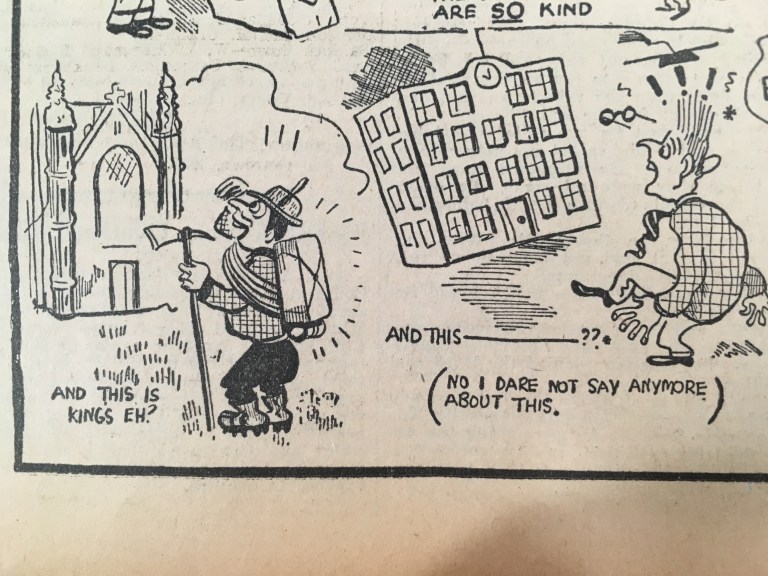
Above – Ronald Searle lampooning the unpopular Guildhall design – hated by many in the 1930s. From the Cambridge Daily News 03 Oct 1936, in the Cambridgeshire Collection.
We spent much of the 20th Century arguing about who was building what in Cambridge and to whose vision. Not much has changed since! Yet as I mentioned a few days ago in this blog, the Housing Minister who is ultimately deciding the big picture vision for our city’s future must surely be aware of our broken governance structures – ones almost designed to be adversarial rather than co-operative. Thus making it even harder for Cambridge to achieve success for the many, not the few.
That’s not to say Leese and Bernstein had everything their way. They tried a referendum on congestion charging but didn’t succeed. ***But they had a Plan B*** (as I quote Ms Williams later on)
Cambridge’s proposals before the GCP’s doomed attempt never got past the consultation phases in the 1990s and 2000s – GCP senior officers going on public record saying they had not done any analysis of past transport proposals, and GCP Assembly and Board Members failing collectively to insist that they do the historical analysis and report back their findings. That thing about regular turnover of senior decision-makers? That’s what happened on both the GCP Board and Assembly over the past decade. Only former councillor Lewis Herbert, and Cllr Elissa Meschini have been around for a long-enough period of time in their tenures to have built up something of a political corporate memory. That point about stability made by Lord Adonis? That.
“The importance of local reliable institutions…”
Williams (2024) in the FT again
Hard to have reliable local institutions when you’ve got such a fragmented system of government and the lead institution for that city is a borough-level council. Cambridge City Council never had the policy-making capacity to do what the knights of Manchester could do. They had to contend with a Conservative, and a Conservative-UKIP county council at various points until the Cambridgeshire political earthquake of 2021.
“Whitehall can’t possibly know the needs of each local economy. But at the moment there’s not the abundance of expertise across local government either”
Williams (2024) in the FT again
Ms Williams making the point about how austerity amongst other things has starved local councils of that essential policy-making capacity. In times gone by there was an attempt by Tony Blair’s Government to get that policy capacity into the regions via the old Government Office Network – which was around the time I started my former civil service career in the Cambridge regional office. One big problem was that the top-heavy, over-centralised system in England meant that regional offices did not have the critical mass of staff with Whitehall experience, and the London-based civil service was generally unaware of the basics of local government – in particular outside metropolitan areas. When I moved to London my new team on local government reform policy was pleasantly surprised to have someone familiar with two-tier authority working. (Yet even then I was out of my depth).
“Always have a Plan B”
…writes Ms Williams in a sub-title – something that the Greater Cambridge Partnership never had – and almost imploded over when the first Combined Authority Mayor James Palmer made it clear of his hostility towards the GCP – the latter promoting busways while the former was promoting his now defunct CAM Metro. That thing about long term stability? A lesson not learnt by ministers – and ironically George Osborne who was the driver behind a combined authority that incorporated Cambridge.
Bernstein had a Plan B for expanding the Manchester Tram network when his plans for a congestion charge fell through in the face of a voter revolt. The Greater Cambridge Partnership’s senior officers on the other hand did not – and the complete hash that the GCP made of the whole thing ultimately enabled the Conservatives to get their first councillor elected (albeit in a by-election) since the early 2010s. The GCP still do not have a plan to deal with all of their busway buses when they hit the city centre – the City Access Project responsibilities now residing with the Combined Authority.
“Cambridge and Manchester are not the same though – if there’s one thing Cambridge is not short of, it’s private sector investment – especially in property”
This is the different problem that ministers have not considered – and need to. What happens when too much investment is targeted towards too small an area?
This is the problem that Cambridge faces because every investor and their parents seems to want to indulge in punting-on-the-Cam fantasies that the marketing people sell them. The developers and the private schools are the worst in my opinion for this – giving the impression that people buying into what they are selling will be living in the equivalent of ancient colleges (chances are it will be a snag-filled newbuild as Daniel Zeichner MP complained about in Parliament back in 2021) or a place at a private language college stuck out in a 1960s-style pokey office building in a suburb, or a not-fit-for-purpose Victorian building.
This is one reason why I wrote urging ministers to consider designating other historic county towns as ‘landing points’ for Cambridge spin-outs that had grown too big for our city. Places like Bedford and Northampton that have huge potential for regenerating riverside fronts where the Create Streets movement can turn their pre-election Cambridge AI fantasies into a reality without the high land costs. That’s on the assumption they have sought and received the consent of the local residents and electorate. Otherwise the same complaint arises: someone from outside imposing their vision onto an unsuspecting population without their input at design stage, and without their informed consent.
And democracy matters.
If you are interested in the longer term future of Cambridge, and on what happens at the local democracy meetings where decisions are made, feel free to:
- Follow me on BSky <- A critical mass of public policy people seem to have moved here (and we could do with more local Cambridge/Cambs people on there!)
- Like my Facebook page
- Consider a small donation to help fund my continued research and reporting on local democracy in and around Cambridge.
Below – The Trials of Democracy workshops start this weekend! Sign up here

 The Cambridge Town Owl