
I missed this significant paragraph in a letter from the Minister for Local Government, Jim McMahon (Formerly Leader of Oldham Metropolitan Borough Council in Gtr Manchester) to councils on the Oxford-Cambridge Partnership
Also, a quick reminder of The Trials of Democracy: Who Gives a XXXX? the third of three workshops this weekend at the Mill Road Community Centre.
“I can’t believe it’s not the OxCamArc!”
Me neither – but we’ve covered its establishment before.
This post is about something that few picked up on in what is a fairly routine internal letter before a big policy announcement that will have the details in it. It’s in item 11 Appendix A of South Cambridgeshire District Council’s Full Council on 28 Nov 2024
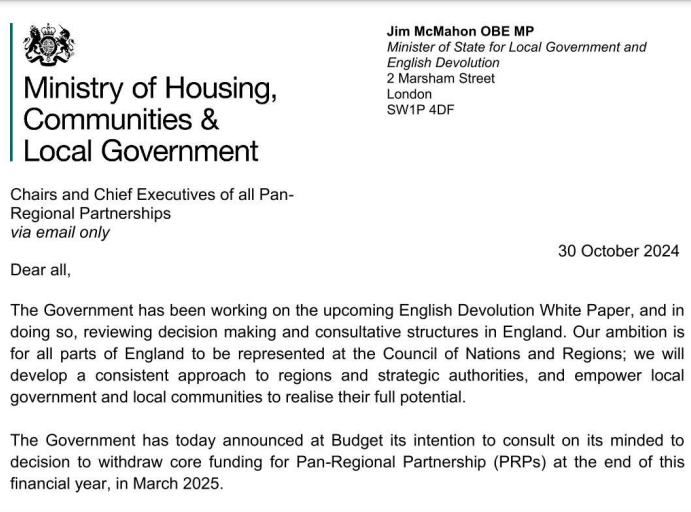
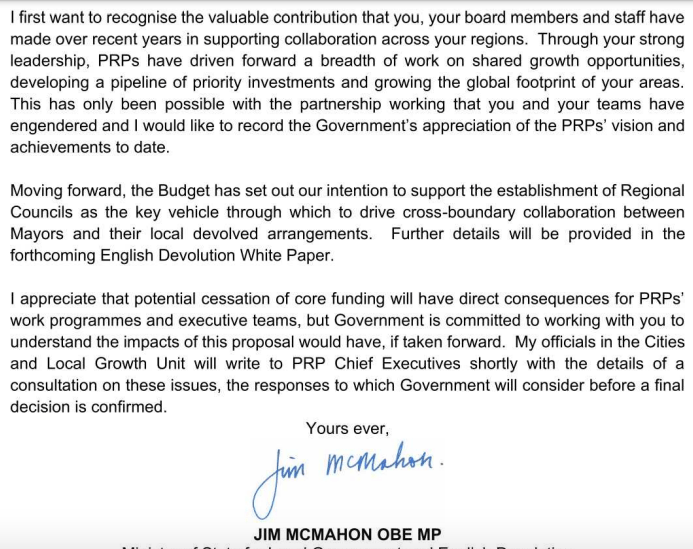
The second-from-last paragraph is the important bit.
“Moving forward, the Budget has set out our intention to support the establishment of Regional Councils as the key vehicle through which to drive cross-boundary collaboration between Mayors and their local devolved arrangements. Further details will be provided in the forthcoming English Devolution White Paper”
Minister Jim McMahon MP to Pan Regional Partnerships, 30 Oct 2024 at item 11 App A South Cambs District Council 28 Nov 2024
“Regional councils? That sounds like Regional Assemblies – or the provinces that Redcliffe-Maud proposed“
For those of you unfamiliar with the concept of regional provinces, I summarised these in articles covering how Redcliffe-Maud’s proposals would have affected Cambridge in a pair of blogposts covering press reports at the time.

In Redcliffe-Maud’s plan, the four major settlements of Cambridge, Peterborough, Norwich, and Ipswich would have been the economic centres for each of the unitary councils within the province.
Redcliffe-Maud rejected by the incoming Conservative Government
One reason why we did not go to a unitary council model for the whole of England was because the Conservatives feared local government becoming too remote – with the loathed figure of the bowler-hatted civil servant coming to inspect things with no local accountability. Hence why we have the structures of today for most places except those that were converted to unitary status because they grew too large for a two tier system (Peterborough) or financial problems resulted in ministerial intervention (Northamptonshire).
With remoteness being an issue, I had a look at how this might be overcome in this blogpost for Cambridgeshire. To summarise, I proposed unitary councillors being full time – and also ‘ex-officio’ (by virtue of already having been elected to the unitary council) members of local town and parish councils. Where within a clearly-defined settlement a majority of councillors want to have powers and funding devolved to town/parish tiers, they could do so. The larger the settlement, the more powers should be available – so that a ‘City of Cambridge’ council (replacing the current city council) could take responsibility for things like maintaining side roads and pavements, and libraries (both currently county council responsibilities) without having to refer back to the unitary council.
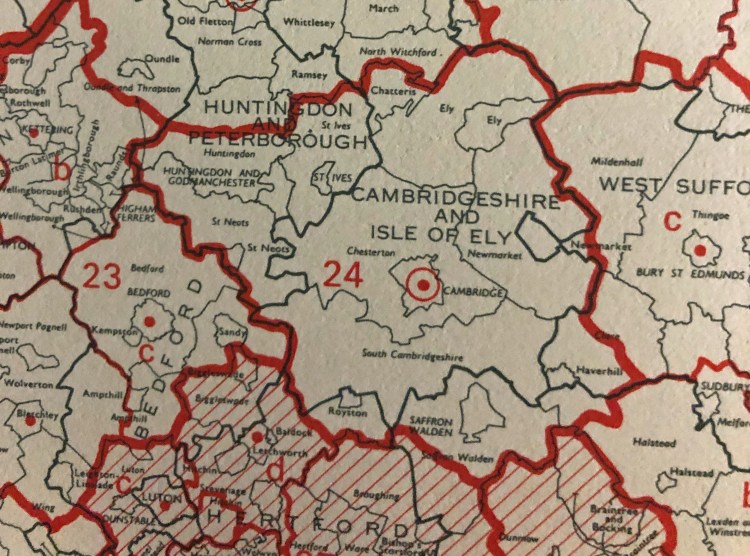
Above – from Redcliffe Maud’s maps – the proposed but abandoned Cambridge unitary council
Note how the boundaries broadly match the ‘travel to work area’ below.

Above – Cambridge & Peterborough’s bus travel to work area commuting patterns 2011 – from the ONS here
That also gives an indication of what a light rail network could cover.
Lessons from the old Government Offices for the Regions
Although established by Michael Heseltine in 1994, the old Government Offices for the Regions gained prominence in the 2000s for their strategic planning role. They were despised by rural, often Conservative-voting district councils that were faced with new housing targets – something that remains an issue today. However, such is the housing crisis that Labour effectively gave themselves a policy blank cheque within their manifesto that put house building front-and-centre of both their growth plans and also proposals to deal with the chronic housing crisis. People in unstable and poor accommodation are less likely to vote, let alone engage in consultations. Therefore our system is failing them – people who happen to be disproportionately poorer than those in owner-occupied homes.
Where Labour got stung was going out to a referendum on regional assemblies in 2004 – where voters in the North East rejected the proposal for theirs, and ultimately bringing down the entire policy of elected assemblies for England. I remember talking to one of the policy advisers working on this a couple of years later when I transferred down to London. He was convinced the elected assemblies were a good thing and was appalled at the referendum result! Yet as we were to find out with the EU Referendum, no efforts had been made to engage with and educate the general public about democracy and politics in the years before. Which is why the House of Lords report on the Future of News published today is ever so important.
“The period of having informed citizens with a shared understanding of facts is not inevitable and may not endure.” @LordsCommsCom – have we **ever had** a period of informed citizens with a shared understanding of facts?
Above – I questioned one of the statements in the executive summary
“What will these new ‘Regional Councils’ be like?”
They could be reconstituted indirectly-elected regional assemblies of old – where each local council gets to nominate representatives based on the political balance of their council chamber. It would be up to them to scrutinise major infrastructure projects and developments that cut across council boundaries – a bit like the joint development committees of Cambridge City and South Cambridgeshire District Councils, but on a bigger scale.
Beyond that, it’s up to Ministers to decide what additional powers and responsibilities they have – and for MPs & Peers to scrutinise them properly. Furthermore, some of the changes will require primary legislation – clauses within a new Act of Parliament to bring forward. Hence the Government stating that these will be included as policies in the Devolution White Paper and the supporting Devolution Bill to be tabled before Parliament in the very near future.
“Where are the conversations happening on regional partnerships?”
At a big event ***ages away***
The OCRP’s Regional Conference which is on Friday! See here and scroll down

Above – see here and scroll down to see the agenda and who is speaking on what.
It’s free – if you can get to Milton Keynes and back. (I can’t, so if someone else wants to go to this and ask lots of questions, please do!). Both the CPCA Mayor Dr Nik Johnson will be speaking, as will the Leader of South Cambridgeshire District Council, Cllr Bridget Smith. Hence if you’ve got questions for the latter and live in South Cambridgeshire District, get them in soon or email one of your district councillors via https://www.writetothem.com/ and ask them to put your questions to the council leader when Item 11 is debated. Note the council meeting will be live-streamed on Thursday afternoon on Y-Tube so you’ll be able to hear who says what.
If you are interested in the longer term future of Cambridge, and on what happens at the local democracy meetings where decisions are made, feel free to:
- Follow me on BSky <- A critical mass of public policy people seem to have moved here (and we could do with more local Cambridge/Cambs people on there!)
- Like my Facebook page
- Consider a small donation to help fund my continued research and reporting on local democracy in and around Cambridge.

 The Cambridge Town Owl