
A sobering statistic from Claire Stoneham of Cambridge University Hospitals Trust at the Cambridge Biomedical Campus forum of 03 Dec 2024 at the start of a major organisational overhaul. (See the slide pack here)
It was a strangely intense gathering full of people mainly older than me in the audience (I think may have been the youngest member of the public there, and I’m five years off of my 50th birthday!) which is one of the reasons why the NHS Trust has been trying to get more younger generations involved in influencing what it does (join the NHS Trust’s membership scheme here).
‘Have your say in shaping our Campus and become a Local Voice.’
…says the website halfway down here
Above – from the CBC’s Amplifying Local Voices leaflet here
If you know someone who is not me and if you know someone who is younger than me who might be interested, drop them a link. Actually, this is one of the reasons why I think GCSE Citizenship Studies should have rocket boosters put underneath it and also be extended to 16-19 courses, and even into higher education as a core module for all undergraduate courses. The idea being – especially if you are moving to a new city, and even a new country, learning the essentials of how it functions and does things is not a bad thing.
Cambridge Biomedical Campus acknowledge how controversial the Greater Cambridge Partnership’s actions and proposed transport schemes have become
While they distanced themselves from being decision-makers, it was abundantly clear that they had received forceful feedback and comments from local residents over things like the CSET Busway – which Rail Future East confirmed it would be opposing the application for a Development Consent Order from the Transport Secretary. (See p15 of Rail Future East’s December Newsletter here)
Decades of structural and political failures reflected in a single statistic.
“Our emergency department was built for a quarter of the patients that we have today”
Above – from one of the slides from Claire Stoneham
It was meant to have been enlarged in the late 2000s as I wrote here, but the Banking Crisis followed by Andrew Lansley’s catastrophic tenure as Health Secretary meant that no significant improvements or expansions were made. (A chance for Pippa Heylings, the new MP for South Cambridgeshire to make an impact where generations of Conservative South Cambs MPs before her failed?) It gets worse:
“Between 2011-21 Cambridge’s population grew by 17.6% with no increase in capacity at CUH, resulting in a c400 bed deficit which is materially impacting our local population’s access to healthcare and the quality of patient care we can provide”
Above – Stoneham (2024) to CBC 03 Dec 2024
Remind me which political party had ministers holding the offices of Secretary of State for Health and Chancellor of the Exchequer? Oh.
The stereotype in political history is that the economy ends up in a worse shape under a Labour government while public services end up in a worse state under the Conservatives. Conservatives don’t want to devolve funding or revenue-raising powers to local tiers of government due to the fear of ‘A socialist Chancellor of the Exchequer in every town hall up and down the country’ (Which in part explains the centralising tendencies of Thatcher’s era) while Labour historically have refrained from devolving too much to local government lest Conservative-controlled councillors refuse to use the powers and spending freedoms granted to improve public services.
One of the reasons why the NHS was founded was because Nye Bevan – one of the most left-wing politicians ever to have held such a senior government position as Minister of Health and Housing in Attlee’s Government, did not trust local government to deliver the overhaul that he envisaged. (A local-government-delivered health service was sort of what the Conservatives had in mind rather than the huge institution that Bevan sought (on 30 April 1946 – Second Reading of the National Health Bill, transcribed by Hansard here) – and received the approval of Parliament to establish (see the vote on 2nd reading on the principles of the Bill – Tories led by Churchill at the time opposed the Bill for the reasons set out in their failed amendment).
One of the later reforms that Harold Wilson’s Labour Government proposed for the early 1970s was to restore some of the links between healthcare and local government – which was why Redcliffe Maud was ever so important as it would have created far greater consistency between healthcare and local government structures. But he lost the 1970 general election and the rest is history.
It’s one of the reasons that helps explain the mess we are in now
While the Conservatives in central government were content for Cambridge to expand in the way that it has done – in particular their ministers responsible for planning, housing, and local government, their counterparts in the Treasury and Department of Health did not ensure that capital funding for an expanded A&E (or as others at the meeting said, for a new district general hospital for North Cambridge) was forthcoming. Which is why everyone is trying to figure out what to do before the next lot of major housing developments get the go-ahead. And don’t even ask about water!
“What about the water?”
The Cambridge Biomedical Campus representatives said that their support for the Government’s growth plans are highly conditional. This is underlined in their revamped 205 vision here. At the same time, they also said that the audience’s scepticism was understandable given what had happened over the past few decades. (Light Rail is not a new concept – I covered a previous vision from the early 1990s in Lost Cambridge here).
“Does Cambridge have the governance and institutional structures to deliver what the Cambridge Biomedical Campus wants?”
In a word: No.
This was something I tried to press Ms Stoneham on but (quite understandably) she said my points were out of scope for her organisation. Which means that when the Devolution White Paper comes out, ministers will have to account for the yawning gap between the NHS and local government that currently exists – along with the extremely low levels of trust between the public and decision-makers due to the actions of the Greater Cambridge Partnership. Some of the transport consultants there acknowledged that the failures of the City Access Project, and the problems with the Cambourne-Cambridge busway plus former Mayor James Palmer’s CAM Metro never getting out of scoping stage represented major failures of previous five year transport plans. One critical common factor they told the audience was lack of funding. The documents had a list of things to achieve but no budgets behind them. This time around for the present five year transport plan they said was different because money had been successfully bid for an allocated.
“We have got to have a conversation about a city-wide master plan, about what goes where, and who is responsible for what”
Furthermore we also need to have a conversation on dependencies and improving the resilience of the city. This came up at the very end when one of the people in the audience mentioned Long Road being blocked for four months because East West Rail needed to build a new railway bridge there for East West Rail – something completely missing in the transport plan going forward. (***Ooops!!!***). Furthermore, the transport consultants acknowledged that such is the transport network at the moment that a snarl-up at one critical junction inevitably brings the city centre to a standstill. Which is why a couple of them said that if Cambridge is going to expand any further as ministers propose, Light Rail has to be part of that mix.
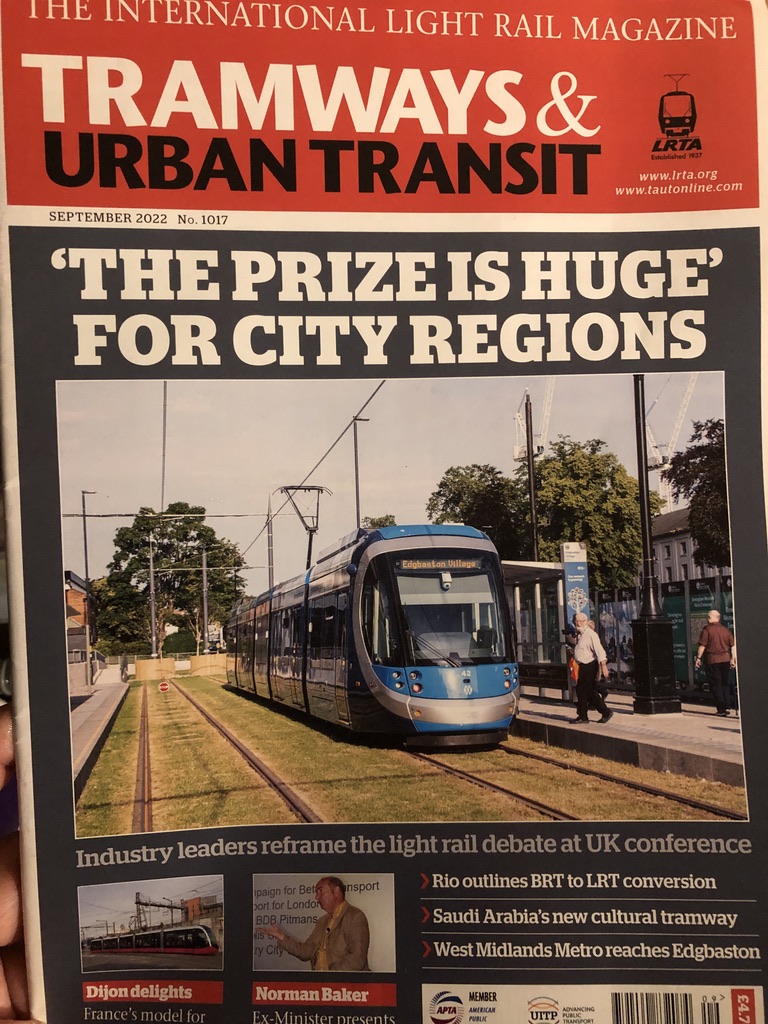

Above – former Transport Minister Norman Baker (LibDems – Lewes 1997-2015) in Tramways and Urban Transit Magazine Sept 2022 (Back copies via LRTA here)
At the end, people asked for longer meetings in future!
Can’t say you get such requests regularly, but there were two very content-heavy topics that people wanted to scrutinise in detail, and the one hour wasn’t enough. It was also one of those sessions where if more people had known about what was going to be discussed, and it wasn’t a cold December evening with traffic jams on the roads around the venue, more people might have taken part. There will be time for further discussions – one that I think could be incorporated into a wider Societies Fair event that I mentioned in my previous blogpost.
Food for thought?
If you are interested in the longer term future of Cambridge, and on what happens at the local democracy meetings where decisions are made, feel free to:
- Follow me on BSky <- A critical mass of public policy people seem to have moved here (and we could do with more local Cambridge/Cambs people on there!)
- Like my Facebook page
- Consider a small donation to help fund my continued research and reporting on local democracy in and around Cambridge.
Below – don’t forget if you are in the proximity of the Mill Road Winter Fair on Saturday and want to do something else come 1.30pm walk down Tenison Road to the Rail Future East annual Cambridge meeting at the Clayton Hotel (a 10 min walk from Hotnumbers on Gwydir Street),

 The Cambridge Town Owl