
I went to the opening of Stir Cafe’s new branch at the place where I used to get my work suits and ballroom dancing dinner suits dry-cleaned. A suitable location for Sunday informal community conversations? [Update – first one is on 12 Jan 2025]
Speaking to one of the staff after a menu-mixup (it happens – first day with a completely new team), they informed me they were opening on Sundays. Which means I don’t have to choose between them and Balzano’s (closed on Sundays), which I’ve been going to ever since they opened their cafe in the early 2010s (and from which my family has been buying food from there since the 1980s).
Also, I noticed a slightly different clientele when I was there on the opening day. Combined with the new firms and people establishing themselves on the Old Swiss site there should be enough patronage to go round.
A space for community conversations?
There are many spots that are suitable for them, and I’ve only picked Stir because it’s a new establishment within walking distance from where I live. And when you have chronic fatigue and other health problems, proximity becomes a much more significant criterion than twenty years ago when I’d think little of cycling across town to get to somewhere. Because CFS/ME plus ADHD (I’m still on the waiting list for a diagnosis – and also I prefer the term ‘I am ND+’ than having ADHD) means that travelling and arranging transport takes up a disproportionate number of spoons, which is why I haven’t arranged any civics workshops this term.
As I’ve mentioned, there are other places and spaces that you may not be aware of in the Queen Edith’s/Coleridge vicinity, including ones due to open such as:
Further afield you have the likes of:
Additionally, Cambridge City Council has its own community centres of varying size and quality. That said, when you look at the map and geographical spread across Cambridge, it’s easy to see the unequal spread which reflects how the council has struggled for years to deal with our city’s micro-pockets of poverty and multiple deprivation that don’t show up on public statistics. That combined with the inability of local government to raise additional revenue from the wealth we’re told Cambridge makes. Which is also why I was particularly disappointed that the developers of The Paddocks said at their webinar earlier this evening they have no plans to build a community centre on their new development. Rather, their strategy is to build the ‘shell’ of structures and leave it to potential tenants to decide whether they make any of the interiors they fit out accessible to the community. Whether the city council have – or will get any new powers – to compel the developers to do better remains to be seen.
The Future of Cambridge and Community Conversations
I mentioned the lack of a city-wide masterplan here but we’re not even getting the neighbourhood level conversations that we need to have. Note that the pausing of area committees as agreed in October 2023 has had some impact. We’re still waiting to find out what the city council’s alternative might be, although events (i.e. the Devolution White Paper) may overtake this piece of work.
“What is the purpose of ‘community conversations’?”
Unlike my many grandiose dreams and plans (concert halls and light rail networks), this is the opposite and has a ***really low bar***. It takes a few really basic successful things I’ve picked up over the past decade or two and apply them at a low effort, low cost level – and see what people make of it. For example there is a Meetup Group that has regular big picture conversations in Cambridge which talks about the sorts of subjects I’d have jumped at while at university. Such as Should Universities Exist? (Sun 26 Jan at the Station Tavern).
The purpose in the short-medium term is to enable local residents in a particular part of Cambridge (i.e. my local neighbourhood) to find out who is interested in the future of our city, and to see where the conversations and connections take people. And that’s it.
What we don’t have is an equivalent to the Big Picture Conversations Group that covers the future of our city and county.
The problem is that running any group takes up a surprising amount of mental space. Especially for someone like me. Furthermore, the various online platforms have put up so many financial barriers that it makes the job of organiser a much greater burden than it needs to be. It’s why I think that some of the organisational functions could be taken on by local government or a funded civic society group who employ people to carry out what are often tedious but essential tasks that are hard to find volunteers for. For example the feedback I had from the 2023/24 civics workshops at Rock Road Library showed I did a decent job of designing and facilitating the events.
But the room booking, the financial risk, and the advertising took too much out of me to sustain it. And after 15 years of austerity it’s not like there’s this well of energised good-minded people able and willing to take on and expand it. Almost everyone I’ve spoken to in recent times involved in any sort of community action is absolutely burnt out. Furthermore, there are entire cohorts who are conspicuous by their absence – (generally people from their mid-20s to late 40s) An unwritten cost of being in the Precariat?
Starting small and keeping it simple
The principle:
- Find venue that is open on a Sunday afternoon just after the lunchtime rush (2-4pm)
- Pick a series of Sunday afternoons – eg monthly or fortnightly (it could be the latter during term time and the former outside of it)
- Say: “I will be here, look for the person wearing whatever colour coat (or what has been easier in the past, sitting at a table with a big cuddly dragon called Puffles!)
- Say: ‘The topic/issue will be whatever is newsworthy or whatever has been published by whichever council / institution that is about the future of our part of the world
And bring along some print-outs if necessary – such as maps or diagrams.
Only having the A1-sized printouts at the Cambridge Biomedical Campus open forum earlier this week made a significant difference to the conversations people had before the start of the meeting. Maps in my experience always do this.
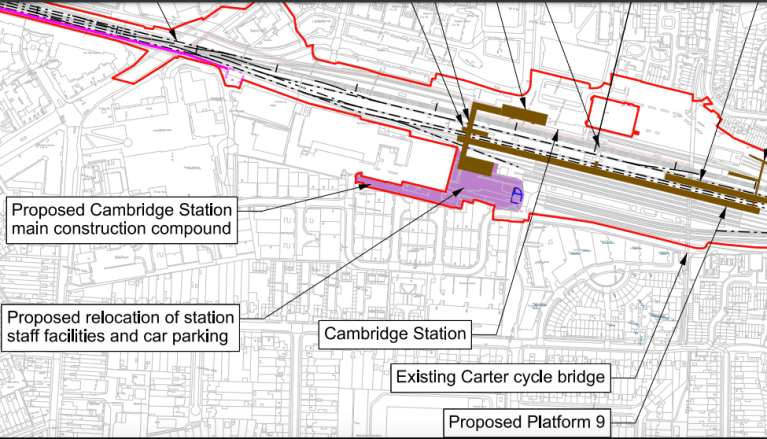
Above – I can imagine more than a few local residents in Coleridge will have something to say about the proposals from East West Rail – which have an eastern entrance to a staff compound but as yet no eastern entrance for passengers proposed for the station itself.
Are there going to be people who will want to talk about the above? Of course. But how do you get them informed and aware of what is proposed, and knowledgeable and motivated to respond to any consultation that might influence the decision-makers? For example local surveys by the Combined Authority show two-thirds of local residents are aware of the £2 bus fare cap (See para 3.3. in item 3 here – noting that Mayor Dr Nik Johnson is proposing *extending the cap* until the end of the financial year (March 2025) under devolved legal powers he has as a Combined Authority Mayor). When you think about how much advertising went into the cap from central government, and how frequently it has been in the news, the fact that 1/3 of people were not aware of it shows how difficult it is to get anything more than the minority of awareness.
“And if the Community Conversations prove successful?”
It’ll be up to other people to arrange similar in their own neighbourhoods. Because we have to start where people are. Not where we think they are or would like them to be. One thing that could be done is having some sort of informal co-ordination where you have more than one running at the same time in different parts of the city. Especially if there is a city-wide issue that affects everyone, or affects a specific group of neighbourhoods. (For example neighbourhoods bordering the railway line for East West Rail).
“Why not have it like a roadshow?”
Because that involves me going places and doing more work than I have capacity for. Furthermore, part of the success criteria has to involve keeping the groups relatively small and informal, rather than having people traveling across town for larger gatherings. That’s for the constituted and established campaign groups to run with.
For example, fast forward to September 2025 and success might involve something like:
- The Government announces a major new policy affecting the future of Cambridge
- One of the convenors (eg me) selects a Sunday (eg Sun 21 Sept 2025) as a day for a suitable Sunday afternoon discussion on the announcement
- Each convenor/volunteer picks a cafe or community venue in their neighbourhood and says: “I’ll be here on Sun 21 Sept 2025 from 2pm if you want to talk about what the Government has announced!”
- Someone like me publishes a blogpost with links to official reports/papers and materials that participants can print out and bring with them
- We end up having multiple group conversations across the city on the same day at the same time on the same issue, with participants choosing how, if at all they want to follow anything up within their own social circles or even local councillors.
It also means people get a choice of convenor or venue because it might be the case that:
- They don’t like a specific venue
- The venue is inaccessible
- They don’t like a convenor or one or two of the regular participants for whatever reason (it happens) but still want to have a conversation with other people about whatever the issue being debated is.
It might work, it might not. But having somewhere open on a Sunday that is within walking distance given my own limited mobility means I’m in a position to try it out.
If you are interested in the longer term future of Cambridge, and on what happens at the local democracy meetings where decisions are made, feel free to:
- Follow me on BSky <- A critical mass of public policy people seem to have moved here (and we could do with more local Cambridge/Cambs people on there!)
- Like my Facebook page
- Consider a small donation to help fund my continued research and reporting on local democracy in and around Cambridge.

 The Cambridge Town Owl