
The Chvrches lead singer released her first solo album, and the first few singles of it are incredibly powerful – not least given the incredibly rough time she’s had in the music industry and from social media abuse
I wanted to write about something different, but old habits on politics and local issues are hard to shake off! Have a listen to Ms Mayberry’s piece on IG here or below. A textbook example of how to film a short piece to camera that goes out to millions of people yet at the same time feels like it was made just for you or a small group of you. A technique very difficult to master.
**Blood, sweat, and tears… (really don’t matter – just the things that you do, in this garden)**
For some of you who were teenagers in the 1990s you may recall the lyrics of This Garden by The Levellers. A less-musically and emotionally oppressive South Cambridge (and more inspirational and open-minded teachers and mentors) might have picked up on the political and deeper meanings to those songs of the era. But our generation never had the chance.
There was something in the chorus of Something in the air that struck a chord or three with me.
- “I just want to be someone / someone who’s happy”
- “Why d’you even care? / Must be someone in the air.”
Above – from Something in the air (Mayberry/McDougall 2024)
Much of the music I stumble across these days is from doomscrolling in IG – and half the content involves being ADHD-bombed by various content creators shining a different light onto my teenage years. The excruciating thing being that ADHD wasn’t conceptualised/acknowledged by the medical community in children until the year 2000 (when I had already arrived at university) and in 2008 for adults (at which time I was already struggling in the civil service Fast Stream as my policy area started imploding in the face of the banking crisis.
The top sentence “I just want to be someone…” resonates with me because I’ll never understand why the politicians of the day and wider society insisted on a toxic exams culture that sucked the joy out of life for so many of us, and for what? And as for religion, why was it me that had to go to church every Sunday but not anyone else who I went to school with, and why did they even care? What was it all for? Strangely enough, it’s also why (for me at least), secular music groups, choirs and collectives are also really important. Especially in a city like Cambridge which are full of subsidised religious choirs (eg college choirs).
Again with/in hindsight I shouldn’t have dropped the activities that could have made me happier (arts, drama, music) and got me out and about between 15-18, or been the people-pleasing teen I was, selecting subjects others strongly advised me to take rather than the ones my heart wanted to do. As I’ve often remarked to others, while I may have eventually found my way into the civil service, I’d have had a damn sight more fun on the way (and might not have crashed and burned in the way that I did in the late 2000s).
Coming back to the collective singing groups which have become a thing of late (not least because of the mental health benefits) it’s why local (to me) collectives such as We Are Sound (back after the long interruption) which have complex arrangements for Sop/Alto/Tenor/Bass accompanied by professional musicians are just as important as the more familiar big-brand style singing groups that sing to backing tracks. My take is that Cambridge is a large enough city for all of them to co-exist and support each other. (We just need a much bigger and grander concert hall!)
Talking of concert halls, one of the things I want within such a complex is a very large assembly hall. Not stadium-gig size, but something that could take inspiration from Blackpool’s Winter Gardens and have your very large dance floor pop/rock concert space in one part, and an opera house section next to it.
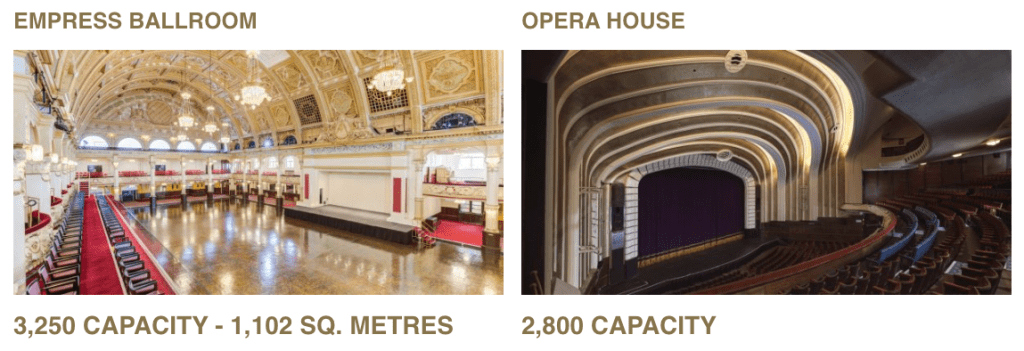
Above – the two largest halls in the Winter Gardens complex in Blackpool – which really need massive investment in its rail links.
Because as Cambridge continues to grow, the pressure for it to function as larger regional venue becomes much more greater. The Cambridge Corn Exchange – even if it had its capacity somehow increased to 2,000 people (the County Fire Service won’t let it hold more than 1,500 due to fire safety regulations) would still not be enough to attract the calibre of contemporary acts such as Ms Mayberry today. Furthermore, a couple of the larger collective music groups that have held gigs at the Corn Exchange (including We Are Sound under their former name) have sold out that venue. There is nowhere else to go size-wise so we have to build one.
Cambridge also needs to rebuild the social scene it once had in order to sustain larger venues
One of the shorts that is doing the rounds social media at the moment is Ralph Beaubrun’s earworm of a track La Madame – to which dancer Estelle Bliah has absolutely nailed on the choreography that the former is teaching at his Paris dance studio (you can see her other choreographed pieces on her IG page here). And that choreography isn’t easy to do by anymeans. Even in my own dancing days in my early civil service days when I was doing 3-4 hours an evening on weekdays I’d have struggled with that. Yet the energy within that dance hall in the various video clips doing the round is one that I’ve not seen for over 15 years. Justin Neto’s classes have a similar energy too. Even in London in the mid-late 2000s. In those clips you’ve got people from all sorts of backgrounds, ages, genders, and so on. (When you see nearly 6ft men going grey hitting every beat on the choreography (irrespective of technique or even complexity of choreography), you know they’ve put in the effort and hours. The closest you can get to open classes in the dances seen in the video above are the open classes for adults at The Bodyworks Studio off Hills Road. Several years ago their students performed a piece inspired by the Women who made modern Cambridge, and the Suffragettes in the Blue Plaque celebrations for Lost Cambridge hero Clara Rackham.
If we’re going to have the events and festivals that can make somewhere like Cambridge greater than the sum of our parts (we are nowhere near that point despite what property professionals might have in their literature) then that means starting with the roots and foundations. Something that contrasts with the impact that conspiracies are having – the ones that Ms Mayberry calls out in Something in the air. Furthermore, news from Romania shows ministers and Parliament need to start moving quickly to take on the same thing and safeguard our elections. It’s easy to smash things up. It’s much, much harder to build and rebuild. Something I’ll look at in a future blogpost looking at the Power to Change Report: Fixing the Foundations following the race riots after the general election.
If you are interested in the longer term future of Cambridge, and on what happens at the local democracy meetings where decisions are made, feel free to:
- Follow me on BSky <- A critical mass of public policy people seem to have moved here (and we could do with more local Cambridge/Cambs people on there!)
- Like my Facebook page
- Consider a small donation to help fund my continued research and reporting on local democracy in and around Cambridge.

 The Cambridge Town Owl