
It might sound familiar to longterm public policy-watchers but one thing the past decade has taught us is that senior politicians have to repeat the same short soundbites again and again in order for them to sink into the consciousness of the general public
Which is why I didn’t take too much notice of the media noise around the announcement – they had to try and re-spin the headline policy content into something new – which most of it wasn’t.
First things first: The content. Always go to the original source documents
- Plan for Change – HM Govt (2024) presented to Parliament
- Transcript of Statement to Parliament by Pat McFadden MP of Cabinet Office, and the Qs from MPs that followed.
- Transcript of Prime Minister’s speech at a think tank
You can also read the BBC’s takeaway here
Are too many civil servants “comfortable in the tepid bath of managed decline”?
I don’t know – I’ve been away from the coalface for far too long. But given the dreadful management of the civil service by the Tories over the past howevermany years, I wouldn’t be surprised if ‘being comfortable in a tepid bath’ was simply a collective response to years of mismanagement and rapid ministerial turnover. No institution could function properly with such a dysfunctional tier above it. And this was picked up by Henry Zeffman of the BBC as he tried to read between the lines with some help from some off-the-record briefing.
Note the impact of the build environment on decision-making within Downing Street
““10 Downing Street is a ridiculous place to run a major economy,” one government adviser said. “You go from a modern open plan office in opposition to Downing Street where you’re all scattered around like kids in a big house who’ve gone off to separate bedrooms to do their homework.””
Henry Zeffman, BBC News 05 Dec 2024
Given the problems of the Palace of Westminster and the squillions being forecast on the costs to try and turn it into a 21st Century workplace (see the renewal programme here), it makes me wonder why they Government does not turn at entire part of London into a museum of history and politics and relocate Parliament and Government to another part of London close to a cluster of the major railway stations. (It would make central government far more accessible to many more people). But then I wouldn’t trust the UK construction industry to come up with anything inspirational let alone built to the minimum standards required by law given what the Grenfell Inquiry exposed!
On missions, milestones and targets – and turning around the civil service tanker

Above – three of the five missions from Plan for Change – HM Govt (2024) presented to Parliament, with a specific high profile target under each one
There was an interesting exchange between Ed Hammond and Peter Thomas here on what levers the Government has after a generation of reforms that began under Margaret Thatcher’s Government. The latter has built up a website all about civil service reforms past and present. (For followers of Prof John Denham the former Communities Secretary, see the Total Place piece here). The NPM points were on New Public Management theory and the move from in-house services to outsourced and privatised services, or ‘commissioning’ of services from a range of providers that many in local government are familiar with today.
The embedded thread by Jess Studdert of New Local here also teases out the subtle differences between the party political (in particular the things the general public will notice – and the media will report on), vs the public policy. The post that will resonate with many is the one below.

Above – Jess Studdert, 05 Dec 2024
This reflects how over-centralised our system is – one not helped by an over-centralised media and a declining local and regional news ecosystem. For some reason ministers are expected to have an informed opinion on *everything* – even things outside of their policy areas. Not surprisingly, in an environment of ‘Bad stuff is happening, why isn’t the government doing anything about it?!?!’ headlines, it’s understandable that ministers might feel incentivised to centralise things. If they are going to be blamed for bad things done by other parts of the state, may as well ‘take control’.
The party political environment also reflects this – it’s striking how quickly backbench MPs will ask a minister to say something bad about a local council controlled by another party or a combined authority mayor on the floor of the Commons when really such things should be left to local tiers of government to deal with. In part there’s a hangover from the days of Empire – not least with some of the topics that MPs raise about ongoing wars and catastrophes across the world. Compare what Labour’s policies were in 1923 here (especially in the Middle East – and also on equal suffrage vs the Tories) vs what the present Labour government can/cannot do in the same parts of the world today.

Above – Labour Speakers’ Handbook (1923) p134/70pdf. Trouble happening over the border in Gaza? The British Government could literally send a military expeditionary force from its military bases at Alexandria in Egypt to sort things out.
That’s the institutional inertia that the UK’s Political Establishment still struggles to come to terms with today: policy options from historical eras past are long gone, yet Parliament still holds debates on them as if The Government has any realistic or meaningful influence on the course of events. (That’s not to say ‘do nothing’ – but rather if the UK wants to have any meaningful influence it has to involve doing the opposite of what successive Conservative-led governments did while in office. But rebuilding that trust will take decades).
“How serious is Sir Keir Starmer on Devolution in England?”
I was expecting the Devolution White Paper to have been published by now given the media speculation, but it may well have been that it was held back by Downing Street to ensure it was consistent with whatever changes were being drawn up there. Not least the appointment of a new Cabinet Secretary – as the Institute for Government explains:
“In one of the most memorable passages Starmer said that “too many people in Whitehall are comfortable in the tepid bath of managed decline”. Combine that with his earlier direction to his newly appointed cabinet secretary Chris Wormald to work on “nothing less than the complete re-wiring of the British state” and you have a sense of a prime minister frustrated with the support he is getting from the system.”
Institute for Government 05 Dec 2024
Although the new Cabinet Secretary was my Director General for a couple of years at DCLG in the mid-2000s, I never got to speak to him directly, let alone get to know him because as an incoming fast-streamer you went head-first into policy-making rather than high-level strategy. So don’t ask me about any insights because I don’t have any!
The bit I’ve put in bold shows that if the British State is going to be ‘rewired’, then inevitably that involves local government – and also the NHS. That rewiring has to involve how local councils are funded – whether through grants from The Treasury, through new revenue-raising powers, and/or through new measures such as land value capture for development, and even an annual land value tax as an alternative to council tax and business rates. Perhaps one more philosophical question he could ask is:
*Which parts of the public sector can become more self-financing and self-governing so they require far less central government intervention?*
The answer to that question will demonstrate how far the Government wants to go with devolution in England. Is it still going to have a minister for planning who decides the future of a city like Cambridge, where the voices of residents in and around the city (and I’m not just talking about home owners, it’s the homeless, temporarily housed, those in social housing, and those commuting in who are priced out) have been conspicuous by their absence? Will we still have planning applications for a single block development decided by the Deputy Prime Minister? <<– There’s a strong case for the Deputy Prime Minister to devolve those appeal powers to the Mayor of London (and similar for Liverpool and Manchester). Or making decisions on handing out micro-pots of funding as the DfT has here.
Major planning applications fast-tracked
It was one of the things included in the Plan for Change that has its own press release – mainly for the benefit of the specialist/trade press rather than the print press. One of the questions that the Government was asked in the Lords earlier was about developers land-banking.
Lord Watts (Lab) : “My Lords, does the Minister agree with me that, to increase the number of houses available, we will need to deal with the way housebuilders keep some of the stock off the record and land-bank? Will we do something about land-banking to make sure that, if developers do not develop land, someone else will?”
Baroness Taylor (Minister) : “We will take measures to deal with land-banking and the situation with long-term empty homes. Sometimes, homes are built but still not occupied. We will increase funding to make those affordable homes and remove tax incentives and informal approaches. If they do not work, local authorities can use enforced sale procedures or empty dwelling management orders to make sure that land and property are used for their intended purposes.”
It will be interesting to see what new legislation is tabled to deal with land banking – and whether ministers will provide councils with the powers to develop in-house capacity to build directly like in previous eras, rather than rely on developers trying to figure out what the most profitable build-out rate is in order to meet chronic housing needs.
One other thing to note was that the former Health Secretary and ex-MP for South Cambridgeshire also tabled a question and didn’t declare his financial interests.
A controversial figure politically – especially with his Labour opponents, because of his catastrophic reforms (“[His] reforms…will be judged as “one of the most major public policy failures” of all time.“), his highly-criticised Lobbying Bill and also in this item over paid lobbying that highlighted a loophole in the rules. (i.e. registering as a director of a lobbying company rather than the individual firms and interests you are lobbying for).
He should have declared them in advance of tabling his question, but as you can see from Parliament TV, he didn’t. (See his register of interests in the Lords here – noting the ‘honorarium’ bit)
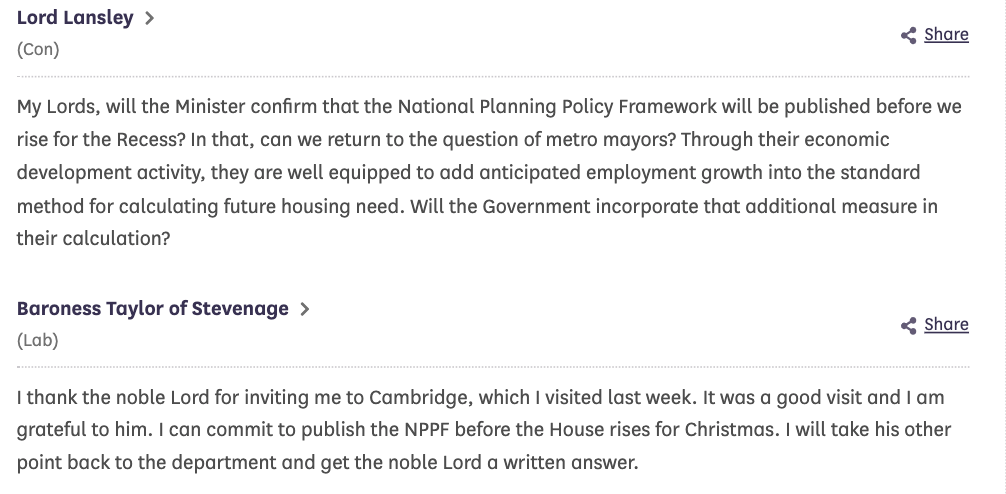
Above – from Lords Hansard 05 Dec 2024
The former Health Secretary chairs this lobby group (the secretariat to the forum provided by the firm which he is a director of), which has these members, and has their own development corporation sub-group.

Above – from the CDF’s website which does not state what their membership fees are and what they get in return.
Under the previous Conservative government the department dragged its feet on a Freedom of Information Request I submitted on 07 March 2024, only getting a substantive response on 16 September 2024, long after the general election.
If anyone else would like to find out what correspondence ministers and civil servants have had with the CDF, feel free to send in your own FoI Request here. (I can’t do it as it would probably be treated as a repeat request).
“If it wasn’t the former Health Secretary doing this, wouldn’t someone else be doing it instead?”
Exactly. Which is why as with so many things my issue is with structures, systems and processes. Pick any major controversial development (Cambridge Station, Cambridge North, The Flying Pig pub, The Beehive Centre…) and the same things crop up time and time again.
Whether the new government will be able to change the structures, systems and processes so that they benefit the many and not the few…remains to be seen.
Anyway, go and get involved in something positive now that the Mill Road Winter Fair has been cancelled due to the forecast for cold rain and very high winds.
Rail Future East Anglia at Cambridge Station (or near it)

 The Cambridge Town Owl