
Veteran public transport and cycling campaigner Jim Chisholm asks when Cambridge Station will get its long-proposed new Eastern Entrance, and highlights from Cllr Katie Thornburrow’s presentation
It wasn’t just me asking about it then! But what astonished the audience – myself included, is that Mr Chisholm at made the case in previous public consultations about incorporating an Eastern Entrance into East West Rail’s proposals, and yet they are still not included in them.
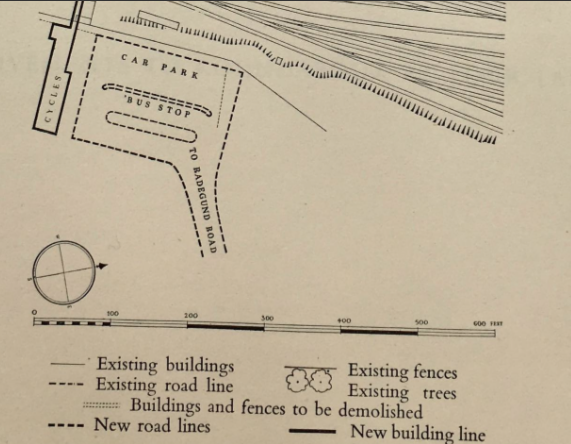
Above – from Holford Wright quoted in an earlier blogpost
Cllr Katie Thornburrow gave a presentation on some of the latest developments in transport planning and policy
The Executive Councillor for Planning and Transport at Cambridge City Council, Cllr Katie Thornburrow MRIBA (Labour – Petersfield) gave a host of insights not just as a councillor but also as a professional architect into the recent events and the things coming down the lone.
The unnecessarily over-complicated structures came up again – mindful that we’re expecting the Devolution White Paper *and* the refreshed National Planning Policy Framework to be published in the next week or so. As things stand, the fragmentation of everything makes it almost impossible to function. For ‘Cambridge’ however you choose to define it, we have for the built environment:
- Strategic transport planning – Cambridgeshire and Peterborough Combined Authority (based in Huntingdon)
- Strategic development planning (‘The local plan’) – Cambridge City Council and South Cambridgeshire District Council (as part of the Greater Cambridge Share Planning Service)
- Planning permissions – Cambridge City Council (supported by GCSP officers that cover both city and district councils)
- Roads and highways – Cambridgeshire County Council
Which is why groups such as Cambs Unitaries (which I’m a member of) think the structure should be overhauled so that you have two or three unitary councils that cover everything for their specific area – removing the otherwise artificial barriers between the functions.
Moving towards more co-ordinated transport and housing planning?
Cllr Thornburrow mentioned this was the direction of travel coming from central government, and mentioned that in her personal opinion this was long overdue. I’m not sure what the merits were for decoupling housing from transport unless it was something that came out of the wash when the Department for Transport became its own separate department following the failure of John Prescott’s ‘super-ministry’ to function properly (DETR)
I wrote about the last structure plan for Cambridgeshire and Peterborough here. Cllr Thornburrow mentioned it in the context of sub-regional planning, stating that the economic sub-region of Cambridge stretches not just beyond the city boundaries, but also over the county border. The problem is that we don’t have the institutional infrastructure that enables Cambridge to co-ordinate with surrounding market towns over the county border. It’s even worse with Peterborough which itself is on the CPCA border but has no relationship with Lincolnshire County Council – which historically has also been in a different region when we had the system of regional offices 1994-2010.

Above – from the 2001 Cambridgeshire and Peterborough Struct Plan Review
For those of you interested in browsing through the source documents, see:
- Cambridge Local Plan 2001 Issues
- Cambridgeshire Structure Plan Review 2001
- Cambridgeshire and Peterborough Draft Proposals 2002
“Who is keeping track of what?”
Cllr Thornburrow mentioned that back in 2014 Cambridge and South Cambs worked up their own transport strategy. When you look back at the main map for Cambridge, the reasons Greater Cambridge Partnership’s actions start to become clear. Doesn’t mean I agree with what they did – just that I understand why they are doing what they are ploughing on with.

Above – Cambridge City Plan/Proposals (2014) from Cambridgeshire County Council here
“You don’t actually believe them on the ‘high quality bus routes’ thing, do you?”
Never did – not least because The Coalition and the Tory-majority governments that followed hit local government and local transport with such huge cuts that the general public was never going to trust, let alone believe the promises that were being made about ‘high quality [anything]’ when everyone could see the impact of cuts to maintenance budgets – especially potholes. If we look at some of the controversial proposals still kicking around:
- Mill Road bus filter – controversial because it has polarised opinion between local residents who want reduced traffic vs a mix of some traders and some drivers who want motor access maintained. The proposal to have Mill Road as a high quality bus route sort of makes sense – although is this consistent with the more recent re-designation of roads?
- Cambridge South-East Transport (CSET) – which has been cut back from its original proposal for a guided busway to Haverhill to only going half the distance from Cambridge and not being guided in anyway, rather just a road with signs and a designation saying ‘buses only’
- Cambourne-Cambridge busway – that’s also being opposed by many residents in the villages west of Cambridge, along with people who want The Cambridge Connect Light Rail option.
“And the ones that never made it out of the bag?”
- The Addenbrooke’s to Milton Road – a major road flyover across Stourbridge Common? Oh Behave! Previous generations of residents kicked up a storm over that one in the 1960s. Fast forward to today and 6,800 people voted for The Green Party that now hold all of the city council seats in one of the wards that such a route would go through. Not happening.
- The M11 busway to Addenbrooke’s – I recall the former Stagecoach Cambridge Director Andy Campbell turning up to a few early ‘City Deal’ meetings but those proposals never got off the ground. Presumably he said unless the government was prepared to subsidise such things, he was not interested.
I can see the merit in a bus orbital as a concept, but not as proposed on this map. Furthermore, when we look at what ministers since Michael Gove in 2023 have put forward as the future of Cambridge, they are better off starting from scratch and having a much longer term vision.
Easy to find and easy to access data and information has to be at the heart of any communications strategy going forward.
What Cllr Thornburrow has created for herself is a spreadsheet of the projects listed in the 2014 plan and added columns keeping track of progress. For example:
Cambridge to Newmarket
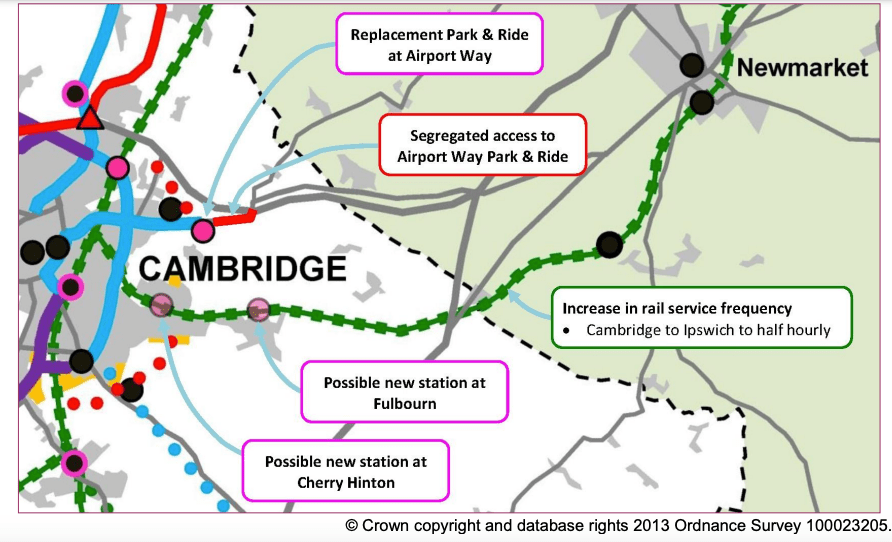

Above – Cambridge & South Cambs Transport Strategy (2014) CambsCC p91 (pdf)
list of proposed actions for Cambridge – Newmarket, trying to hide ‘buses only road’ under the acronym HQPT corridor, or “High Quality Public Transport corridor”. (It always seemed to be stubborn angry men in highways engineering fields who insisted on this term in public meetings both in person and online – I remember clashing with one who I never saw again. Maybe I scared him off?!?)
Cambridge – Haverhill

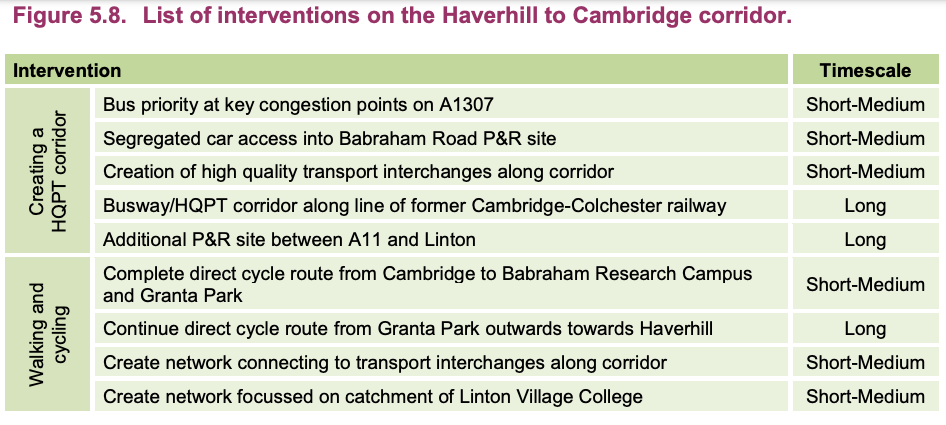
Above – Cambridge & South Cambs Transport Strategy (2014) CambsCC p95 (pdf)
Again, that HQPT Corridor phrase is there again.
The toxic transport engineering culture of ‘design and defend’
Going back through this document with a longer term overview, the more it becomes clear that the mindset of the transport engineering profession was one of ‘design and defend’ – and to use every tool and tactic necessary to drive their proposals through. When you look at the history of what was the ‘Cambridge City Deal’, then rebranded as ‘The Greater Cambridge Partnership’ (because the City Deal brand had become too negative – something now ironically associated with the GCP), you see how such a mindset poisoned local politics in and around Cambridge. One of the reasons for this was that the councillors collectively failed to stand up to the officers when the electorate delivered major Political changes via the ballot box. Which is what I found myself concluding in September 2021, followed a few months later by Smarter Cambridge Transport.
The fallout has been grim from the abuse that was generated on the back of unpopular decision after unpopular decision following extensive consultations – with a number of councillors leaving local democracy altogether. This was something I mentioned at a property industry event in November where the industry wanted to talk about social responsibility of their industry – in particular in and around Cambridge. Their opening speaker was from Brookgate. Reflecting feelings from this earlier blogpost in the Q&A session that happened after the representative from said company had left for another meeting, I gave a few examples of where big developers had not worked constructively with local residents but had simply ploughed on – making huge profits in the process. And that was in the shadow of the Grenfell Inquiries findings into their industry. The challenge I put to them was to discuss how they were going to rebuild trust with local communities in and around Cambridge given that it is currently on the floor.
While the sentiment was ‘Through our actions rather than words’ in the debate that followed, the same applies with the future of Cambridge more generally. A couple of speakers however did raise the issue of the culture in their industry – a phrase I banked in my memory. It was the culture of ‘design and defend’ – which is basically what The Paddocks are doing off Cherry Hinton Road. They have come up with designs for ‘shell’ units aimed at the biotech sector, and it will be up to tenants to decide what to put in them – including any community facilities. The consultants employed by the firm’s consultants said the architectural style and the designating of new community space were things they were not negotiating on.
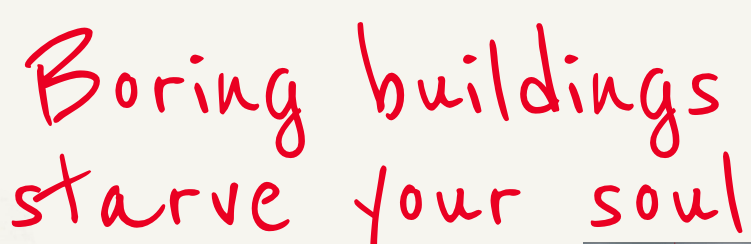
Above – Quite! From Humanise which I blogged about here.
The big two big takeaways from Cllr Thornburrow’s presentation for me were:
- Have all of the information and data sets in one place – similar to what Dr Andy Williams told the GCP Board recently, so that it is easier for everyone (including the decision-making institutions) to keep track of everything
- Early public engagement with The Future of Cambridge programme/Government Policy. It needs to have a series of early workshops across the economic sub-region to get a critical mass of the public familiar with the structures, systems, and processes in order to help shape the vision. This *must* involve civil servants facilitating exchanges between the public and corporate lobbyists/wealthy interests. No hidden agendas. They lobbyists won’t like it but in the longer term it will make for far better public policy-making and far better policies if those corporate interests are stress-tested in a public arena.
Food for thought?
If you are interested in the longer term future of Cambridge, and on what happens at the local democracy meetings where decisions are made, feel free to:
- Follow me on BSky <- A critical mass of public policy people seem to have moved here (and we could do with more local Cambridge/Cambs people on there!)
- Like my Facebook page
- Consider a small donation to help fund my continued research and reporting on local democracy in and around Cambridge.
Below – talking of community conversations about the future of our city, a new cafe has opened within walking distance from where I live, and it’s open on Sundays. I’m pondering setting up an informal fortnightly or monthly afternoon discussions – see my blogpost here
 The Cambridge Town Owl