
This is from a report published by Britain Remade with Create Streets here Both the principles they have set out and their list of case studies are worth reading and scrutinising. For decades I’ve said “Bad news first” so in part 1, I’ll look at some issues and how you can scrutinise what has already been submitted to local councils.
Chances are you’ll find a number of things in the Britain Remade/Create Streets report that you agree with just as you’ll find some things you might oppose.
In these blogposts I’m working from an assumption that the high level policy decision on expanding Cambridge has been made.
That’s not to say there isn’t a case to be made for minimal expansion (or even degrowth) for the future of Cambridge. Note that at Sarah Nicmanis of the Cambridge Green Party received over 6,800 votes at the 2024 general election – a record for the party. (Add to that over 7,500 in the three constituencies surrounding the city that were until then safe-as-military-fortresses Tory constituencies.) This shows that ministers and developers should not take political consent as a given – as councillors found out with the now abandoned congestion charge.
“What are Britain Remade proposing?”
See here and scroll down to Our top twelve towns
Below – Britain Remade’s proposals.

Above – Britain Remade/Create Streets 2024 – proposal for expanding Cambridge
“A Greater Cambridge urban extension provides the solution to all of these problems. Building out the city provides space for at least 150,000 homes in mixed-use and beautiful neighbourhoods.”
This implies a population expansion of 300,000 people via urban extensions. Note the Minister for Housing has also instructed Peter Freeman that a future vision of Cambridge should incorporate the urban expansion of Cambridge in at least one direction. Cambridge’s population is already around 150,000, up from just over 100,000 in the early 1990s. Therefore in a very short time frame by historical standards, the construction industry – utterly exposed at the Grenfell Inquiry, is charged with building all of those properties to a high quality in that short time period at an affordable price. To say that is ambitious is an understatement. And that’s before we’ve looked at what infrastructure (utilities, to open spaces, to sport, arts, leisure, and governance structures) is required to make such a settlement function as a city. So serious an issue is this that MPs and Peers are tabling questions in Parliament (such as Lord Sikka today) to get answers from ministers.
An urban extension to Grantchester, and a newtown around Magog Down

Above – note the proposed extension west of Grantchester (left of the label of Darwin radial tram line and Trumpington labels.) Furthermore, note the proposed urban extensions east of Shelford hat surround Magog Down on three sides, with the existing Babraham Road enveloping it.

Above – from G-Maps here: Wandlebury, surrounded by the Gog Magog Golf Club, with the car park to, and Magog Down on the other side of the road.
“Who owns the land? Who has development options?”
Questions always worth asking when it comes to building in Cambridge as much of the land around the city has already been snapped up by speculators – as the submissions to the call for sites from the Greater Cambridge Planning Service demonstrated.
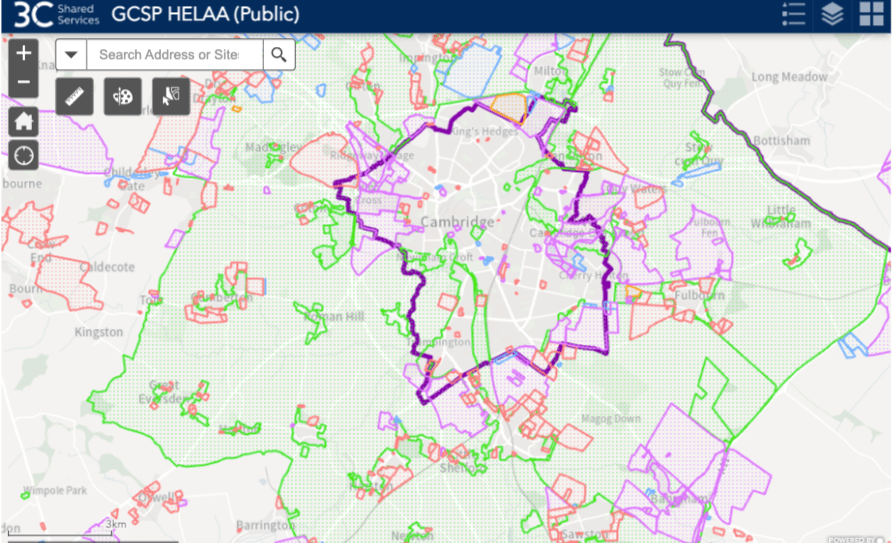
Above – from the GCSP Service – click here, zoom into the section of the map of interest, and click on the shaded area.
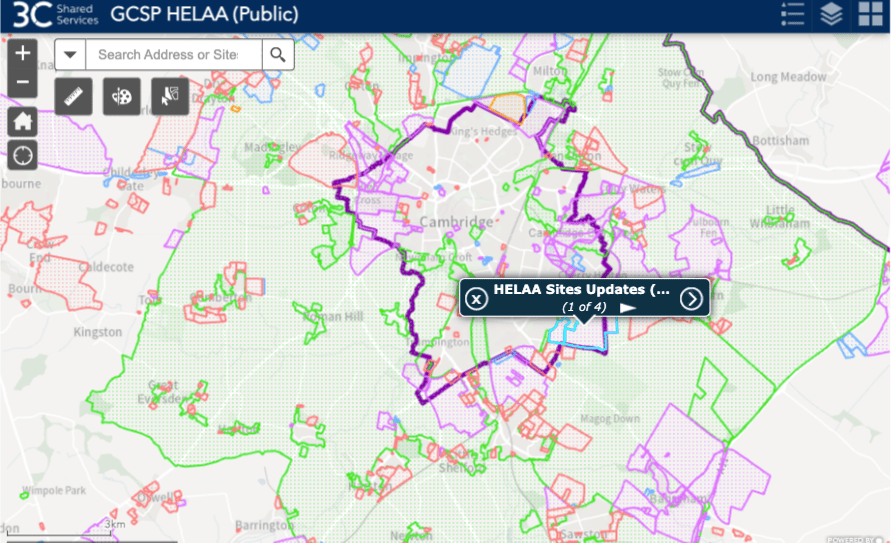
Above – clicking on a shaded box will bring up this icon. “HELAA Sites Updates…” Click on the > icon and you’ll get the pop-up below

Above – with the pop-up below, click on the ‘More Info’ link
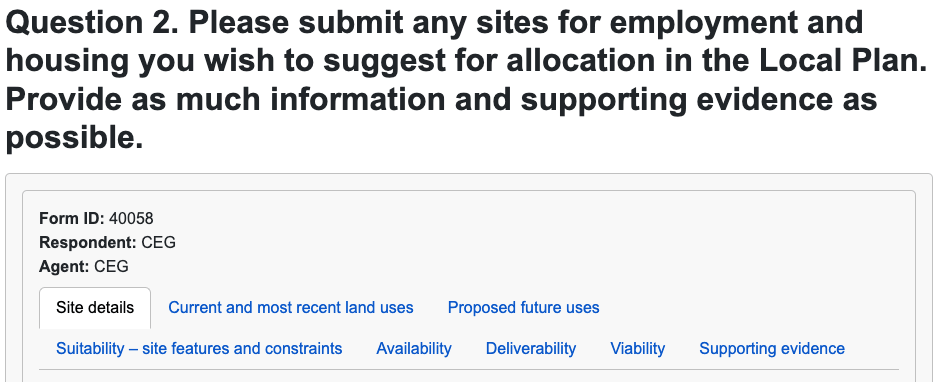
Above – the ‘More Info’ Link will bring up a page that looks like this. Click on the ‘supporting evidence’ tab (bottom right of this image)

Above – the supporting evidence. If the developer has done their homework, chances are they will have commissioned consultants to come up with significant proposals that are public but not publicised. As is the case here with the CEG representations document

Above – the documents which include the vision
- Commercial Estates Group
- Peterhouse Cambridge
- Guys St Thomas’s [Hospital] Charity
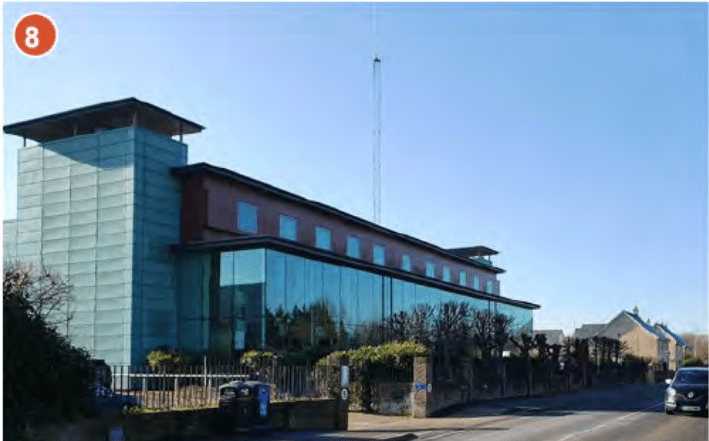
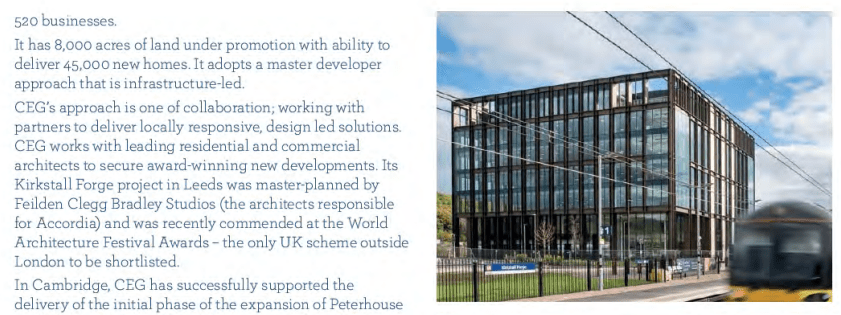
Above – I don’t think Create Streets had these buildings in mind in their vision
The risk with Cambridge is that the developments that get built are ugly and oppressive, and that we see the continued gaslighting from the construction industry that lavish ‘money-shots’ of the ancient colleges that bear no relation to the buildings they are proposing to build. To be fair to Create Streets, they have been a high profile voice speaking out against such designs that should feature in a second volume of Hideous Cambridge.

Above – I have no idea why the now scrapped Cambridge Airport redevelopment proposals of 2008 (they are starting again from scratch) put a silhouette of King’s Parade next to a design of a hideous carbuncle
The question that policy-makers need to answer is how to manage that risk – and how to prevent worst-case scenarios of high-rise, poor quality, unsustainable tower blocks being built in a ring around our city with developers and their financiers extracting most of the financial wealth for their own gain, leaving residents present and future picking up the costs.
Over to you – pick a site and scrutinise it. Then post about it
It’s not all bad news!
There are a number of things that I quite like about the Britain Remade / Create Streets report – and I’m going to focus on those in the following report.
If you are interested in the longer term future of Cambridge, and on what happens at the local democracy meetings where decisions are made, feel free to:
- Follow me on BSky <- A critical mass of public policy people seem to have moved here (and we could do with more local Cambridge/Cambs people on there!)
- Like my Facebook page
- Consider a small donation to help fund my continued research and reporting on local democracy in and around Cambridge.
Below – talking of community conversations about the future of our city, a new cafe has opened within walking distance from where I live, and it’s open on Sundays. I’m pondering setting up an informal fortnightly or monthly afternoon discussions – see my blogpost here

 The Cambridge Town Owl