
Following on from Part 1 here, in this blogpost I look at the things in the Britain Remade/Create Streets report that I quite like
The first thing to note with the map below is ***Yes! Trams!***
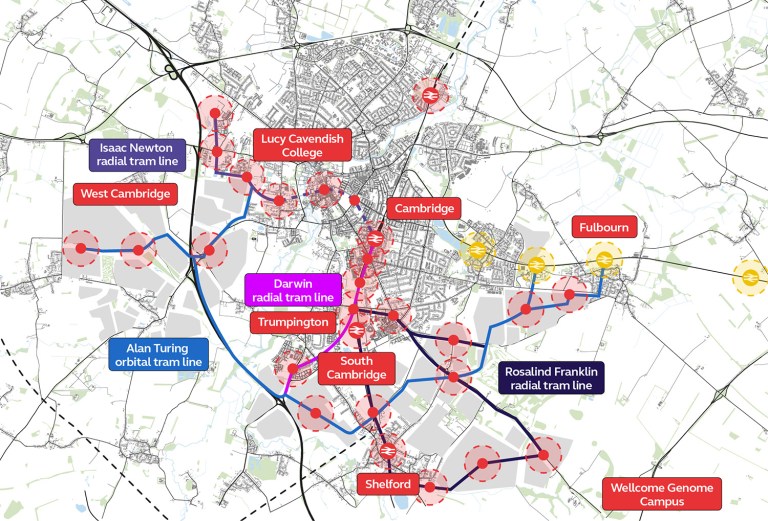
Above – from Britain Remade/Create Streets 2024
Compare that with the latest iteration of the Cambridge Connect Light Rail proposals below, which have been in development since 2016
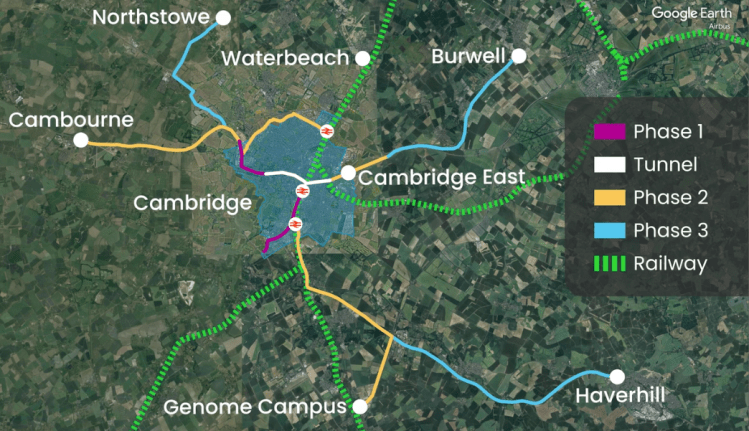
Above – Cambridge Connect (2024)
I support the principle of having trams and light rail at the heart of any new developments in and around Cambridge. Dr Colin Harris has focused his efforts on getting Phase 1 and the tunnel under Cambridge. Therefore the diagram above inevitably looks more like a series of A-to-B lines rather than a wider network at present. At the same time, the building of Cambridge Connect (in particular the tunnelled section) would take a significant amount of motor traffic off of commuter roads to free up space for massive improvements to bus services – in particular punctuality.
Land value capture
“A Greater Cambridge urban extension could be used to fund the transport upgrades that would make it easier to get to the many high quality jobs on offer and to see friends and family around the city. According to the figures in Table 2 at the beginning, every extra home built in Cambridge currently unlocks £235,650 in value uplift that can be spent on infrastructure upgrades.” Britain Remade/Create Streets 2024
While that figure is based on a median house price of nearly £500,000 (i.e. utterly out of reach for a city with a median salary of around £34,000) it is essential that the land value uplift from agricultural to development land is ‘captured’ by the state to pay for the infrastructure needed – not just in the new developments but also to fill the gap created by past developments that did not cover such things – Cambridge Railway Station being the most high profile example of privatised benefits, socialised losses. It is essential that ministers table new laws in Parliament (and for the latter to approve them) to enable the benefits of development to be socialised.
“A Greater Cambridge urban extension could be used to fund the transport upgrades that would make it easier to get to the many high quality jobs on offer and to see friends and family around the city”
Britain Remade/Create Streets 2024
I agree – and not everything needs to be in Cambridge anyway as I wrote here. I’d particularly like to see Rail Future East Anglia playing a much more prominent part and having a much higher profile in and around Cambridge, influencing potential regional links – not least to the East Anglian seaside resorts of Hunstanton and Great Yarmouth where previous generations used to take regular day trips by train.
On top of that, the principle of local light rail looped lines – starting with a Cambridge-Haverhill line could take a significant amount of road traffic off of a number of destinations. A loop line going from Cambridge to Haverhill via the biomedical campus and Linton (with its zoo and village college) could loop back round to Cambridge via Saffron Walden, the Wellcome Genome Campus, the Imperial War Museum at Duxford, and Cambridge City Football Club at Sawston (which also has the oldest of our village colleges).
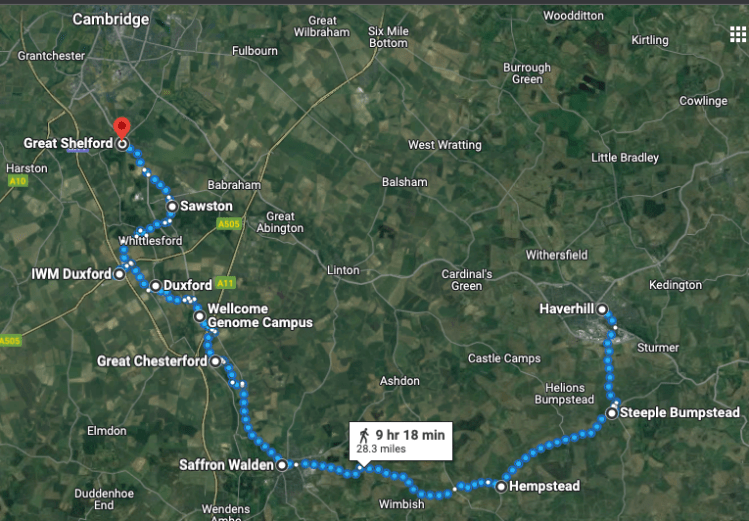
The above example demonstrates building a light rail network that serves more than just the needs of commuters. It covers sports, education, and tourism as well.
‘Build beautiful’
The CGIs and publicity for Eddington are ‘worse than communism’ in my opinion.
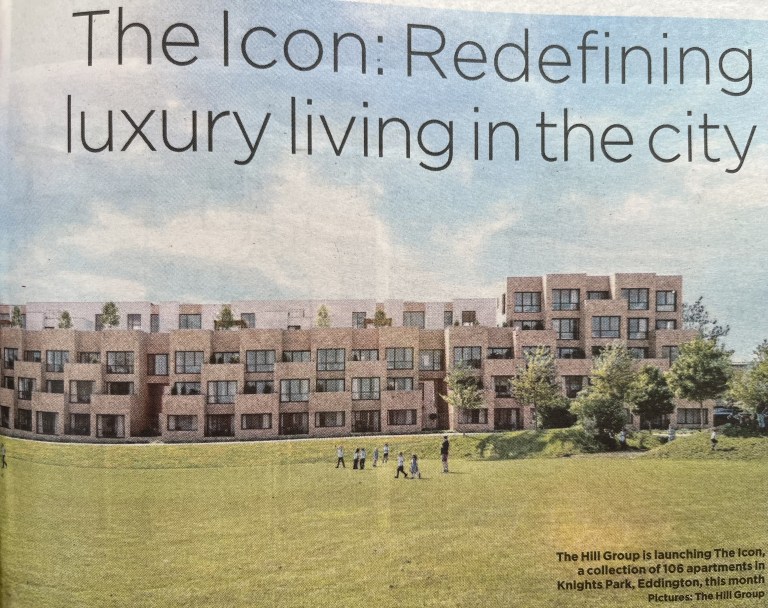
Above – CGI for Eddington in a recent copy of the Cambridge Independent

Above – a housing poster from East Germany in the early 1980s when it was part of the Communist bloc.
My worry remains about the culture wars and the debate about design codes artificially dividing people along party political lines. It’s one thing to admire a building that was constructed in a specific era, and it’s quite another thing to say ‘Let’s impose the economic and political systems of that era so we can build like that again! Empire 2.0 anyone?’ ***No!!!***
Not least because to build the intricate components and carvings that feature on the likes of the Fitzwilliam Museum, we don’t need to go back to an era of oppressed workers. Rather, developments in robotics and renewables mean that stone can be used as an alternative to fired bricks, steel, and glass as external building materials.
Above – an example from the USA of using robotics to carve stone. See also this longer piece on robotics and stone. Furthermore, there is discussion in architectural circles about the return of stone as a structural building material.
New research on why aesthetically-pleasing design matters
Here I defer to Cambridge University Ph.D researcher Cleo Valentine and the findings that she has made about the impact on our collective mental health of the places that we live in and spend our time in and around. One of the things I sometimes say is that one of the few good things about Brookgate’s designs for the buildings around Cambridge railway stations is that their facades are so bland and basic that a future generation can come along and easily remove them and replace them with something nicer than reconstituted stone (something some in the construction industry market as ‘Cambridge vernacular’ like it’s a good thing!)
If Create Streets ran some workshops on design codes in and around Cambridge (as they have done elsewhere), they may well find supporters for some of their proposals. But they have to engage with people beyond those of us who follow these things closely
Furthermore, I’d love to see materials made for schools like with previous generations when Cambridgeshire County Council had an in-house production unit that did this. The Cambridge traffic jam board game from the 1970? That! (You fall down a pot hole. Miss a turn). Given the review of the education and examinations system in England, now is exactly the time to be looking at the types of materials that can be produced aimed at schools, colleges, and university researchers. The Greater Cambridge Shared Planning Youth Engagement Service has already started work in this field. Can we get it mainstreamed so that generations of children can shape the future of the city that they are likely to live in as adults?
If you are interested in the longer term future of Cambridge, and on what happens at the local democracy meetings where decisions are made, feel free to:
- Follow me on BSky <- A critical mass of public policy people seem to have moved here (and we could do with more local Cambridge/Cambs people on there!)
- Like my Facebook page
- Consider a small donation to help fund my continued research and reporting on local democracy in and around Cambridge.
Below – talking of community conversations about the future of our city, a new cafe has opened within walking distance from where I live, and it’s open on Sundays. I’m pondering setting up an informal fortnightly or monthly afternoon discussions – see my blogpost here

 The Cambridge Town Owl