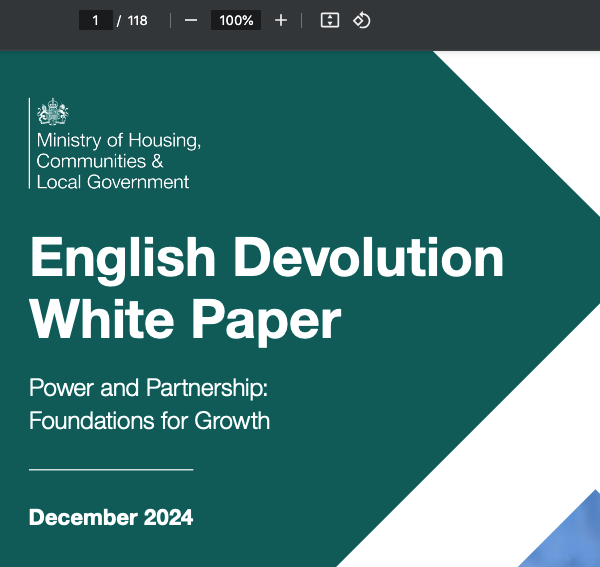
The long-awaited formal statement of government policy on the governance of England, English regions, and local government in England has been published
You can:
- Read the English Devolution White Paper here
- The speech in Leeds by the Deputy Prime Minister
- Read the written statement to Parliament from the Minister for Local Government here
- Watch the oral statement to Parliament from the Minister for Local Government here – followed by the questions from MPs in response.
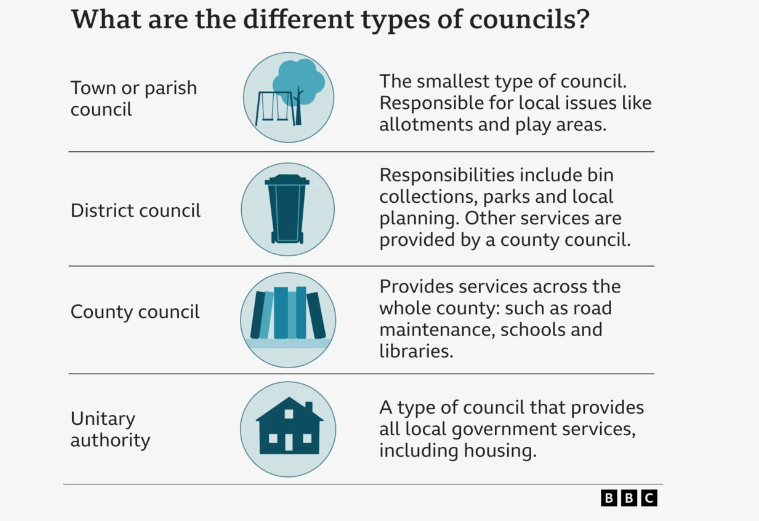
The new structure raises the importance of combined authorities.

Above – structure of government proposed by the Government
The two points I want to focus on are:
- The lack of content on funding and tax/revenue structures, systems and processes
- The confirmation that district and county councils as we know them in Cambridgeshire will be abolished.
HM Treasury is the weak link in the Government’s devolution plans
I wrote this on the back of Jen Williams’ article in the FT a few days ago. At the same time, The Chancellor tabled a written statement in Parliament on the timetable for the Spring Budget. This means that any lobbying efforts on getting this part of any devolution settlement for England has to go to The Treasury. In particular ensuring they add ‘Local Government experience’ as a desirable competency for incoming Treasury senior civil servants!
I won’t say more on this here other than to note that so long as the municipal council responsible for Cambridge does not have the power to tax the wealth being generated here, we will remain a settlement with a globally-recognised name that is governed like a market town. We are better than this.
Switching to a unitary council
The last time Labour tried anything on this scale regarding local government was back in the 1960s in the Redcliffe-Maud report. I’ve published links to my digitised copies here. The main proposals from back in 1969 are shown below
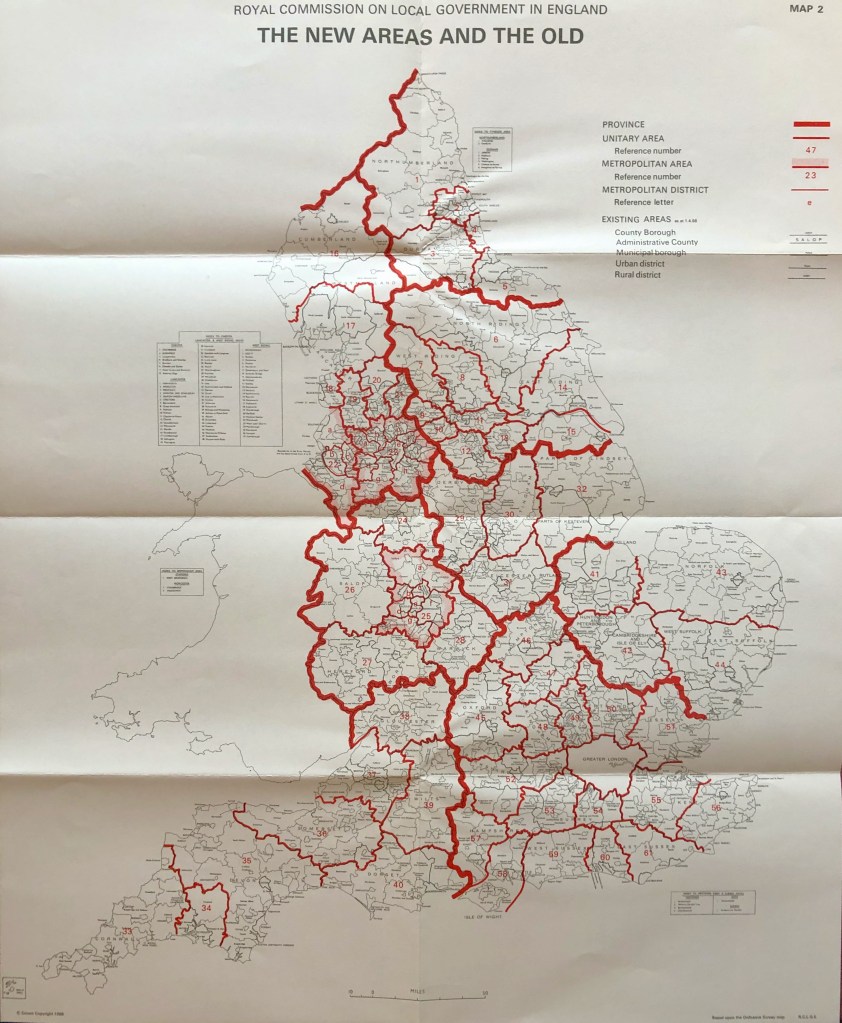
Above – Redcliffe-Maud’s proposals for unitary councils within regional provinces, 1969
Note that the proposals for a Cambridge unitary council from 1969 broadly follows the rental market area for Cambridge
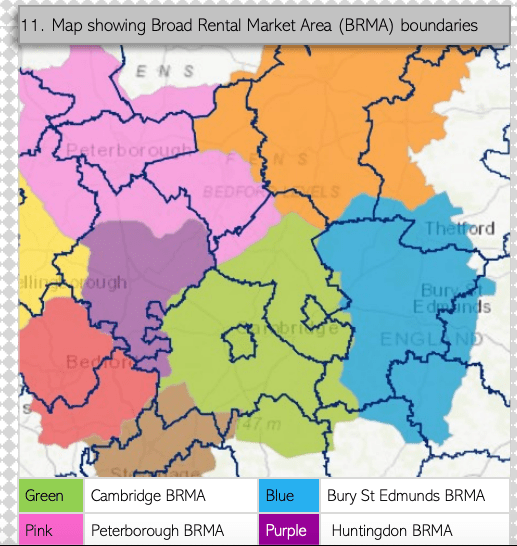
Above – from my blogpost on what a Cambridge Unitary might be like
The principles set out in the White Paper are:
- Scale: Strategic Authorities should be of comparable size to existing institutions. The default assumption is for them to have a combined population of 1.5 million or above, but we accept that in some places, smaller authorities may be necessary.
- Economies: Strategic Authorities must cover sensible economic geographies with a particular focus on functional economic areas, reflecting current and potential travel to-work patterns and local labour markets. It is likely that where travel to work areas are small and fragmented, Strategic Authorities will cover multiple travel to work areas.
- Contiguity: Any proposed geography must be contiguous across its constituent councils (either now or with a clear plan to ensure contiguity in the future through agreed local government reorganisation).
- No ‘devolution islands’: Geographies must not create devolution ‘islands’ by leaving areas which are too small to go it alone or which do not have natural partners.
- Delivery: Geographies should ensure the effective delivery of key functions including Spatial Development Strategies, Local Transport Plans and Get Britain Working Plans.
- Alignment: The government will seek to promote alignment between devolution boundaries and other public sector boundaries.
- Identity: A vital element of successful devolution is the ability for local residents to engage with and hold their devolved institutions to account – and local identity plays a key role in this.
Above – English Devolution White Paper (2024) p31
Note the “No ‘devolution islands'” criterion. What that rules out is a geographically-small ‘Cambridge Unitary’ based on its current 1935-era boundaries. Given that the Minister for Local Government has given a ballpark figure of 500,000 people, we’re looking at the combined populations of the existing Cambridge and South Cambridgeshire council areas, along with either one or two of the existing districts within Cambridgeshire County, or some of the towns and villages the surrounding market towns that are geographically closer, but are over the county boundaries. It remains to be seen how radical ministers will let local areas be.

Above – Mayor Dr Nik Johnson of the Cambridgeshire & Peterborough Combined Authority on p70 in a case study on the new Anglia Ruskin University Peterborough site
The proposed evolution of the Government’s plans
One concern the media put to the Deputy Prime Minister in Leeds was the lack of content on further and higher education. One of the issues I raised with the Combined Authority Mayor involved the establishment of two new departments in Peterborough:
I will be interested to see what election candidates for the county council and mayoral elections in 2025 will have to say about what additional powers and functions they will be calling for.
Harmonising the disparate structures of other parts of the public sector in England.
- The NHS
- Academies (for schools)
- The Environment Agency
- Sub-national transport bodies
None of the above have structural boundaries that are consistent with the combined authorities. One of the policy objectives in the White Paper is to deal with this – something that is long overdue. Why previous governments insisted on messy structures I don’t know. But this is a big opportunity to deal with that problem in England.
“The government will therefore work closely with Mayors to explore how their skills, employment support, health, and housing levers can be better brought together at local level to support rehabilitation and reintegration of offenders into society.”
English Devolution p85
There’s an interesting small section on offender management in the White Paper – something that could be expanded upon in future years with the overhaul of the criminal justice system. While Police and Crime Commissioners get several mentions, the Courts do not. It was in the 1970s that the courts were effectively centralised. It will be interesting to see if anyone can make the case for decentralising the Magistrates Courts and County Courts functions so that their funding and local work is integrated into the work of partner local public services, and that the heads of each court (the most senior civilian officer – like a council chief executive or permanent secretary) can be answerable to the unitary council for their area.
Early 2025 – Cambs Unitaries Campaign public meetings
See the campaign here – and keep an eye out for events early in 2025 for the opportunity to discuss what the future structure of local government could be like.
If you are interested in the longer term future of Cambridge, and on what happens at the local democracy meetings where decisions are made, feel free to:
- Follow me on BSky <- A critical mass of public policy people seem to have moved here
- Like my Facebook page
- Consider a small donation to help fund my continued research and reporting on local democracy in and around Cambridge.

 The Cambridge Town Owl