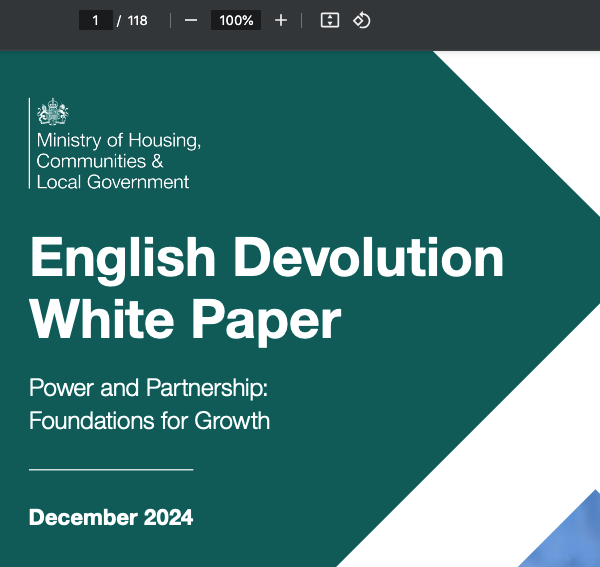
Those who say Cambridge is the perfect small city have not been looking closely enough. In the meantime, Ministers need to come up with a new vision for what they think 21st Century Municipal Government should be like – so that villages, towns, and cities can start putting it together for their part of the country
Browsing through this week’s Cambridge Independent newspaper (available in/around our city, requires £subscription online) either side of a music rehearsal, I spotted this article about Cambridge’s independently run and independently-funded tourist information centre at The Guildhall. (See also https://www.cambridgetouristinformation.co.uk/about/)
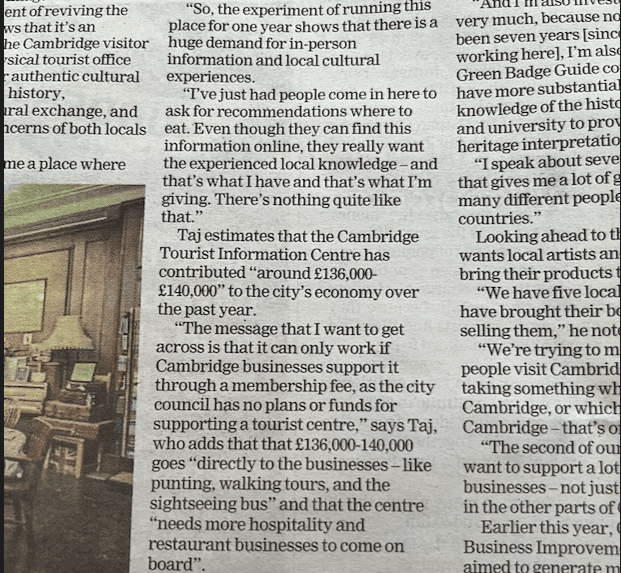
Above – Cambridge Independent 18-24 Dec 2024
“The message that I want to get across is that [the independent tourist centre] can only work if Cambridge businesses support it through a membership fee, as the city council has no plans or funds for supporting a tourist centre”
Taj Khan Kalash speaking to Adrian Peel of the Cambridge Independent
So much about how austerity hit local government can be encapsulated by this piece. If David Cameron were still around he’d be running over to have his photograph taken, extolling the virtues of ‘Big Society’ in the tourism sector.
There are also questions for the Labour administration as to why they have not prioritised a permanent tourist information centre, their Cambridge BID partners (established by the Coalition Government in part to placate angry local businesses watching local services collapse in the face of the onslaught by messrs Pickles and Osborne to provide some funds for basic services) preferring the mobile City Ambassadors. (Can’t we have both?) Note at the same time the massive cuts to bus services and the fragmentation of local public services means that basic common sense suggestions such as having visitor information booths at busy bus stops and transport interchanges don’t have any institution where such a solution that would do wonders for bus punctuality (because otherwise tourists understandably ask the nearest human being who looks to be in a position of knowledge/authority on transport, which is more often than not a bus driver – delaying the buses).
“But Cambridge is the perfect small city! I heard it from a property chap!”
Industries that stand to gain financially from marketing the exclusivity of Cambridge end up coming out with slogans or statements that don’t match the lived experience of our city for the many. (I wrote more about this here). Browsing through a copy of Cambridge Edition recently I was struck by how limited Cambridge’s night life offer is compared with previous eras – even more so given our supposed wealth increase along with a population increase.
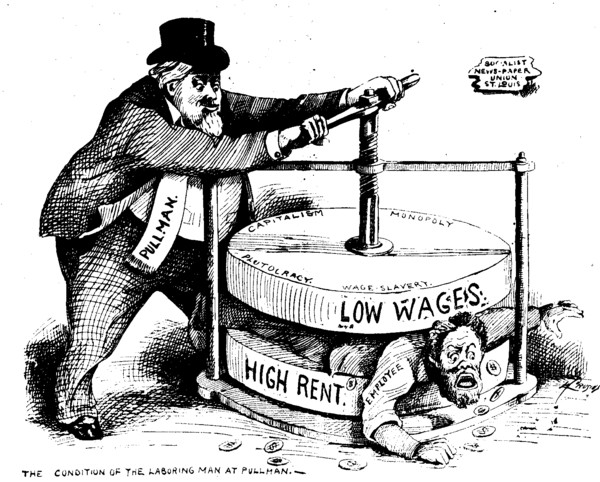
Anyone reminded of the Pullman sketch of 1894? The twin pressures of high rents and low wages?
“What could an alternative, inspirational vision be like for local government in England?”
Mindful of the recent ministerial statements, it will mean different things for different people. One way of looking at it is through the eyes of a visitor. Imagine yourself in the shoes of a visitor to another city, what of the basics would make a short weekend break more enjoyable?
- Information – 1) : I can find what I need and want to find in an easy and intuitive place
- Information – 2) : The information in 1) is accurate, up to date, and *trustworthy* – and consistently so across other platforms
- Transport – I don’t want to have to use a car unless I really have to (we’re talking about cities here, not rural), so want to have a public transport system that has all the superlatives that we’d like to see in such a system
- Transport – consistency of branding and convenience of ticketing, for example so we know that the ‘one day travel card’ is valid on all of the services that have the branding/logo/municipal coat of arms stamped on the vehicles/carriages
- Effortlessly sequenced and synchronised – whether the buses waiting take on passengers when the trains arrive, to pubs/bars next to theatre venues staying open for long enough after performances end/showings finish, and having public transport still running (especially at weekends) to facilitate this
- Having uniformed and clearly identifiable public servants who are knowledgeable and able to deal with most issues then and there
- Having properly-maintained street scenes, from roads to pavements to shop fronts to green spaces – and a planning system that can design out the worst of the visually noisy corporate brand designs that now dominate too many town centres
- Properly-maintained and accessible public conveniences – including but not limited to clean and secure public toilets
- Safe spaces for teenagers and young people to be themselves – for all of the rhetoric, it’s the young people who face an increased risk of being victims of crime. If a place is not safe for them, chances are it’s not safe for the rest of us
- If I have a mild illness, I’d want to know where the nearest pharmacies or ‘drop in’ clinics are. (Why doesn’t Cambridge railway station have a pharmacy?)
When I first visited Germany some 20 years ago, I was struck by the splendid public transport system – in particular the interaction of buses, trams, light rail, and heavy rail. Some of the things that are relatively recent here (eg separating used items for recycling) had been in place in Germany for far, far longer.
Could the Cambridge BID model be extended to cover services and activities for teenagers and young adults?
Personally I’d prefer local taxation to cover it, but in the meantime it’s politically expedient to use the BID model – even though it would require primary legislation and a change in government policy to do so. The difference being that it’s an easier sell to business to promote the collective consensual nature of such a policy and implement it relatively quickly, rather than risk it getting caught up in the wider debate on local government finances.
There are wider conversations to have on what a new unitary council for Cambridge will be like
I think either Cambridge City Council or the Cambridge Labour Party should have put out a formal press release on their respective institutional responses to the Ministerial Statements from the Minister for Housing, and the Minister for Local Government respectively.
The Leader of Cambridge City Council, Mike Davey has repeatedly expressed his reservations about the principle of a unitary council (See my blogpost here) – and others within the Labour Party have expressed Party Political concerns about how this would affect their electoral fortunes if traditionally Conservative or Liberal Democrat-voting wards were incorporated into a Cambridge Unitary. Note the creation of the Cambridgeshire and Peterborough Combined Authority was (in my view) a party-political move by the Conservatives aimed at taking greater Political control of the city of Cambridge without having to win any seats within the city at the ballot box – their once-mighty local party experiencing an unstoppable decline throughout the 1980s & 1990s.
“Cambridge has some of the most complex local government arrangements in the country, with a district-level city council, Cambridgeshire County Council, Cambridgeshire & Peterborough Combined Authority, and the GCP.
“We ran a survey in the summer asking whether people would like alternative governance arrangements to be explored, and respondents said they wanted more joined-up public services, with 83 per cent asking us to explore options for a unitary local government for Cambridge. So the city council is already reflecting on local governance arrangements, and working to understand local opinion, and we therefore welcome this signal from government and the opportunity for further debate to take place”
Cllr Mike Davey (Labour – Petersfield) Leader of Cambridge City Council

Above – Cambridge Independent Press 18-24 Dec 2024
Comparisons with Peterborough City Council – a Unitary since 1998
If you look at the geographical boundary of Peterborough City Council, its large rural wards east and west of it (Lincolnshire over the county border is to its north) are clearly visible

Note below how the population is much more spread out in rural areas.
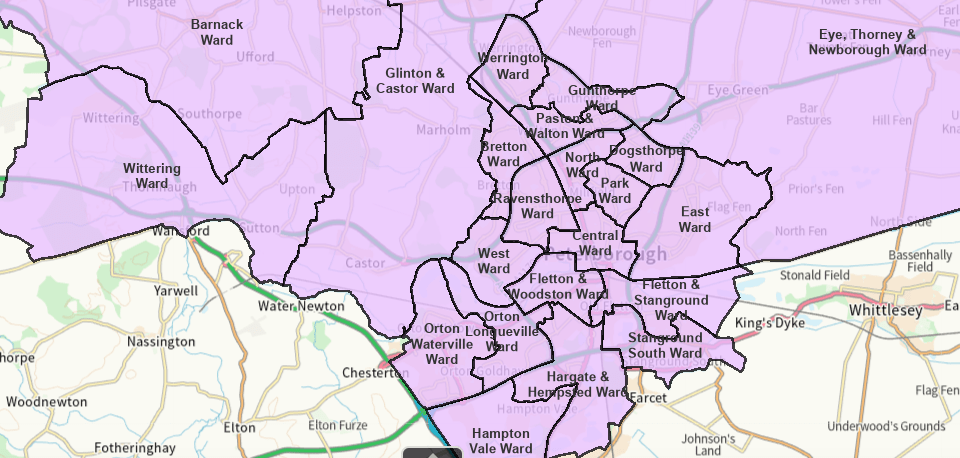
Above – Peterborough’s ward map – 60 councillors across 22 wards.
Cambridge by comparison has 42 city councillors across 14 wards, plus 12 county councillors across 12 divisions – the Conservative-led county council breaking up the previously consistent ward-divisional boundaries in the early-mid 2010s. It remains to be seen what external boundaries a new Cambridge Unitary will have, as well as where any new ward boundaries will be.
Heavy reading over the winter break
It remains to be seen what local councils in Cambridgeshire make of the recent announcements which include:
- Overhauling town planning
- Bringing in new land value capture powers
- The Local Government Financial Settlement – how much will ministers provide councils?
- Overhauling governance structures – new powers for combined authorities
This is why I hope local civic institutions and campaign groups can organise a series of joint public events for residents to find out about how our city and county will be affected, and influence what the new institutions are like.
If you are interested in the longer term future of Cambridge, and on what happens at the local democracy meetings where decisions are made, feel free to:
- Follow me on BSky <- A critical mass of public policy people seem to have moved here
- Like my Facebook page
- Consider a small donation to help fund my continued research and reporting on local democracy in and around Cambridge.

 The Cambridge Town Owl
