
‘…after we were so rudely interrupted…’, our Cambridge-based music collective performed two successful sold-out shows at the 460-year-old Trinity College Chapel
“…described by the press as “a harmonic phenomenon bursting onto the scene like a firecracker” and by fans as “explosive”, “thrilling” and “a tour de force”, Cambridge’s finest sound collective returns after a 5 year hiatus.”

Above – Photo by Ian Olsson. Trinity College Chapel, Cambridge, 21 Dec 2024
This is the same chapel that Ēriks Ešenvalds and Trinity College Chapel Choir recorded the exquisite Only in Sleep – itself originally written as a poem by Sara Teasdale.
You know what? I think we really needed that event
As I’ve started progressing through middle age (I was in my early/mid 30s when I joined) my battles with CFS/ME – the post-exertional malaise (PEM) that go with it, have become harder. Hence missing more rehearsals than I’d like to because as this video shows, there are some days when getting out of bed is a challenge.
It also means pacing myself on performance days. What many people might not realise is that for most of those involved don’t rock up an hour before a performance is due to start, do their sketch, and then go home. It’s a 12 hour day that requires precision planning and micro-managing who is meant to be where and when. (Which is why I’d be useless at it!)
The acoustic impact of being in such a narrow and old venue
As the photograph above shows, the chapel wasn’t designed for huge musical performances. After all, the chapels in most of the colleges are designed to be in service of the institutions they are contained within, not for the general public which have their own set of ancient churches. In terms of density, the centre of Cambridge probably has more religious buildings per square kilometre of land than most other cities in the country.
Being where I was right in front of the piano, I felt the full impact of the cross-vocals of sopranos and altos (separated into upper and lower parts, and further into two sections) due to the concave shape of the standing plan, combined with the tiering. Because of the lighting, most of the time we couldn’t see the audience so you end up concentrating on the sound even – and especially when you are not singing.
It’s very difficult to put what I was hearing and feeling into words – in part because it wasn’t something I had experienced before. It was one of those moments in life where all you can do is simply close your eyes and take in the experience. It’s like time stands still, and all sense of past and future is suspended just for that short period. I might have one such experience every decade if I’m lucky. Halfway through my 40s, this was that one for this era.
As with some of the previous concerts I’ve sung in with the group, this was also one where having the presence of individuals and parts in close proximity makes a big difference. To me anyway. I’ve always appreciated the presence of an influential second (lower) alto section as a musical anchor as the musical arrangements Andrea composes often has altos and tenors alternating. Which makes it easier for me to work out when our section starts. The same goes for having tenors in the same section one or two tiers behind me to keep me not just in time but also stopping me being led astray to the parts of another section. Sometimes the presence of the quietest voices that the audience might not pick up upon can be the most influential in a given section – something I’d not appreciated until I joined Andrea’s collective just over a decade ago. (My first outing with them was in front of several thousand people on Parker’s Piece back in summer 2014!)
At the same time, I also have to watch the lighting because – and as happened in the second set, I had to sit down to give both eyes (and feet) a rest. Hence why I was also at the front. Because at the back of my mind there’s always the question of ‘What are you going to do if you start to get chest pains?’ Hence looking around to see where the most convenient place to be in order to make the least disruptive and most convenient place for a quiet sharp exit before the performances. And given the ‘V’ shape that us tenors and basses traditionally have to make in large music collectives, in such a confined space that meant being at the front. Which ironically is a place I don’t really like being in because I feel really exposed there. There was a point in the interval when I didn’t think I was going to make it for the second set because of what I put down to a minor stent pain which comes and goes at this time of year. Hence taking a discrete seat on one of the platforms during one of the small group sets that involved several of the vocalists moving from their spots to the front.


Above – L-R, before, during, and after.
The phoenix hanging below my panic-bought bow-tie was a gift from the collective following my first stay in Addenbrookes back in December 2017 when we were halfway through an experimental project at The Round Church in Cambridge called In The Dark (Have a watch/listen here)
The feedback was so good that Andrea is bringing the concept to London – see the shows coming up in early 2025 (some of them have already sold out!)
As Andrea Cockerton said during the shows, the past five years have been difficult for so many of us. She reminded us of the power of community being greater than the sum of our individual parts.
It’s a lesson that our city of Cambridge (and in particular the institutions within it) still need to take on board. I last wrote about it back in 2023 quoting Sir Roger Norrington at The Proms in 2008.
That blogpost explores a host of things including academic research on why so many teenagers ‘give up’ playing a musical instrument in their early teens through to those musical pioneers such as Ludovic Stewart of the Cambridgeshire Music Service in the post-war years.

Above – Ludovic Stewart in the Cambridge Evening News from the British Newspaper Archive – his father, Dr Hugh Fraser Stewart was the Dean of Trinity College Chapel in the interwar era. Ludovic’s sister Frida was also a musician in her own right. Amongst other things.
We’ve since had a general election after I published that piece. We have to wait to see what the Comprehensive Spending Review of next year brings not just to arts and music policy, but also to local councils to see how well the arts are integrated in the reconstruction of local government, our towns, and cities.
The revamp of the Cambridge Corn Exchange – a venue We Are Sound have previously performed in
I last wrote about this highlighting the ideas from 5th Studio
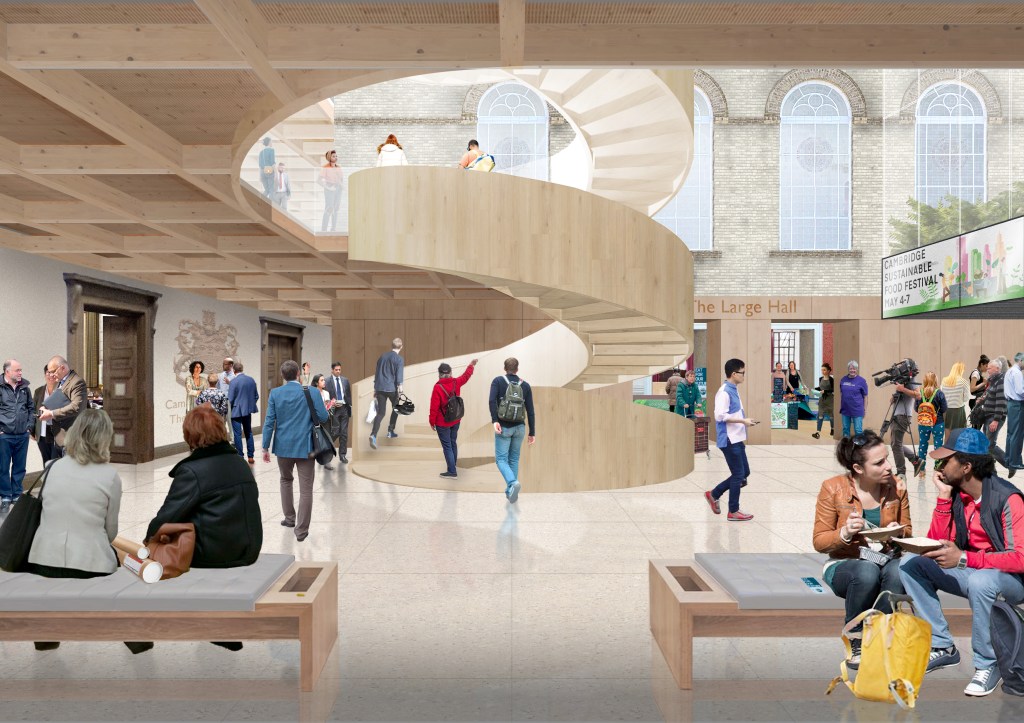
Above – from 5th Studio – having a shared entrance for both the Cambridge Corn Exchange and the large assembly hall in The Guildhall. Nov 2024
Since then, Cambridge City Council published its in-depth proposals for what should happen to both The Guildhall, the Corn Exchange, and Market Square. You can view the papers here. If you are interested in the Cambridge Corn Exchange proposals – which could increase the capacity to 2,000 people due to safer designs enabling faster exits in emergencies amongst other things, you will need to see the documents:
- Stage 2 design report (part 5) [PDF, 24.5MB
- Stage 2 design report (part 6) [PDF, 27MB]
- Stage 2 design report (part 7) [PDF, 27MB]
(…only the full list here as lots of other things in it)
We’ve also got the confirmation that ministers will be overhauling local government in England which all but confirms:
- The abolition of Cambridge City Council
- The abolition of Cambridgeshire County Council
- The creation of a new unitary council covering Cambridge
- The strengthening of, and granting of new powers and responsibilities for the Combined Authority.
You can see more here noting that any new council for Cambridge will be starting from a very low point. What the restructure will mean for the proposals remains to be seen. I’m still of the view that Cambridge needs a new second urban centre in the face of the Housing Minister’s policies for our city, and that a 3,000+ concert hall/music venue would be an ideal anchor building along with a grand new city hall and a lifelong learning college.
How long it might take to build those even if the Minister achieves his vision…only time will tell.
If you are interested in the longer term future of Cambridge, and on what happens at the local democracy meetings where decisions are made, feel free to:
- Follow me on BSky <- A critical mass of public policy people seem to have moved here
- Like my Facebook page
- Consider a small donation to help fund my continued research and reporting on local democracy in and around Cambridge.
Below: Opening in early 2025 (there have been further delays) : The Cambridge Room. Let’s talk about the future of our city – design and built environment included
 The Cambridge Town Owl