
As Cambridge’s community and amateur (i.e. not paid professional, or church/chapel choirs) have a breather over the festive break, the popularity of both their groups and audiences collectively might be telling us something about the sort of city we want to become
That’s not the same as appropriating every single person’s motivation to participate in an activity to a political objective. (eg. ***Look at all these people singing! That means they all support the idea of a new large concert hall!***). Not least because some of the ones I know are against the principle of Cambridge growing as a city because of the ongoing environmental stress our local ecosystem is facing.
I’m also not going to get into the business of pitching one music group against another. Our city is big enough for all of us. Furthermore, one of the things I’ve learnt in the decades of volunteering is that for a community or a society to maintain a support network for elite-standard activities, there has to be a thriving grassroots society underpinning it. Unless you’ve got historically large endowments to subsidise such activities which as Cambridge University found a month ago (Nov 2024) even that is no guarantee of survival.
The historical town/gown divide has meant that our city has struggled to function beyond a level where we are greater than the sum of our combined parts. It’s not something easy to explain unless you lived it – which I did growing up here in the 1980s and 1990s. The University of Cambridge and its colleges were all too often high walls that we walked past, or parts of our city that we never frequented because we had no reason to – little was put on for us in those times and if they were, they never reached our eyes and ears.
There are at a number of community choirs within walking or cycling distance of me in South Cambridge, in no particular order, including:
- We Are Sound (who I’ve been with for over a decade on-and-off)
- The Collab Choir in Trumpington
- Some Voices (part of a national network)
- The Sing! Community Choir
- Vocal Remix (at Coleridge)
- Rock Choir (Queen Edith’s) (part of a national network)
- Cherry Hinton Community Choir
- Abbey Voices Community Choir
- Cambridge Tuneless Choir
- Cambridge Harmony Chorus (women only acapella group)
- Cambridge Timeline Choir
“That’s a lot of singing!*
One of the reasons I’m gutted that the Mill Road Winter Fair was cancelled was that some of the groups were preparing performances for that event.
Above – from the Mill Road Winter Fair 2017 – the Sing! Choir with the Railway Singers and local primary school children as part of a HistoryWorksTV local history project.
The project celebrating our local industrial history is a reminder of how music can make use of local history for community events.
Combined with the loss of both the Strawberry Fair – cancelled for 2025, and the scrapping of the council-funded Big Weekend where Cambridge’s famously-wealthy firms that politicians and the media like to tell us all about were unwilling to step up and meet the costs, the city-wide opportunities for those community choirs to make themselves known to much larger audiences has been lost. In the mid-2010s there was often a community music tent for smaller groups, while the larger choruses were regularly booked as opening acts for The Big Weekend – as I found out the hard way in summer 2014.
It’s a fragile musical ecosystem – one that policy-makers might not be aware of, let alone know how to support
If there is one city that should have a thriving network of lifelong learning for leisure, it should be Cambridge. But it isn’t. I continually remind whoever is burdened with my presence at public policy events that Cambridge does not have its own lifelong learning college that other towns and cities have. Many of the venues that used to host such courses were sold off as part of the mergers and moves that created Cambridge Regional College in the early 1990s, and Anglia Polytechnic/Ruskin University as a standalone higher education institution. Then as now, the facilities were woefully underfunded – as the photographs from the 1970s show.
“Yeah – why is there no community singing group in Arbury and King’s Hedges?”
While the Young Arbury Music Makers group is still going after 40 years, I’ve not found the equivalent of the groups in the south of our city. Looking at the programme of bookings in the recently-opened Meadows Community Centre for January 2025, the absence of a singing group is prominent by its absence.
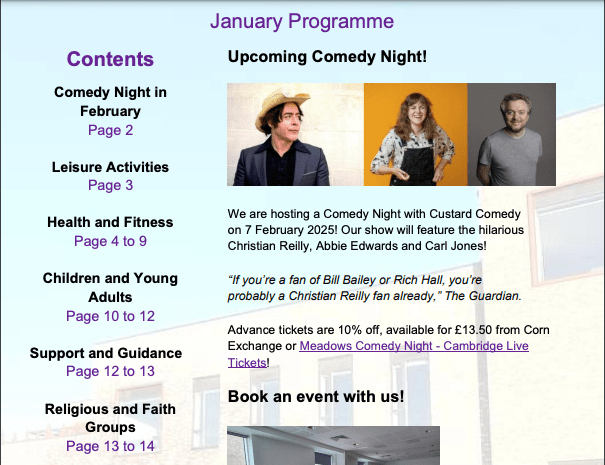
Above – Programme of events for Jan 2025 at the Meadows Community Centre, Arbury, Cambridge.
Note the range of venues north of the River Cam that the Chesterton Chorale has performed at over the past decade. That combined with the number of community venues that Cambridge City Council owns or has working agreements with.
The Cambridge Science Park appear to have tried to form their own science park choir earlier this year, but it doesn’t seem that much came of that initial expression of interest back in April. Which makes me wonder what the Cambridge Biomedical Campus got right (to the extent that they are full up) that the Science Park did not. Furthermore, could the Section 106 money coming from the Crown Estate’s redevelopment of the Cambridge Business Park go towards addressing this as an extended community building project?
What things could the popularity of the singing groups be tapping into, and what’s missing in the north of the city?
This for me underlines the importance of community-mapping (we’ve done it before) and data-mapping – and beyond that, how the people of city and county communicate with our civic institutions. This is something the House of Lords looked at on a grander scale back in 2023 in their report on Citizenship and Civic Engagement. Because the implosion of social media with gamed algorithms and the decline of local media has meant that those single points of comprehensive information are no longer there for us – and so far we’ve got nothing to replace them with.
The other thing to note is that some people will cross district, if not county boundaries to participate in group activities in Cambridge. It’s easy to forget as a resident within the city of the role it has as a wider civic centre beyond our 1935-era boundaries. It’s also why I’ve kept on going on about Cambridge Connect Light Rail because with costs of land being so high, there’s a strong case to be made about building new community infrastructure and medium-higher density (“missing middle”) housing next to new light rail stops so that those of us living inside the city can travel out of it without needing a car to participate in activities that would be too expensive within Cambridge.
“Who dares take the commercial/financial risk?”
The three main providers of community-based learning for leisure in Cambridge are:
Note the dearth/lack of music-related courses and options
Not surprisingly, the funding which comes via the Combined Authority, is hyper-focused on specific targets and outcomes as their course search themes indicate.
- Digital skills and basic skills (for work and living)
- English for Speakers of Other Languages
- Health improvement – including mental health
It remains to be seen if, and how this changes with the various reviews being undertaken at the direction of ministers.
Some of the things an annual Cambridge Societies Fair could help us find out
It’s a shame that the Strawberry Fair 2025 has been cancelled because the councils could have undertaken a massive survey of attendees and given out free ice cream vouchers for those filling in the surveys. Have a big marquee with displays of the various things that already happen in and around the city, feature some things that we don’t have but might like to have, and find out from people things like:
- What they would be both able and willing to pay for which activities
- What they would be willing and able to help organise and put on
- The things that stop them from getting involved/participating
- Who needs to do what to deal with 3)
Without The Big Weekend, there is no annual big event in the city centre that gets a critical mass of the general public in one place to do that outreach work. i.e. the engagement and listening exercises that go far beyond the likes of myself who follow the goings on at Guildhall meetings.
“I thought you were going to tell us what the popularity of Cambridge’s singing groups were telling the city!”
I would if I knew the answer but I’ve not surveyed them. So I don’t know the answer. Instead I’m looking at a bigger picture over a much longer period of time – both the toxic culture of my teens in the 1990s through to what ministers are lining up for a Cambridge of the mid-21st Century. We’re already halfway there, for it’s a quarter of a century since the 1990s ended. Anyone else remember the most over-hyped date in almost a thousand years? After all, we were promised the party of a lifetime by this chap!
If you are interested in the longer term future of Cambridge, and on what happens at the local democracy meetings where decisions are made, feel free to:
- Follow me on BSky <- A critical mass of public policy people seem to have moved here (and we could do with more local Cambridge/Cambs people on there!)
- Like my Facebook page
- Consider a small donation to help fund my continued research and reporting on local democracy in and around Cambridge.
Below – as mentioned in this blogpost, I’ve since had a catchup with Stir Cambridge’s new Cherry Hinton Road branch and have scheduled the first of what I hope will become a series of wider neighbourhood conversations on the future of our city. See details here for Sunday 12 Jan 2025.
 The Cambridge Town Owl