
You may have seen the headlines earlier on here. There’s little that regulators can do to achieve new growth figures in time for the Sunday morning paper review. Also, it’s a slow news weekend so why the rush?
Image – Whitehall and Westminster still confusing? Here’s a guide from the olden days: Because it’s Your Parliament too.
The mindset behind the headlines is that ministers can pull a policy lever that involves changing the law or changing tax-and-spend levels, and ‘growth’ will magically occur. Thus they will be able to report back to Parliament that “growth has gone up by 0.0001% this quarter, which is more than forecast – oh we’re such a splendid government unlike that ‘orrible lot over there who were turfed out by the British Peeeeeple!”
The reality is very different. Any major spending announcement takes at least 18 months to feed through on the ground. Public policy is a very complex thing. Look how Michael Gove and co struggled in March 2024 to get cash out of the door. After 14 years of austerity, local government in England simply did not have the officer/staff capacity to do the work necessary – whether that was doing the work themselves or commissioning consultants/outsourcing firms to do it for them. (You can see why local government corporate memory has been hollowed out).
When you are responsible for spending large amounts of public money, you have to be able to account for it. Therefore public sector bodies have to put together business cases and compile evidence bases to justify the spending they are undertaking. That takes time – a lot of time. In the decade-and-a-half of austerity, local councils and public service providers simply do not have the capacity to keep a host of large project plans ticking over in the eventuality that ministers will release some funding for it. Furthermore, the mathematics behind deciding which part of the UK gets what can be fiendishly complex at the best of times.
What ministers want to see are potentially one of two things:
- Money allocated by ministers going ‘out of the door’ into productive and useful projects – ideally ones that require photo-opportunity-friendly site visits with lots of hi-viz jackets
- Private sector investment being announced and resulting in new job vacancies and an injection of cash into starved local economies – the multiplier effect so to speak. (In reality it’s much more complex than that, not least due to the realities of international trade and international labour markets)
The worry for environmentalists is that the past half-century or so of neo-liberal/Thatcherite/call-it-what-you-like economic policies has often been the type that removes protections from people and places most vulnerable. This might be a prohibition on development (so no jobs in the construction, and no jobs in an unbuilt factory), or an expensive and time-consuming process that to the business person at least, looks like a disproportionate cost that’s not worth bearing.
Because the headlines are screaming that he has asked regulators for policy ideas (I thought they were meant to be in his election manifesto?) the fear is that they will point to regulations that can be eased or can go – at the expense of the environment. With the likes of OfGem (electricity generators) and OfWat (the water companies) and the Financial Conduct Authority (anyone remember the 2008 financial and banking crisis where woefully poor regulation was a big cause – a policy pushed for by the same banking sector that demanded and got bailed out?) have all been asked to come up with things.
To re-state the point, there is little in the short term that ministers can do. The things that will make a difference are the policies that require detailed planning, and the rebuilding of broken institutions starved of resources – starting with local government.
The thing is, they have already made the announcements that support growth – such as proposals on funding for a new generation of town planners, and making town planning a cost-recovering function of local government.
Personally I don’t think it has gone nearly far enough – to get more GPs, dentists, community nurses town planners, and construction professionals into work, the Prime Ministers needs to come up with a set of policies that deliver what the Education Select Committee called for way back in December 2020. Those include building and opening new community learning centres in every town. Because where else are people like me going to learn about the new technology that today’s school leavers take for granted? It certainly isn’t going to be at an underfunded adult education programme that is entirely outsourced to external providers at venues with limited transport access. And it certainly won’t be through trying to get learners to sign up to ever more loans in an era of high consumer, university, and housing debts.
One of the most radical things the Prime Minister could do is to bring back a system of maintenance grants – ones that match the cost of living, for people who want to switch careers but are otherwise unable to. In a place like Cambridge where there is a chronic shortage of just about every skills set going, how in the world is anyone meant to make ends meet while retraining full time? People could retrain part-time but:
- Part time evening classes are *utterly exhausting* when you have a full-time job even when you are free and single. When you have caring responsibilities and a house to look after, the burden is even greater
- Remember that the Government wants growth and quickly. Part time learning policies will not deliver what it wants in the time period concerned.
In my case I’ve got multiple barriers due to what really should have been an avoidable decline in health had the previous governments properly invested in healthcare, in active travel infrastructure, in decentralised working (that didn’t involve being in London all the time) and research in all things neurodiversity. Easier said than done I know. Sadly on more than one occasion I’ve seen the hearts of healthcare professionals metaphorically fall out in front of my eyes when they’ve come to the conclusion that the long term restorative and rehabilitative care that I need (following heart attacks and mental health crises/exhaustion/burnout) are simply not available on the NHS at all. And if they are, not at the capacities or the places that are easily accessible. (In my case it means crossing county boundaries if not regional ones. Not a realistic prospect for someone who has hardly left Cambridge since the late 2010s. No – really.)
Coming back to the definition of ‘growth’ – that needs unpicking
Not least because it has been over a quarter of a century since my cohort at sixth form college were discussing the limitations of GDP as a measure of economic progress in A-level Geography and A-level Economics. I somehow ended up with a degree in the latter in the early 2000s as well. I still recall one seminar where I pointed out to a nearby woodland visible from out of the window and asked why GDP figures did not account for the trees as having any value in economics, but that when they were chopped down and processed into timber they very much did have an economic and monetary value.
The environmental challenge for Sir Keir Starmer and his ministers includes being able to increase the productive output of the economy without actually increasing the inputs needed at the same time. And so much of the waste generated is utterly avoidable – as I found to my horror when working in housing and sustainable homes policy in Whitehall in the late 2000s. This is one of the reasons why anything other than the smallest development has to have a site waste management plan. Yet still the figures are shocking.
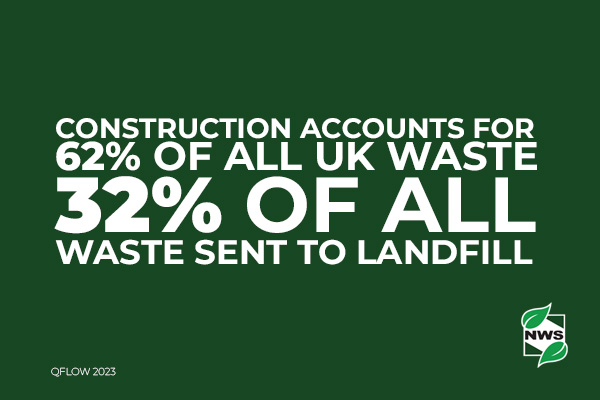
Given the noise that BBC’s Blue Peter was making about recycling and reuse in the 1980s and 1990s, that is still an astonishingly high figure of materiel going into landfill. In the case of the construction industry, having better trained architects and quantity surveyors, and much stronger financial incentives and penalties for developers on sustainable material use (especially the stronger penalties given the Grenfell Inquiry) could result in the designing out of wasteful and polluting components.

Above – the Waste Hierarchy from the University of Nottingham back in 2012
- How much of each product/component produced annually is not used and simply thrown away?
- How much of each product/component is ordered by quantity surveyors that are then not needed? (Again, think of the importance of post-construction evaluation)
- How many of the components and how much of the old materiel removed from sites can be re-used? The classic is the old wooden railway sleepers that can be filtered out at rail recycling plants such as this one in Cambridgeshire, that are re-used in urban landscaping and in gardening
- Anything that cannot be reused could be considered for industrial recycling, melting components and reducing & refining them for recasting into something new
- Anything that cannot be recycled then gets landfilled.
Yet still unused components and materials are being landfilled.

“The industry does not currently account for unused material that is sent to waste as this is typically added to an existing skip on site. Through greater waste segregation and material management we hope to reduce the volume of material being sent to waste and dramatically increase material reuse. This in turn would reduce construction waste management costs and carbon emissions.”
Above – UKCI AWR 2023 p16 / p12pdf
While the government statistics on recovery of waste from the construction industry look impressive – over 90% each year over the past decade, that still leaves around 4million tonnes going into landfill. How much of that is unused material?
The Tories are going to need better answers – and better questions too
That lot? Back in Government? Behave!!!
It’s one thing to question whether the Government has got its policies wrong and stating that it’s those very policies that have led to the not great figures published recently. But to state that getting the Tories back into power would somehow solve it – even if said in jest, simply reminds the public of his party’s own record of wasteful spending, instability in ministerial high office, and allegations of corruption and a collapse in standards in public life. Note previous governments have launched their own ‘Red Tape Challenges’ in the past (Such as the Coalition here in 2010) but I’ve not seen any substantial studies as to whether they achieved much other than a few short term headlines.
With Parliament back in less than ten days (on 06 Jan 2025), chances are this will all have been forgotten about as more details are published about the major policy announcements on housing, transport and local government. One of the reasons given for yet another centrally-provided pothole fund is that the improvements to roads will be much more visible compared with other policies. Furthermore, councils that are highways authorities (in our case, Cambridgeshire County Council) have lists of which repairs need doing and in order of priority. Therefore compared to major building projects, in principle turning on the funding taps to deal with potholes should be much more straight forward – and something that the public may notice sooner. But that’s no guarantee it’ll convert into electoral success in those areas holding local elections in just over five months time.
If you are interested in the longer term future of Cambridge, and on what happens at the local democracy meetings where decisions are made, feel free to:
- Follow me on BSky <- A critical mass of public policy people seem to have moved here (and we could do with more local Cambridge/Cambs people on there!)
- Like my Facebook page
- Consider a small donation to help fund my continued research and reporting on local democracy in and around Cambridge.
Below – as mentioned in my previous blogpost, I’ve since had a catchup with Stir Cambridge’s new Cherry Hinton Road branch and have scheduled the first of what I hope will become a series of wider neighbourhood conversations on the future of our city. See details here for Sunday 12 Jan 2025.

 The Cambridge Town Owl