
I have no idea how this will end or tail off either – and given my chronic ill-health I know I’ll never pay off my loan, which had I been able to carry on working would have been paid off long ago.
Image: How to be a Minister – from John Hutton’s book – as the root of this is in Whitehall
You can see the details in this House of Commons Library Research Paper from 2024
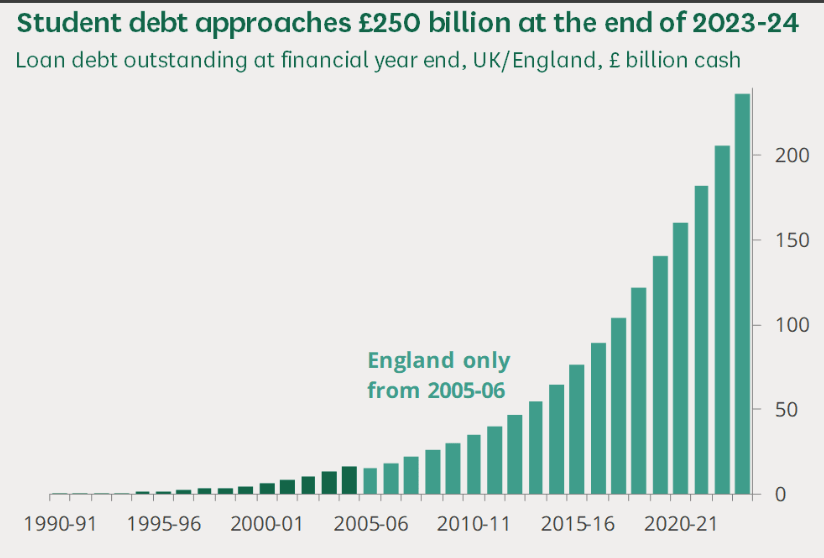
Above –
Furthermore, some of the student loan book has been sold off to the private sector under the previous Conservative Government. The interest rates charged on student loans combined with high costs of living, and the chronic housing crisis means generations of young adults face grim prospects.
“What we do know is that expecting young people to face a marginal 41% tax rate for the next 30 years while also trying to live, save for a future and old age, is quite simply intergenerationally unfair.”
Intergenerational Foundation Dec 2017
The problem is that student loans are not treated like other debts in government finances. Paul Johnson of the IFS explains:
“…the first thing you need to know is that when the government spends about £14 billion this year on loans to students, government debt rises by £14 billion but government borrowing does not. That £14 billion does not count against the deficit. That’s because the national accounts treat student loans as financial transactions. A loan is issued. It is due to be paid back in the future. There is no impact on the deficit unless and until the borrower fails to pay back.”
Paul Johnson for the IFS, 2018
We won’t know what the definite figures are for non-payment are until around the year 2050, when we’ll have had the first few years of the tuition-fee era cohorts passing the retirement age – the point at which their outstanding debts are wiped out. But like Climate Change, that point is sufficiently far ahead in the future for present generations not to worry about it, just as politicians paid lip-service to climate change in the 1990s. If you want to know what we were being told as children back then, get a copy of the Blue Peter Green Book.
Student numbers and regional policy in England
Jim Dickinson’s piece for WonkHE pulls up a policy area that ministers have not thought through properly, and it will require some substantial negotiations between departments and The Treasury. And at the moment HMT’s response to any proposals that involve granting a much wider range of independent revenue-raising powers seems to be similar to how Sir Humphrey reacted to proposals for regional government.
“A British Democracy recognises that you have to have a system to protect the finer things in life, and keep them out of the hands of the barbarians!!! Such as…The Universities – both of them!” Sir Humphrey explaining to Sir Bernard why regional government is a bad idea in Yes Prime Minister / BBC Studios.
Part of the problem in my opinion is the blurred line between academic and intellectual freedoms in teaching and research (a longstanding principle of keeping Politics and Religion (and the powers of) away from decisions on teaching, research, and content, vs the wider social and economic impacts of capital investment and student numbers on the towns and cities that the institutions reside in. And when it comes to rocking up to an unsuspecting town and behaving like they own the place, the University of Cambridge has got 800+ years of form. Aided and abetted by various monarchs in pre-democratic days (as Professor Helen Cam wrote before she became the first Woman Professor at Harvard)! (Have a look at how Oliver Cromwell became MP for Cambridge – in particular the size of the electorate)
“Mayors will be told to have a plan. But not over student numbers…”
…is the headline from Mr Dickinson’s article – one that causes Cambridge and the Combined Authority more than a few problems. Or rather, it perpetuates the existing problem of Cambridge having no powers to manage the impact of student numbers on our city (positive and negative impacts it has to be said).
The housing crises in university cities
“If we look at the last two years alone, areas like Manchester, Liverpool, and various bits of London saw significant increases in student housing – but smaller university towns like Lancaster, Lincoln and Colchester seem to have experienced sharp declines.”
Dickinson (2024)
I lived through this in multiple guises – including as a student living in Brighton at the turn of the Millennium – an era where the universities there had not invested in their own residential properties to match their rising student numbers. These were the days when ministers tied university funding to increased numbers while ignoring pleas from local councils about housing while selling off the council houses and not returning the revenues to local councils.
Yet the problem has gotten worse for both local residents *and* students in the fight for private rented accommodation. Furthermore, successive ministers and policy advisers will have experienced life in the private rented sector during their university days (and/or know those who did), and so should be aware of the basic power imbalances of landlords against students (who generally change accommodation every year – so have little incentive to kick up a fuss to get major improvements made) to those struggling in the private rented sector who lack the agency and political capital lest they risk being made homeless.
The loss of social housing sites to student and ‘apart-hotel’ accommodation
I’ve lost count of the number of case studies in Cambridge where this has happened. The two that stand out off the top of my head are in Romsey Town (The Cam Foundry) and the various developments along Newmarket Road in Abbey Ward – both of which have high housing need, but both of which got accommodation that is exempt from a social housing requirement *and* from council tax. You can see why it causes issues with residents even though local government finance is fiendishly complex. Quite understandably, residents see asset-rich property owners extracting the wealth generated in their communities and see little benefit for themselves. As I wrote in 2017, I don’t blame the students or young people for this. Especially in an era where they’ve not been educated about politics and democracy – a deliberate decision by Michael Gove as Education Secretary, and also a deliberate decision from Thatcher’s ministers for my generation in the 1980s & 1990s. (If you can find any text books teaching children and young people about politics and democracy from that era, please let me know as I’ve not found any – and I think this speaks volumes about the political party and its ministers in government at the time. Rant over).
The risk that inequalities will get worse both within cities, and between smaller and larger cities
It’s the worst of both worlds really – Oxford and Cambridge due to the size of their colleges’ financial endowments and annual numbers of tourists effectively being counted as larger rather than small cities/large towns.
“The biggest areas are getting bigger, while the long tail is getting thinner. That could be about shifts in student enrolment patterns, changing housing market dynamics, and local policy decisions impacting housing incentives or restrictions – or maybe that students are in halls instead.”
Dickinson (2024)
If Mayors cannot have some sort of control or influence over total student numbers in their areas, then they are in trouble. If Universities with major financial muscles can do what they like and override the needs of the residents that share the cities they are located in – which is what Cambridge University did by persuading ministers / planning inspectors to approve Eddington with no council housing – and the city council called them out on it. But then you had a Conservative Government and a Parliament with backbench MPs some of whom oppose the principle of state-subsidised housing, and who think that ‘the market’ can be left to provide. The Grenfell Inquiry exposed multiple market failures as well as regulatory and policy failures.
“How do you persuade universities to account for the needs of the cities that they are based within?”
Being independently constituted with their own royal charters, the kickback that would result from putting them under local council or combined authority control would be huge – and from both sides. I can’t imagine any combined authority mayors would want to take on that can of worms. At the same time, there is one starting point that could make a difference – and it’s sort of linked to the old Local Strategic Partnerships of the mid-2000s, and the creation of the old Local Area Agreements in the Strong and Prosperous Communities White Paper of 2006. The agreement that ministers and the LSP for Cambridgeshire signed off is here

Above – the LSP Partnership Board as of April 2010, before Eric Pickles and George Osborne scrapped the entire system later that year.
“Should they bring back LAAs?”
Hell no!
I wrote about it here – note the 198 national indicators that every local council area had to report against and publish information about. How many of those would you improve? How many of them are relevant to today?
There is something to be said for major employers and large firms having greater consultation and co-operation duties imposed on them in primary legislation. It doesn’t need to be draconian, but it does need to account for problems where economic activities cause knock on problems and increased costs that are not borne by the institution creating said costs. Privatising the profits, socialising the losses and all that. Which as I continually remind people about Cambridge Railway Station is what happened when Brookgate managed to negotiate its way out of the social and community infrastructure commitments due to the 2008 Financial Crisis.
“From then on, the quality of the project was progressively watered down and obligations renegotiated, each regressive step argued on the basis of the straitened economic climate in the wake of the 2008 financial crisis.”
Oliver Wainwright, The Guardian, 13 June 2017
Fast forward to today and Brookgate is (and has been for quite some time) one of the most profitable companies in Cambridge. And yet the city and county have no way of taxing the excess profits having pled poverty to get them out of building the heritage and cultural centre promised to the county council.
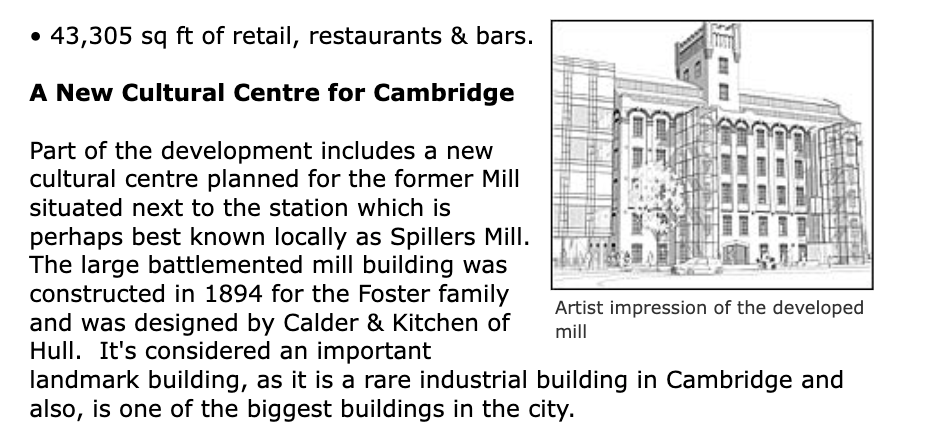
Above – from BBC Cambridgeshire 20 Oct 2005 – the mill building is now expensive private apartments.
What was that I said about socialising the losses and privatising the profits?
The risk of empty buildings that are not fit for purpose
Given the exposure of the construction industry’s shortcomings at the Grenfell Inquiry, Mr Dickinson raises the risk of empty student halls of residence – Purpose-Built Student Accommodation, as demand from students due to lower numbers enrolling. This is a huge risk for towns and institutions that don’t have the strong brand names to withstand a decline in student numbers – whether home-based or international. In Cambridge’s case the switch to apart-hotels or cheap accommodation for ‘young professionals’ are options, but for higher education institutions it seems like the hidden costs of their decline has not been considered by policy-makers.
One example of the risk for smaller cities was reflected by former oil tycoon Lord Browne of Madingley calling for Cambridge to host a proposed National Energy Institute Great British Energy. Fortunately it went to Aberdeen – for me it had to be a coastal city given the need to utilise wind and wave power.
It also reflects why I’ve continually called on the Combined Authority to expand the provision of courses at Peterborough to cover sectors where there are chronic shortages of trained staff – such as in dentistry. Furthermore, I’ve also stated that new premises should be within walking distance of existing or new railway stations so that the benefits can be shared with towns and villages up and down the railway lines. Peterborough, which is the larger city in the Combined Authority only has one main railway station. There are multiple sites that have potential for a second or third railway station for the city (the CPCA should invite residents to suggest where would be best for their city – have a look at the map online) as well as options for a Peterborough light/suburban rail loop line which I covered here.
Given that we are moving to a future where more people will be staying in their localities to learn, and/or learning part-time throughout their lives in an era where more of us will be expected to retrain in new professions, both student accommodation bubble and the financial arrangements that keep it afloat look dangerously unsustainable. I hope ministers and policy advisers are listening to the smaller institutions, and are not being dazzled by the bright lights of the big names.
If you are interested in the longer term future of Cambridge, and on what happens at the local democracy meetings where decisions are made, feel free to:
- Follow me on BSky <- A critical mass of public policy people seem to have moved here (and we could do with more local Cambridge/Cambs people on there!)
- Like my Facebook page
- Consider a small donation to help fund my continued research and reporting on local democracy in and around Cambridge.

 The Cambridge Town Owl