
Does planning law enable such things to be imposed by local councils?
The Greater Cambridge Shared Planning Service has re-publicised its trio of consultations here, covering:
- Planning obligations that cover the negative impacts of development, and contributions towards much needed physical, social, and environmental infrastructure
- The Cambridge Biomedical Campus
- The Health Impact Assessment
Additionally, please watch the video here from the GCSP and share the link to anyone interested.
Commenting on the consultation
- Online on the council’s consultation system hub
- By email at localplan@greatercambridgeplanning.org
- By post: Planning Policy, Cambridge City Council, PO Box 700, Cambridge, CB1 0JH
- Or by requesting a form to complete and return to [The City Council] by email or post.
On the Planning Obligations, there are only 23 chapters, two appendices, and four supporting documents to read through and familiarise yourselves with, so it should only take a few minutes, right?
*The system of consultations in Cambridge is broken*
I have no idea how to prioritise my very limited ADHD-riddled attention-span (which is about as long as that of a goldfish) on all of the consultations happening at the moment – noting that there are three ongoing annual budget consultations going on (for the city council, county council, and Combined Authority) at the same time.
How do residents who are not me go about making their views known in a way that can be incorporated into officers’ considerations? Do councillors know? Turns out it has become so complex that (and I can’t blame them for it) you can get in touch with consultants who for a small fee* ***you can get your bespoke objection submitted in three days!***

“Wow! Where do I sign up?!?”
Don’t you want to know how much the fee is before you do?
*You said small*
Small for a big corporate consultancy or a rich person. “Don’t risk doing it alone in a complex system. Our team of expert Chartered Town Planners have years of experience and are the best at writing powerful objection letters in just 3 working days for only £150.”
“£150?!?!?”
Exactly – not small if you are on a low income, struggle to make ends meet, and have no community champions with the in-house expertise, time, and motivation to stand up for your community. Especially when big corporations can instruct eminent counsel/senior barristers who can charge rates of over £1,000 per hour.
Actually, in the grand scheme of things the Planning Voice people who run the site/service have provided enough free advice in their knowledge hub here for many reasonably-organised campaigns to make representations without having to pay for a service. When compared with similar professions such as the legal profession, you will find examples where the research required combined with the writing up of, and submitting a letter will cost more than £150 quoted. This is because you are paying for the costs that individual/persons incurred to become an expert in their field. For Town Planning that means the costs associated with an undergraduate degree combined with a Planning Master’s Degree and professional registration with the MRTPI. Both my brothers followed this route in becoming town planners. The workload is *huge* and therefore the undertaking to provide the level of professional advice especially on large and controversial planning applications, is also complex.
There is a wider question on having a qualified ‘Professional public advocate’ on town planning cases where a local council covers the cost of professional representation of the public on controversial and/or large planning applications. This is because the council planning authorities and their planning officers are required by law to work with applicants to get their applications into a state where officers can recommend them for approval at planning committees. It’s the designated council planning caseworker who makes the case to councillors on the planning committees – and the latter have to act in a ‘quasi-judicial capacity’ as set out in legislation (i.e. they cannot consider things like party political issues, or things ruled out of scope by legislation). While developers and/or their consultants can make a short speech in support of applications, and objectors and/or their representatives as well, there is no automatic right of fee-free professional representation for people commenting on standard planning applications. (It’s slightly different IIRC if it involves things like compulsory purchase etc where you risk losing your home against your consent).
“Doesn’t Cambridge already have the equivalent of such advocates?”
Cambridge Past, Present, and Future sort of carries out that function with its planning watchdog role. but only insofar as its charitable objectives and funding will allow. It’s not a general service that a public advocate funded by a local council would provide for.
On student accommodation
The consultation document for planning obligations state:
“There is a need across Greater Cambridge for c.750 additional social/affordable rent homes to be provided per annum up to 2040”
One of the things that has frustrated local residents for years is the ability of developers to wiggle their way out of providing either accommodation or financial contributions towards much-needed social housing because of an exemption that covers student accommodation and apart-hotels – short-term accommodation.
I don’t know what the legal position is regarding the Government’s policy, nor whether local government has any powers to impose such cost onto developers. My concern is that developers buy up land and buildings for much-needed social housing (as we saw with the CAM Foundry at the eastern end of Mill Road) which has become a cash cow for the owners of the property in a city with a huge social housing need.
Going by figures for 2023, developers in Cambridge are significantly under-providing for social housing. But the statistic is buried in council reports.
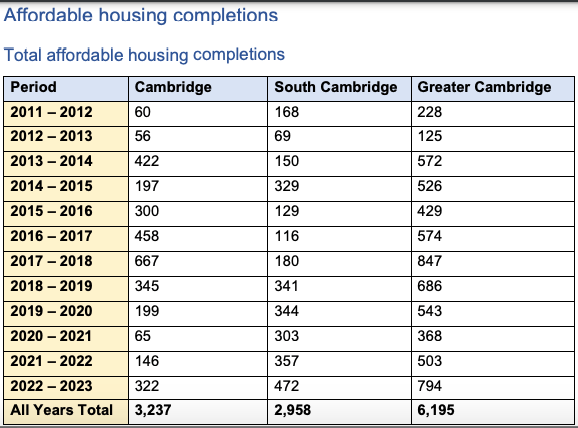
Above – Annual Monitoring Report, Cambridge City, South Cambs District, 2022-23, table A2.15 p187
To pull out the above-table, you’ve got to know that the Annual Monitoring Report process exists, and that such data is published. Which means you have to know that the city council and district councils have planning responsibilities and duties to collect and publish such information. And that Parliament and Government require them to publish this. How many people know this and where to look for it?
In just over the past decade (2011-24, so also including the 523 for the year just gone), Cambridge & South Cambs have only exceeded that target of 750 affordable homes completed in a year in two of those 13 years. There is no mechanism to force developers to build affordable homes to make up for the years where they have under-provided. Furthermore, we don’t know how badly Cambridge and South Cambs are affected by the inability of housing associations to buy the very homes that developers are required to build – a scandal only recently come to light – see the BBC from December 2024 here. There’s a case that can be made for central government to borrow to buy the homes – because the borrowing creates new assets in housing, then sign over long term leases to housing associations or local councils, and do it that way.
This reflects a wider problem of local councils having no control or influence on the economic activities and expansion of institutions that create the additional demand for student accommodation (I wrote about this here), nor do they have any control over wider municipal planning on being able to influence (from a transport planning perspective) what sorts of buildings might be suitable and where. That doesn’t mean councils have to micro-manage cities. Rather it means they can designate key strategic sites that over time can be converted to host specific functions that a city needs – whether that be a leisure centre, a place of employment for small firms, a public transport interchange, or even new open green space in urban areas. Should some areas that have decaying low-density housing that’s uneconomical to renovate be comprehensively redeveloped to create higher density housing combined with larger shared open green spaces for exercise and leisure? Easier said than done.
Nothing on the Cambridge Biomedical Campus on a lifelong learning facility
Or on the prevention of ugly building designs being approved – that an emerging body of research from Cambridge University researcher Cleo Valentine is showing actually affects our wellbeing.
“The emergence of neuroarchitecture – which studies how the built environment affects brain function – deepens our understanding of how design influences occupant health and wellbeing. Evidence shows that elements like natural light, spatial layout and visual complexity don’t just impact on aesthetic sensibilities, they affect how we function, think, and impact on our physical and psychological wellbeing.”
Mitchelltree and Valentine (2024) Dezeen
I would like to see the SPD amended to take into account this growing body of research. Furthermore, as the document notes at 3.26
“…although parts of the Campus include an element of green space and public realm, it is dominated by streets and buildings. Most users of the Campus do not have direct access to high quality public realm or green open space for play, recuperation, sports or any other outdoor activities to support health and wellbeing. Green infrastructure is also unevenly distributed across the Campus and so there are large areas with no green infrastructure, links to natural habitats to support biodiversity or improve the Campus environment.”
What little there is, has minimal public access – whether the Frank Lee Centre, The Perse Sports Centre (which inevitably has limited opening hours for the public – something planners had to fight for), and venues that once had public access such as Long Road Sixth Form College, no longer seem to offer such access anymore. (It used to have a wonderful programme of adult education classes in the late 20th Century – I know because I did A-level History there on Monday evenings in 1998/99!)
Nothing on music in the Planning Obligations
Trying to find something in the document that says anything about contributions to a new large concert hall is hard to find, and the word ‘Music’ does not come up at all. Which means there’s more for me to moan about on that front. Ditto the swimming pools issues.
But my head hurts already so feel free to browse through the documents and respond directly, or if that feels like too much hard work and you want to make just a few small points, email your councillor and ask them to make representations on your behalf (https://www.writetothem.com/) Also, if you think we should have some group/community discussion sessions facilitated by people who have knowledge of all things town planning aimed at local residents, shout.
If you are interested in the longer term future of Cambridge, and on what happens at the local democracy meetings where decisions are made, feel free to:
- Follow me on BSky <- A critical mass of public policy people seem to have moved here (and we could do with more local Cambridge/Cambs people on there!)
- Like my Facebook page
- Consider a small donation to help fund my continued research and reporting on local democracy in and around Cambridge.

 The Cambridge Town Owl