
The long and controversial process on this busway will shortly go to a public inquiry as the deadline for objections – 08 Jan 2025, approaches. (If you want to submit your own objection (or alternatively, a letter of support), see here). See also Menagerie Theatre’s The Trials of Democracy project and their new events starting in January 2025.
TL/DR? Read the press release here. Quotations from people also in opposition include:
- Clive Anderson, President of the Woodland Trust
- Lord Whitty, former Parliamentary Under-Secretary for Environment (Lab)
- James Littlewood, CEO of Cambridge Past, Present, and Future along with Griff Rhys Jones in his capacity as President of Civic Voice UK
I wrote about the GCP’s busway application here, even though I’ve been following the processes for longer than is sensible. The best part of a decade. As soon as the Cambridge Connect Light Rail proposals were published in 2016 I put my efforts into supporting those proposals – ones that involved a tunnel under the city centre and thus dealing with the problematic ‘last mile’ of road traffic congestion into Cambridge, while at the same time diverting road traffic from motorists living south-east of Cambridge but needing to get to the north-west of the city, and vice-versa.

Above – concept map from Cambridge Connect and Rail Future
There is an in-highway alternative that could be used while a light rail was planned and built
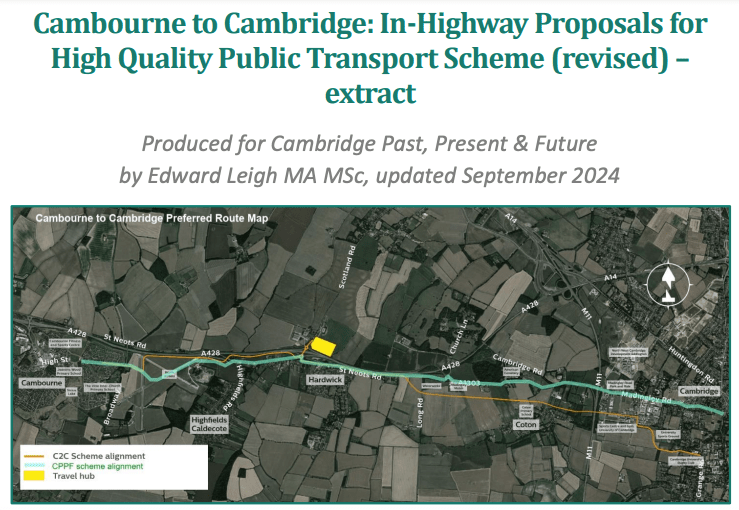
Above: Cambridge PPF commissioned transport engineer Edward Leigh to draw up alternatives – scroll to CD29-04.
The most significant objection in my view is the value-for-money factor: The BCR – Benefit-Cost Ratio is woefully low, and should have resulted in the proposals being dismissed at a far earlier stage.
“From the Outline Business Case (OBC), the Initial Benefit-Cost Ratio (BCR) of the preferred option is 0.43, implying that it will yield £67.5 million of social benefit for a budgeted outlay of £157 million. Even with less-certain benefits included, the Adjusted BCR is only 0.48. Normally such a poor return on public investment would have eliminated this scheme from consideration.”
(Leigh 2024, p5)
“What happens to the buses when they hit Grange Road?”
As I’ve mentioned repeatedly, this problem never went away. Furthermore, the Independent Audit of the proposed busway raised it as an issue and it has not been dealt with. In fact, I raised this issue in this video (as well as in public questions) way back in August 2017. It’s now January 2025. Count the years everyone!
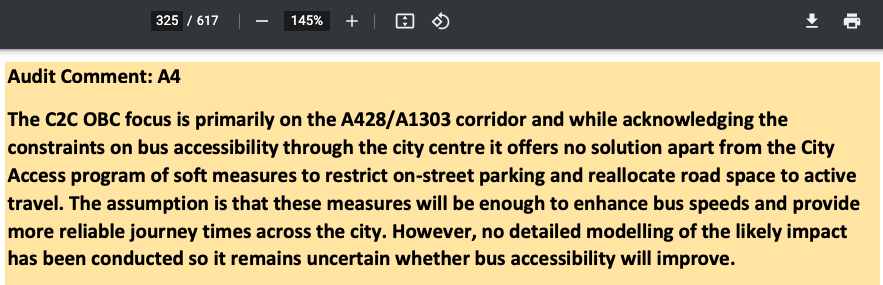
“[The CBC proposals offer] no solution apart from the City Access program of soft measures to restrict on-street parking and reallocate road space to active travel. The assumption is that these measures will be enough to enhance bus speeds and provide more reliable journey times across the city. However, no detailed modelling of the likely impact has been conducted so it remains uncertain whether bus accessibility will improve.
“The OBC [Outline Business Case] recognises the need to access the fringe employment site at the Science Park and Cambridge BioMedical Campus and proposes a pattern of orbital bus services to serve these sites. from the Park and Ride sites at Madingley Road and Scotland Farm via the M11 and A428 as well as connections in the City Centre. These constraints remain valid for the C2C scheme and only weak remedies are proffered at this stage.”
It’s almost as if the concept and design was put together by affluent men who don’t actually use buses on a regular and routine basis – let alone live lives that are dependent on bus access to get out of their neighbourhoods. (I don’t drive, so buses are essential for me given my health and mobility limitations)
Mr Leigh also raises the issues of what happens to the buses when they hit Grange Road.
“The OBC does not make clear what route buses will take between Grange Rd and the city centre, though it indicates in the NTSR (p58) that buses to the Biomedical Campus would run via Silver St and Pembroke St. Downing/Pembroke St is one-way eastbound. Which way will buses run westbound? Has the modelling taken into account congestion on Downing/ Pembroke St and Lensfield Rd, and the westbound detour required from the city centre? (For reference, the Citi 4 service travels via Northampton St, Chesterton Rd, Victoria Ave and Emmanuel Rd in both directions.)”
(Leigh 2024, p7)
Time and again, the Transport Director (now acting CEO of the Greater Cambridge Partnership) Peter Blake said that the buses would join the existing bus network, even though there were no high profile public conversations with, let alone developed plans from the bus companies on how this might work.
For me, this was a Political failure. More specifically, the GCP was (in my view) established by the Coalition Government because Conservative Ministers did not want to create a Cambridge Unitary Council to oversee the transport improvements because they knew the electorate would never vote for their party to run that council. Historically and culturally, within the party, ‘Cambridge’ has been something of an aristocratic inheritance – a previously safe seat and safe council for the Conservatives until the late 20th Century. Therefore the past few decades can be seen by some as something of an historical aberration – the ancient University seat temporarily in the control of woolly liberals and champagne socialists, waiting to be rescued by their traditional leaders and masters. But such has been the growth of housing and of house prices, of inequalities, of the booming sci-tech sector and the lurch to the more extremes of their movement that they have found themselves excluded not just from Cambridge, but also from the southern Cambridgeshire parliamentary seats that used to be their back yard.
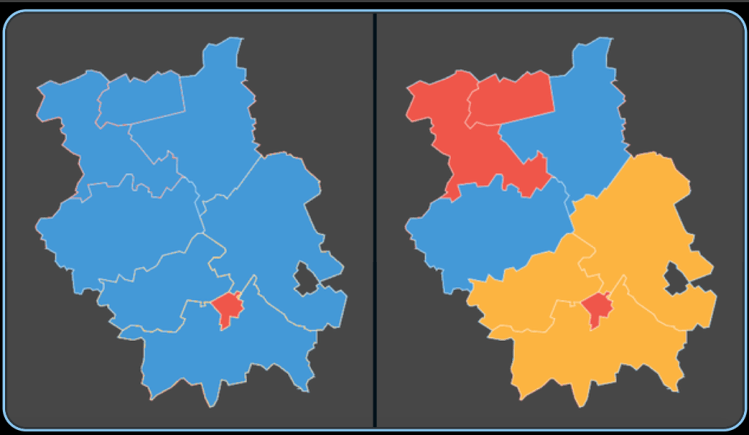
Above – the political earthquake that the electorate delivered to Cambridgeshire in 2024
The problem with our political system is that while the electorate delivered votes for change, the GCP senior officer corps carried on as if nothing had changed. They kept on putting through recommendations that were rubber-stamped by weak assemblies and boards made up of politicians from all three political parties. The Conservative-majority board could have stopped the proposals back in 2017 and worked more co-operatively with the newly-elected Combined Authority Mayor James Palmer – also a Conservative, but the working relationships between the new authority and the GCP both between political parties and within the Conservative Party at a county level made this impossible. All three parties had seats on the GCP Board between 2018-21 and none of them pulled the plug, and from 2021 onwards the Labour-LibDem board again could have pulled the plug but chose not to, instead going ahead with an ill-advised congestion charging scheme that toxified local democracy in a way not seen in Cambridge for decades. Furthermore, it enabled a nimble Conservative operation to regain a seat on Cambridge City Council for the first time since winning one in 2012.
The Cambridge Development Corporation
It’s 2025 now. The GCP funding agreement comes to an end in 2030, and the reality of the Government’s English Devolution White Paper is that the GCP will have to be absorbed into the Unitary Council Structures. It cannot carry on as it is because between now and 2029 Minsters have to draft Orders in Council to abolish the existing two-tier councils and establish the new councils. Therefore the institutions that nominate their voting members of the existing GCP Board will cease to exist.
“Which means in reality that…?”
The functions will transfer either to a unitary authority or to the Combined Authority, and they will figure a way to get the business and education seats on it one way or another. It’s not an insurmountable problem.
What will be interesting to see is how Peter Freeman and his Cambridge Development Corporation fit into all of this, because as Chairman he is directly accountable to the Minister for Housing and Planning. Mr Freeman could easily make the case for the GCP’s budget and programmes to be subsumed into his institution – especially if he chooses to go down the route of building a light rail system. This seems all the more likely given the recent statements from ministers and also social media posts last month from Dr Nik Johnson, the Combined Authority Mayor who is re-standing for election. Furthermore, his recently-announced Conservative opponent, the former MP for Peterborough has also stated his preference for light rail for Cambridge.
Parliament is back next week, so it will be interesting to see who published what over the next few weeks.
If you are interested in the longer term future of Cambridge, and on what happens at the local democracy meetings where decisions are made, feel free to:
- Follow me on BSky <- A critical mass of public policy people seem to have moved here (and we could do with more local Cambridge/Cambs people on there!)
- Like my Facebook page
- Consider a small donation to help fund my continued research and reporting on local democracy in and around Cambridge.

 The Cambridge Town Owl