
These policies must include proposed new powers to tax the wealth generated in the region to pay for solutions to our chronic skills shortages that the employers themselves persistently complain about
One huge problem is that the larger employers are not meeting their potential new employees where they are at in life. Furthermore, the policies themselves won’t necessarily be the direct intervention we’re familiar with, but rather more indirect ones that are perhaps harder to quantify. Yet this was something that the last Labour Government was willing to try with their Local Area Agreements reporting framework for local government 2006-2010 (before the Coalition scrapped it all).
I wrote about Local Area Agreements here, a policy area that dominated my early Fast Stream years when I transferred from Cambridge to London in the mid-2000s. In those days the number of targets and measures that local councils had to report back to central government on was getting silly (anecdotally one unitary council had over a thousand indicators to collect data on – at huge expense, but little was done with the data to improve policy making or service delivery). How did it get so high? Ring-fenced funding pots awarded by ministers or executive agencies each with their own reporting system to account for the money spent. Got a skills problem? Here’s a pot of funding for skills to hand out to these areas, and with a set of reporting instructions to go with it. Got a potholes problem? Here’s a pothole fund.
Think back to the 1990s and the moral panic over teenage pregnancies – previous government policies driven by the mindset that if you educated young people about something ‘forbidden’, they would go off and do that ‘forbidden’ thing – so we got ‘ignorance-based education’ in the 1980s and 1990s instead. When it came to funding allocations, money allocated for public health programmes for example could not be spent elsewhere – for example on programmes aimed at keeping teenage girls in parts of the country most at risk, in full time education. Yet academic research persistently found that increasing the enrolment of girls into schools and encouraging them to stay on into further education found causal links between the number of years spent in secondary and further education, and the reduction in teenage pregnancies as this World Bank Blogpost highlights.
Under the old system of small funding pots, councils were not able to spend money allocated on what might have been the best solution for their area. Such as building a new further education college where there is a significant lack of provision. This is what Cambridgeshire faces – the vast majority of further education places in the county are in and around Cambridge. That has a huge impact on traffic and transport, as well as on the students themselves. So far, the Combined Authority with its miserably small budgets and lack of sufficient powers has not been able to come up with a solution to these ‘further education cold spots’.
*Where is the hope?* one former classmate asked me this week
I bumped into a former classmate from the early 1990s very recently. This was the first time I had seen him this side of the Millennium – a good quarter of a century had passed since we last spoke. Without going into detail, you could see the long tail of institutional failings at school in that decade had absolutely crushed him. The sector that he’d set his heart on going into – a very competitive one, was always going to be a challenge and it didn’t work out for him. What really struck me about where he is now is that none of the institutions who could – and perhaps should be helping him out (not least because of their own staffing and skills shortages) are not meeting him (and thus others in a similar situation) at the halfway point.
Understandably he remarked that people who received large redundancy packages had the option of paying to retrain in a new field. But if you’re from a working class background and have been pushed from agency-job to agency-job, there is no four/five figure pay off. And yet employers and successive governments expect ‘learners’ to take out more career development loans in an era where a sizeable section of the population have incurred substantial debts from their university years.
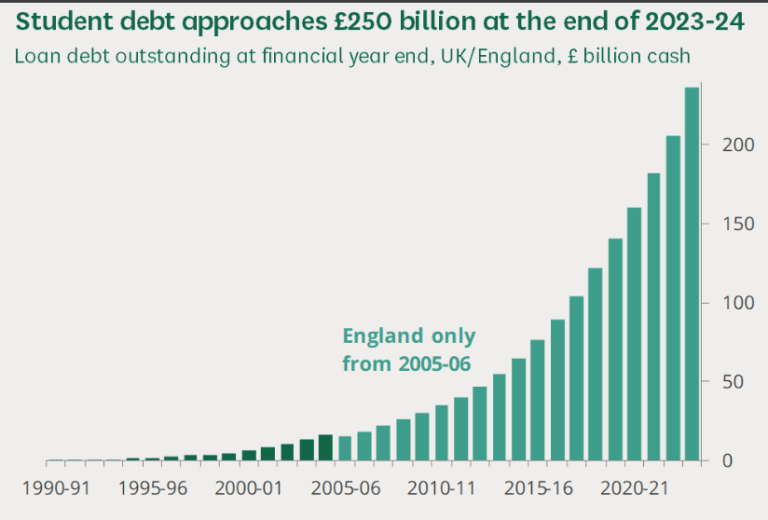
Above – Student loan statistics 2024 – House of Commons Library
Asking people carrying £hundreds-of-billions in student-era debt to take out even more loans feels utterly unsustainable.
Combine this with Cambridge’s huge inequalities crisis – of individuals having their own places to live and not be dependent on their parents. Looking at a new set of newbuilds in the part of town we went to school in, each property built as a family house is on the market for a cool £800,000. What hope for the children who live in the council houses a 60 second walk around the corner?
“The total number of adult children living with their parents increased 14.7% in the same period from around 4.2 million in the 2011 Census to around 4.9 million in Census 2021.”
Census 2021 analysis – 10 May 2023
That inevitably hits people’s self-esteem and mental health – especially as they grow older because the social expectation is that as an adult we have to stand on our own two feet and earn a living – even more so if you’re looking for a partner to settle down with. For some it can all become too much (TW suicide) and yet public policy debates on mental ill health don’t seem to have grasped the underlying causes of that mental ill-health, let alone how to deal with those causes. All we get is the same rhetoric about ‘it’s good to talk’ etc without actually providing health services with the resources, and communities with the means to support those in need.
I don’t talk nearly as much about my mental ill-health as I used to, simply because I’ve lost too many good people from my life as a result of it, mainly stemming from the fact that the professional treatment and assessment I needed at specific times was not there. And so the cost and the fallout fell onto whoever was around me at the time. And they should not have been in such positions to have to deal with me in those states.
“What are the policies that Combined Authority mayoral candidates will need?”
They will need things that are far more radical than anything any of them have tried before. Not least because of the limited powers and funding that they have. That will inevitably mean very tough conversations with Treasury officials, whether seeking direct funding, or new taxation powers to pay for the costs of new policies which include but are not limited to:
- A new adult education/lifelong learning centre for Cambridge with excellent public transport access
- A new building/venue *that does not look like school*, because more than a few of the people using the services sadly will have had traumatic experiences at school – so built environment matters
- Additional essential and convenient services that help people overcome barriers – such as a free/affordable on-site creche or afternoon youth club
- Somewhere to exercise/be active that’s not simply limited to a gym and/or a sports hall or tennis courts. Include a large open parkland.
- Health clinics for both physical and mental health, plus a pharmacy
- A discounted shop for essential supplies
- Safe and secure cycle storage
- A venue co-designed with the people who are most likely to use the services – both learners and potential staff
- Means of supporting those that would like to switch careers into fields that have chronic shortages, but who don’t have the means (eg financial) to do so – such as through maintenance grants
- Financial incentives for those who need to get those essential qualifications for the workplace but do not have them. (Eg on enrolment, completion of coursework/units, completion of an examination, and reward based on results).
With all of the wealth being generated in and around the city, firms cannot plead poverty in the way Cambridge University and its member colleges do. What would it be like for the University of Cambridge and its member institutions if they provided learning maintenance grants for adult learners studying to qualify at a technical/level 3 in fields where the University faces chronic shortages, such as laboratory support staff? (And if they do provide such maintenance grants for adults, why are these not more prominently advertised?)
Let’s not forget that democracy is under threat in a way that feels unprecedented given the use of modern digital technology
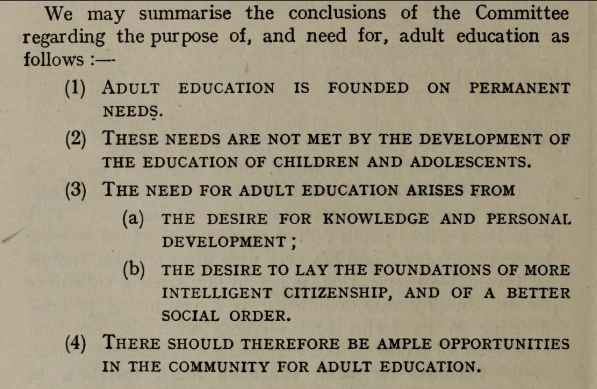
Recall Arthur Greenwood in 1920 in his book The Education of the Citizen, 1920 – for the Adult School Union.
I followed this up a year later with a gloomy post about how Cambridge’s economy and society would crumble if lifelong learning did not receive a substantial boost – and not just a financial one. The problem is that as things stand the Combined Authority does not even have the legal powers to found and open its own new learning institutions. That power resides with ministers as I wrote here. Which is why I hope the Devolution Bill will make provisions to transfer that power from ministers to the most suitable level of devolved local government in England. (Adult education is a reserved matter in Scotland, Wales, & Northern Ireland).
The big sci-tech land owners really need to step up as well – and provide the land and buildings for people to learn in.
As I wrote nearly a year ago in February 2024, Cambridge cannot possibly have these great science parks and not have any decent provision for lifelong learning. Which is why I’ve repeatedly moaned at anyone from the Cambridge Biomedical Campus and the Cambridge Science Park (and others) about this glaring omission. I hope next time it will be the Combined Authority Mayor who asks them for progress updates, not me.
Turning it all into some sort of strategy
It’s now up to the political parties and their candidates to decide which of these things (if any) they want to adopt. (They’re within their rights to completely ignore me too – it goes with the territory!)
If you are interested in the longer term future of Cambridge, and on what happens at the local democracy meetings where decisions are made, feel free to:
- Follow me on BSky <- A critical mass of public policy people seem to have moved here (and we could do with more local Cambridge/Cambs people on there!)
- Like my Facebook page
- Consider a small donation to help fund my continued research and reporting on local democracy in and around Cambridge.

 The Cambridge Town Owl