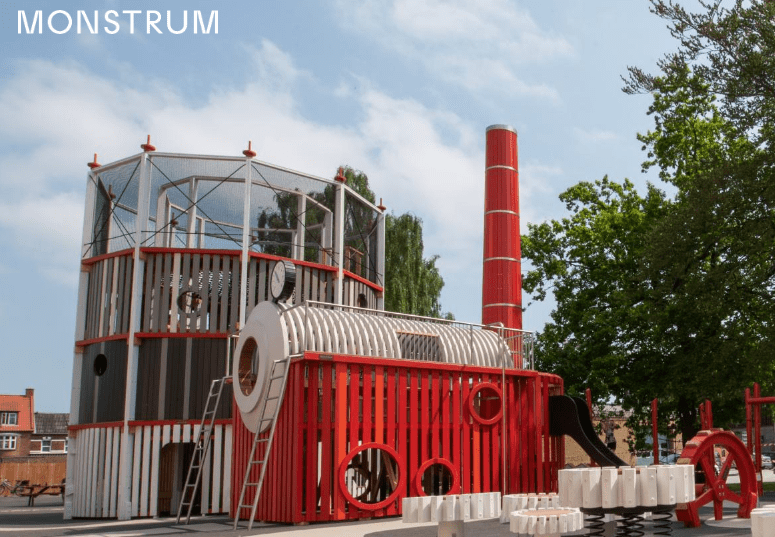
***I want that one!*** (for some of the spare land at the Cambridge Museum of Technology, formerly the sewage pumping station)
Cambridge City Council’s Environment & Community Scrutiny Committee – the one that decides who gets what small cash grants and for what, meets on 16 Jan 2025 at The Guildhall – see the meeting papers here. Anyone can go along, anyone can table a public question (but you need to give them good time to research the answer), and anyone can follow along online. This is the non-party-political end of what local councils do – the focus on neighbourhoods.
One of the things I’ve learnt over the years/decades is how different the community relationships are with local government across class and income spectrums. And beyond that the state. For example if you have a family with school-aged children, own your own home, and send your children to be privately educated, chances are your relationship with your local district level council (assuming you live in a two-tier area) will be noticeably different to a similar family living in a council house with children who go to the nearest school in walking distance.
Austerity has also meant that councils inevitably prioritise spending where the data tells them the need is greatest. In Cambridge’s case, have a look at the map of community centres here, and note the location of the blue balloons indicating the city council-run centres. They are nearly all in areas where there is a critical mass of social housing/council housing. Now compare that with the datamap from Cambridgeshire Insight on poverty and multiple deprivation in Cambridge below.
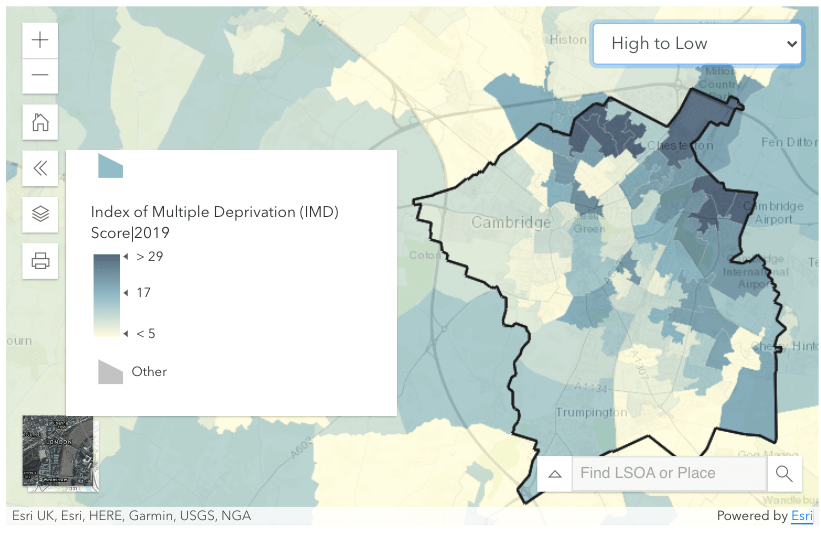
Above – from Cambridgeshire Insight – Index of Multiple Deprivation (2019) the darker the shade the greater the level of deprivation
Hyper-local grants that seldom get publicised
Have a browse through the tables in items 7, 8 and 9 here which cover:
- Community grants
- Sports facilities
- Streets and open spaces
Some of the funding will come from developer contributions which are meant to mitigate for the impact of development – for example the increased number of people living in an area and using community facilities. One of my big concerns with Cambridge’s growth (environmental and ecological issues aside) is that the densification of our city is not being accounted for, nor has the changing economic profile that involves catering for far more visitors and short-stay guests – whether tourists, language school students, or visiting relatives. Given that we now have a population of around 150,000 people within our boundaries last extended in 1935, and with a 50% increase between the late 1980s to today, what are the things we did not need 30 years ago that we could do with not just today, but given the much more clear future projections from ministers?
“Who decides who gets the money, and how?”
The Full Council voted upon the criteria many moons ago which in the grand scheme of things covered poverty alleviation in our chronically unequal city. For community grants coming up, the criteria are listed here. The applicants had to show their proposed activities fell into at least one of the five themes below:
- promote active lifestyles
- arts and culture
- community development
- reduce poverty
- employment support
Interested in coming up with your own idea? Have a watch of the council’s video here. I’ve wondered for years what a playground designed for adults might be like, but I think that’s one for one of the newbuild communities of the future to take on!
Two examples, one past and one a possibility
The first is Coleridge Rec and the big dragon slide (below-left) which is ten years old this year. It was commissioned by the city council on the application of former ward councillor and council leader Lewis Herbert after he had to face a challenge at the ballot box in 2014 from my old Twitter handle Puffles the Dragon Fairy (below-right, who I often brought along to council meetings).


Note the reviews here on the play area installed in the mid-2010s
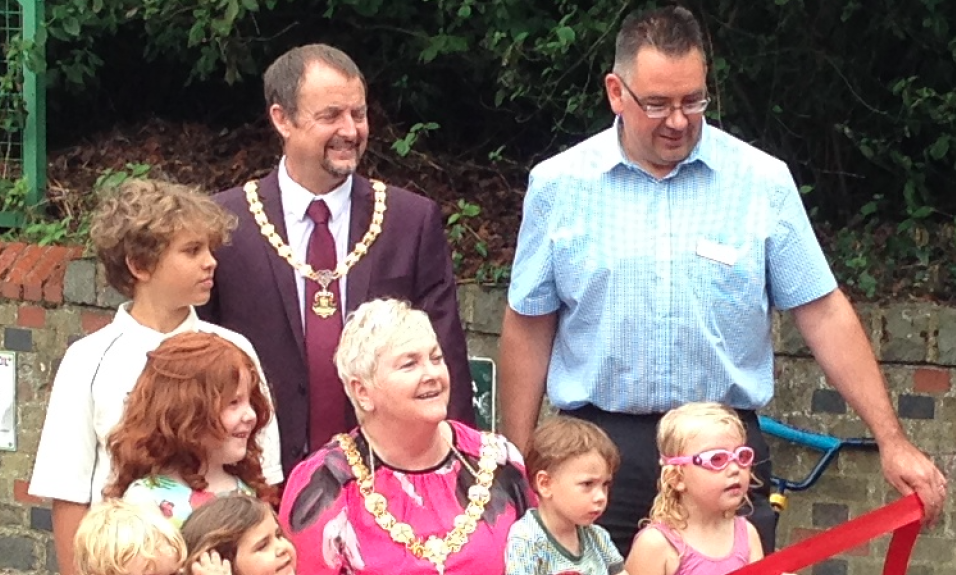
Above – the Mayor of Cambridge for 2014-15 Cllr Gerri Bird (Labour – King’s Hedges) with local children at the opening of the revamped pool and splash pad on 28 July 2014 (It was cold and rainy that day!)
This was part of a much wider and much-needed overhaul of community and playground facilities at Coleridge Rec.
One of the things I hope the city council will do for this summer is to have a summer event on Coleridge Rec both to celebrate the 10 years of the slide and as a means to get more people involved and active in the neighbourhood (which is easier said than done). That means inviting community and activity groups to hold stalls. Historically (compared to other council wards) we’re not a place for big shows that draw the crowds like the Mill Road Winter Fair or the Arbury Carnival. At the same time it could also be somewhere to share information on much bigger things that will affect us – such as the proposals from East-West-Rail which in my view will lead to the long-awaited eastern entrance to Cambridge Railway Station. The flow of passengers will inevitably have an impact (potentially positive for businesses given the passing trade, and the inevitable safety issues with an increase in traffic and cyclists, but these can be managed).
The second is the case study of Horsens Industrimuseum, Horsens, Denmark
…who have kindly explained everything in English here. Also, looking at their IG page here, the similarities with the Cambridge Museum of Technology are striking.
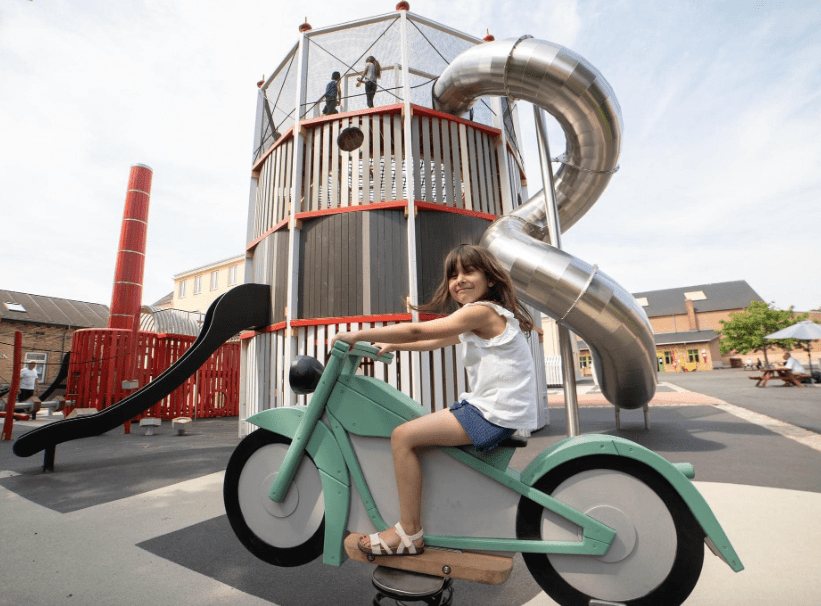
Above – from the Industrimuseet in Horsens, Denmark via their FB Page. Replace the motorcycle with a pedal cycle and you’ve almost got a replica of what the Cambridge site looked like a hundred years ago!
Compare the above image with what Cambridge’s Riverside used to look like:

Above – via Britain from above, the Cambridge Pumping Station with the big chimney in the foreground (now the Cambridge Museum of Technology), the old Cambridge town gas works, and on the other side of the then tree-lined Newmarket Road (at least they made the effort!) the old brickworks. You can explore more of the photos from the area in Britain from above here.
You can read the case study of the Industrimuseet’s overhaul and playground installation here. Given that there are some significant S106 / Community Infrastructure contributions due to come from RailPen for their proposals on Cambridge Retail Park – which they will be presenting their latest iteration to the city council next week (see details here) I think this is something that they and other private sector contributors could help fund. Because when you look at the site of the Museum of Technology (and with the Sea Cadets building next to it), the opportunity and potential to revamp that site, provide much greater community facilities (ones accessible to passing walkers along the Riverside as well as Newmarket Road buses) and thus create a much more sustainable revenue stream for both museum and sea cadets, is huge.
So, who wants to lead on it? (It can’t be me because the role requires the sort of competencies I lack).
If you are interested in the longer term future of Cambridge, and on what happens at the local democracy meetings where decisions are made, feel free to:
- Consider a small donation to help fund my continued research and reporting on local democracy in and around Cambridge.
- Follow me on BSky <- A critical mass of public policy people seem to have moved here (and we could do with more local Cambridge/Cambs people on there!)
- Like my Facebook page
Also, if you live in South Cambridge and are free on Sunday afternoon, have a look at this.

 The Cambridge Town Owl