There are a couple of meetings coming up next week (13th Jan 2025) but with over 170 pages of meeting papers for the one hosted by Cambridgeshire County Council, it can be easy to get lost in the paperwork!
Every time I look at any governance structures that involve politicians I find myself singing the chorus to Avril Lavigne’s breakthrough song Complicated from the early 2000s.
The meetings are:
- Cambridgeshire & Peterborough Health and Wellbeing Board – 17 Jan 2025
- Cambridge University Hospitals NHS Trust Governors – 22 Jan 2025
- Cambridgeshire & Peterborough Foundation Trust (covering mental health) – 27 March 2025
If that all sounds too complicated then you can put your questions and concerns through Healthwatch Cambridgeshire, That said, there’s only so much they can do as the official patients’ watchdog organisation as their lobbying on all things dental services has shown. But then in my humble opinion, anything established by the former MP for South Cambridgeshire and former Health Secretary has had its work cut out from the start.
“The [CUH NHS/Addenbrooke’s] Board of Directors welcome written questions. The deadline for receipt of questions is 12:00 on Monday 20 January 2025.”
Actually, there is a more serious point because these meetings allow the public to have issues responded to by trust chiefs – such as here in 2023 when I asked about hospital funding vs the rising population due to house building. Not surprisingly given the perfect storm of winter infections, rising populations, and 14 years of austerity from central government, the situation on a freezing (literally due to the cold snap) January Friday evening is grim.
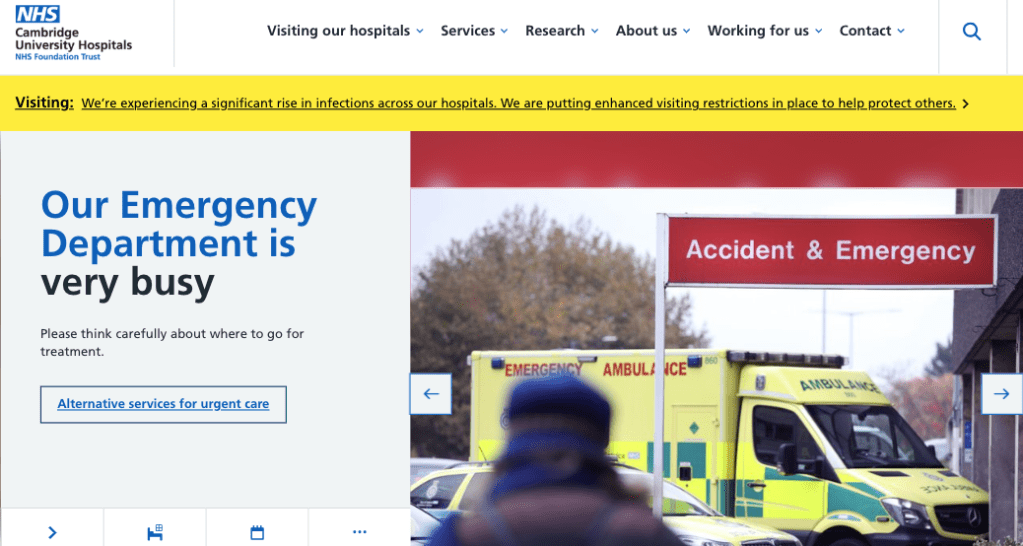
Above – CUH NHS landing page at 5.30pm on 10 Jan 2025
“So ministers, what is the plan to ensure Addenbrooke’s A&E gets the funding it needs from the growth that has already happened and from the wealth you keep telling is Cambridge makes?”
Ministers in the Conservative Government never had an answer to this other than something along the lines of ***Won’t somebody think about the poor rich people?!?!?*** as overcrowding continued to get worse and worse.
“Addenbrooke’s Accident and Emergency deals with 4 times the volume of people it was designed for”
Five weeks ago I went to a meeting with representatives from the Cambridge Biomedical Campus and CUH-NHS and Clare Stoneham from the latter gave us that sobering statistic – see my blogpost here. (That piece also covers wider issues about Cambridge growth vs demand on already over-stretched public services and our environment)
The challenges of Cambridgeshire’s population growth is also picked up in the health and wellbeing board’s papers.
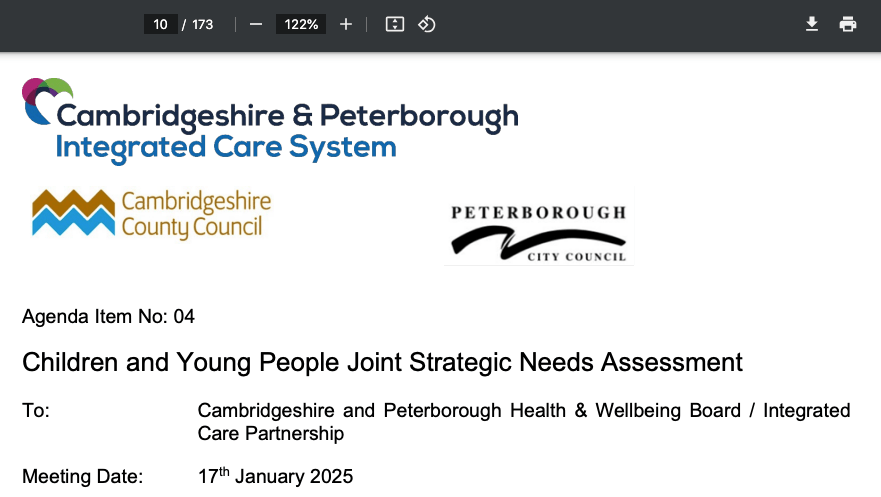
Above – see the Documents Pack in the meeting papers and scroll to page 10
The other major item which is too overwhelming for my brain to process at the moment is their assessment of how the CUH NHS Trust manages/supports patients after they have been discharged from hospital to go back home. AKA ‘Pathway 1’
Above – CUH NHS Documents Pack from p57 onwards
The thing is, when it comes to scrutinising things like this you cannot simply jump in at the deep end (even as a patient) and expect to make sense of this. Yet what we don’t have – and what I think we should have as part of our adult education/lifelong learning programme funded by the Combined Authority are a series of evening classes and courses that are all about educating society about public services and democratic oversight. It does not need to go into in-depth political theory or party political debate, rather that:
- In our city/county/CPCA area there are these different institutions that provide public services
- This is how they relate to/sit within your community
- They are funded by the taxpayer and this is how the funding flows from taxpayer to service provider
- These are the terms under which the funding is paid, and these are the reporting requirements
- This is how they have been performing over the past decade or so
Again, it’s not something that can be done in a single workshop or session. It’s something that has to build up over time. What we should be aiming to provide for a very high/light level series should be just enough for members of the public to know who is responsible for what, and to be able to make an informed choice about which, if any public service they may want to get involved in both supporting (eg volunteering and fundraising) and scrutinising (reading the meeting papers, crunching some of the numbers, turning up to public events and asking informed questions).
Note that public services would collapse without the hundreds if not thousands of volunteers that already do this sort of unpaid work out of the glare of the media. In the case of Addenbrooke’s volunteers have been doing this work for over two centuries – here’s something from nearly 250 years ago for your reading pleasure. Noting that Addenbrooke’s history pre-dates the NHS, and had its own funding crisis during the Great Depression.

Above – Lost Cambridge 13 Feb 2024 on the collapse of subscriptions to Addenbrooke’s in the 1930s
My point here is that getting involved in supporting our public services isn’t just for the present, it’s also about continuing a very long tradition and ensuring that we’ve got something sound to hand over to future generations. It’s also a reminder of our under-appreciated local history and those forgotten heroes who kept things going in previous eras. For anyone wanting to have a look back into 1960s Cambridge, Cllr Iris Owen is a useful person to start with.
If you are interested in the longer term future of Cambridge, and on what happens at the local democracy meetings where decisions are made, feel free to:
- Follow me on BSky <- A critical mass of public policy people seem to have moved here (and we could do with more local Cambridge/Cambs people on there!)
- Like my Facebook page
- Consider a small donation to help fund my continued research and reporting on local democracy in and around Cambridge.

 The Cambridge Town Owl