
The Combined Authority has published its papers for their Skills and Employment Committee – and it has lots to say on adult skills.
You can read the papers here – the committee also welcomes public questions (you can email them over via here, and an officer will read out your question on your behalf)
This clearly interests me because being on Universal Credit and being unable to work full-time due to chronic ill-health, having learning opportunities within close travelling distance from where I live (with my parents!) would make a huge difference to me. The problem is that past and existing policies have not worked for me. And listing to others around me over the years, they haven’t worked for enough of them either.
“Where is the holistic approach to adult education and lifelong learning that research recommends?”
I wrote an in-depth blogpost on this back in 2022 here which covered things like citizenship education (even more important given the threats to democracy – and the need for media literacy). Furthermore, the Combined Authority itself noted:
“We will expect all providers to capture the wider outcomes of learning, such as mental
health and wellbeing, in-work progression, confidence and self-esteem and community
connection.”
Plant and Ravenhall (March 2024) to CPCA, p5
Asking public questions
As it’s one question per person per meeting (and with good reason), the multiple issues that I raise in blogposts like this don’t get raised beyond *unless* more of the public email over their questions. And they don’t have to be on issues that I’ve written about. It could be on something completely different. Late last year a couple of committee chairpeople said they wanted more people to send in public questions. Not frivolous ones, but ones informed by what they had read and based on their experiences of using the public services concerned. Again, for the Combined Authority you can email them via here, ***or*** you can get in touch with any of your local councillors via https://www.writetothem.com/ (you only need your postcode) and ask them to make representations on your behalf as a constituent. It’s what local councillors are elected to do. (And if you are a local councillor, feel free to invite constituents to be part of the solutions to the challenges that they bring to you – Stella Creasy MP in Walthamstow has done this to great effect in her constituency. It was through her that I found out about Active Bystander Training which encourages people to be more confident in intervening in public when things seem to be kicking off).
Vocational skills, adult education, and lifelong learning – what’s the difference?
This brings me back to the headline and my persistent criticism of the Combined Authority’s approach to all things learning and educational for adults once they are out of full-time education. Furthermore, the problems Cambridgeshire and Peterborough have had with skills shortages are persistent and chronic. To compound this, we can state that previous policy attempts to resolve those skills shortages have failed. Otherwise Cambridgeshire employers would not still be complaining about them.
“How long have we had the shortages for?”
“Cambridgeshire has a diverse and dynamic economy. It has a strong global profile and it is also functioning as a hub of the economy in the East of England…Within the labour market, skill shortages are becoming an increasing impediment to realising investment in the area, particularly in construction, health, education and other public services. In addition, there remain large numbers of the population locked into low paid employment often involving long hours of shift work with little prospect of career progression or personal improvement.”
Cambridgeshire’s Local Area Agreement 2006-2009, p52
That was signed off a generation ago. In that time, babies born when it was signed off are now adults.
- Why do we still have major skills shortages?
- Why do we still have large numbers of people locked into low paid employment?
This is where policy-makers need to go back through their policy area’s history (a growing area of academic research, something that should really be incorporated into Cambridgeshire & Peterborough Insight‘s briefings for councillors & decision-makers). For example back in November 2009 Cambridge City Council’s Equalities Panel received a paper about migrant workers in our city and found that a number of them were working in jobs that they were over-qualified for, even though their qualifications were in fields that our city had skills shortages in. How are we doing just over 15 years later?
One exercise the Combined Authority can ask its younger policy staff (especially new graduates) to undertake is to produce a briefing paper – not more than four sides of A4, providing a local policy history of their policy portfolio covering the last quarter of a century:
- What is the current situation?
- What top three statistics reflect/illustrate this situation?
- What was the situation in this local policy area 25 years ago?
- What decisions were taken and by whom that resulted us getting from where we were around the Millennium to where we are today?
Some of those decisions will be related to things like population growth. Have a look at the historical data for Cambridge here. In 2001 the census said our city had a population of just under 110,000. Fast forward to 2021 and that figure shot up by a town the size of Haverhill to over 145,000 – yet remaining within the same geographical boundaries. (Reflecting an intensification in population density in a number of neighbourhoods – which ones?)
The narrow skills focus vs wider outcomes mentioned in previous documents
This is something that the Mayoral Candidates should proactively address in the run up to the Mayoral elections in May 2025 – so less than five months away. Given that there’s likely to be a hustings in Cambridge which I’ll probably rock up to and film, I intend to ask questions about this so I hope that gives them enough notice!
The Adult Skills Fund and the Adult Skills Commissioning Strategy – the latter being the title of the agenda item at item 10 indicates the parameters and boundaries of that area of work. It won’t cover the wider things like lifelong learning for:
- Civics – engaging in democratic and public life in city and county (for example how to get involved in scrutinising and supporting local health and social care service provision)
- Sustaining voluntary and community services – and the skills and competencies needed to do this (and how to acquire them eg through the CCVS here)
- Public and personal health – take this handbook from 1968 produced by Harold Wilson’s Government, and ask where the community equivalent of learning about the issues listed is today – mindful that the gaps in people’s education (eg due to Section 28) need to be covered too
- Learning about new technologies that for older generations were not around when they/we were at school
Politicians need to get tough with employers – in particular those sectors that regularly complain about skills shortages
“The amount employers are spending on training their workers has dropped by almost a fifth in the last decade, according to research from the New Economics Foundation (NEF) published [on 19 March 2024]”
New Economics Foundation 19 March 2024
In Cambridge’s case it’s not simply getting ministers to say: “Cough up or we’ll tax you” – the malaise is even deeper than that – as reflected by the property consultancies that poach town planners from hard-pressed underfunded town planning teams in local government. Which is why when that service becomes cost-recovering, some of that additional revenue should go to the County Council to cover the costs of the research services and facilities that property professionals use in their research.
As Mayor Dr Nik Johnson knows, I’ve been making noise about the lack of a lifelong learning centre for adults in Cambridge for years. Yet there’s nothing in the papers that shows how the Combined Authority is going to put pressure on the sci-tech parks to contribute both land and funding for new lifelong learning facilities. (I was particularly scathing about the Cambridge Biomedical Campus here).
Getting potential learners to the stage where they are both capable and willing to engage with skills programmes
Is the starting point for these policies one from a ministerial office, or is it from where the people are? (In particular the cohorts that need the greatest levels of support?)
- What assumptions have policy-makers and politicians made about the lives and lifestyles of those they want to help? (Who have they missed out?)
- What regular and routine actions does the CPCA undertake to listen to the experiences of those it is seeking to help? (And how is that feedback then analysed and processed by policy teams to improve the policies?)
- What are the things that are outside of the remit of the CPCA, but fall within the remit of other public sector providers or external organisations that are important to achieving the targets of the policy?
Think also of the ‘pen pictures’ of the types of people in the target cohorts. Cambridge Ahead’s City of Quarters Report written by their Young Advisers’ Committee tried to do this on the housing challenges younger adults [not just high-flying sci-tech graduates] face in Cambridge. They identified four broad tribes:
- Worker Bee — Rajan is a recent graduate and has moved to Cambridge to start a new job.
- Space Cadet — Lorna has been in Cambridge for a while, and is starting to commit to staying longer term.
- Cambridge Cog — Heidi has been working in Cambridge for a few years as a healthcare worker
- Limbo Lander — Simon grew up in Cambridge and wants to base his future here.
Above – Cambridge – A City of Quarters (2023) p41 by Cambridge Ahead – see also my blogpost on the report here.
I don’t get the sense from the CPCA’s report that they have much of an idea of who their target cohorts are, let alone the lifestyles that they live of the barriers that they face. That’s not to say this isn’t solveable. Their colleagues in the County Council showed them how to deal with some of their challenges in the Closer to Communities pilots, the reports of which will be discussed on 16 Jan 2025. (See Item 5 of the Communities and Social Mobility Committee meeting papers here)
That wider outcomes thing again
Leisure, arts, and music are all conspicuous by their absence in the paper. Yet when you put all of these together with research on things like loneliness and mental health, a more clearer picture begins to emerge. If we take the findings on loneliness from the English Housing Survey 2023/24 we can see we have a challenge.
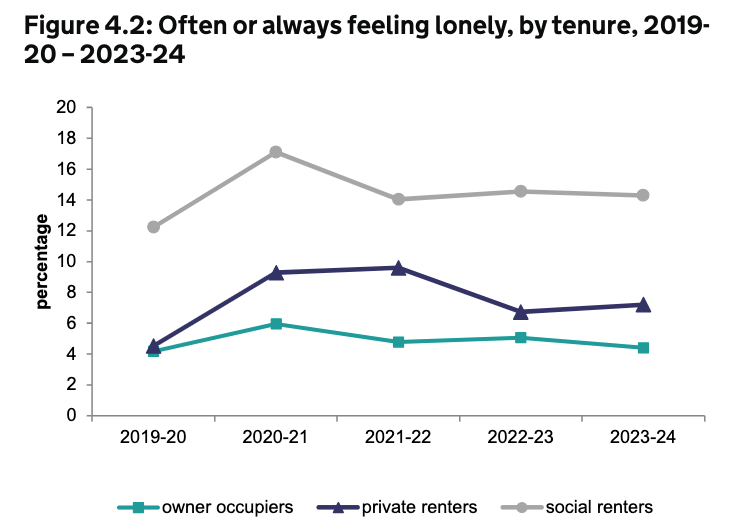
I’d want to know to what extent are those figures reflected across localities within the region. (For example the rural/urban split, the correlation of things like public transport services to levels of crime, to turnover of housing tenure, to residential and citizenship status, to level of educational attainment, for example).
If institutions have too narrow-a-focus on skills for employment, they risk missing the underlying and core needs of individuals they want to help. The risk is that they try to push people into work that they are either ill-disposed towards, and push reluctant employers to take on people who in their eyes might be little more than trouble. Under the previous government’s punitive sanctions regime no one ends up winning because by docking people’s benefits it makes the lives of many of those low incomes even harder. Furthermore, the enforcement regimes themselves cost money to administer. The reality instead may be that those who such skills programmes aim to support need different sorts of help – for example to deal with physical and mental health issues, to deal with loneliness, to deal with insecure accommodation and the symptoms that such instability brings. (Having experienced it during my student days, living in insecure/substandard accommodation absolutely wrecks your diet – with the knock on impact on your health. Housing matters. Really.)
Looking further on community cohesion, sports, arts, and leisure, one thing in Cambridge that I’ve noticed is the huge growth in singing groups – which I wrote about here. What we don’t have in Cambridge is an orchestra / music club for adults who are complete beginners, such as the East London Late Starters’ Orchestra. And yet arts, music, and leisure courses used to be an integral part of the offer in adult education in Cambridge with the predecessor institutions of Cambridge Regional College. See Lost Cambridge here on the old Young Street Centre, and also the founding of CRC here.
The one issue I noticed with Cambridge’s community singing groups is diversity – or lack of. In particular with age ranges. Having been algorithm-bombed on social media because of the blogposts I’ve put out. it’s hard to ignore the publicity or show videos where most of the participants have visibly grey hair. Where are the young adults?
The question that policy-makers should be asking when it comes to future consultations is: “Who is conspicuous by their absence?” in the responses. Who in our city and county should be represented but is not? For example the regular lack of responses from people aged 18-24 is hard to ignore, yet time and again we use the same consultation processes, wring our hands about how depressing it is that young people haven’t responded, and repeat the same processes.
If there’s one thing that the restructure of local government provides us with an opportunity for, it’s overhauling existing failing routine systems and processes and bringing in new things at the start.
Food for thought?
If you are interested in the longer term future of Cambridge, and on what happens at the local democracy meetings where decisions are made, feel free to:
Follow me on BSky <- A critical mass of public policy people seem to have moved here (and we could do with more local Cambridge/Cambs people on there!)
Consider a small donation to help fund my continued research and reporting on local democracy in and around Cambridge.

 The Cambridge Town Owl