The Society of Local Council Clerks (or SLCC – because everyone’s an acronym these days) has a number of interesting looking courses on their books. Just don’t expect anyone to be interested when they find out the fees
I’m picking on the SLCC as a case study to illustrate the wider malaise in lifelong learning for the collective good. The criticisms I’m making of the SLCC could easily be made about any other trade association, professional body, or institution that has high financial barriers to learning about things that really should be made available to much wider audiences.
This isn’t about compulsory courses, mandatory exams, and requiring an institution to vouch for your existence – as that has the feel of inventing a course in response to any problem someone identifies.
“What’s the course?”
It is: “The Level 4 Certificate of Higher Education in Community Governance”
…and the blurb says it “…is a professional qualification, available to all local council staff, councillors and county officers, and builds on the knowledge gained in the Certificate in Local Council Administration”
It is the equivalent of a first year at university, and the topics covered include:
- Community Governance
- Local Council Finance
- Community-led Planning or The Planning System
- Organisational Governance
- Local Council Law and Procedures
- Building Communities
- Managing People or Managing Projects
…which if you’re an up-and-coming local government officer who did not go to university (or even if you did and are unfamiliar with the above), seem like useful things to know about. And not just staff inside, but individuals active within their communities too.
The detail of the modules that go on to cover three equivalent years at university are shown here – De Montford University being the accrediting institution for the qualifications. Some of the modules are the sort that local government and politics nerds like me could have great fun with – such as the level 6 topic: Power and Politics in Community Governance. Can you imagine the fun and games you could have with that if you researched and wrote about that in the context of Cambridge vs Cambridgeshire vs Westminster over the past couple of decades?
“Examine the intricate political context that has an impact on local community governance and questions the effectiveness of the UK’s representative democracy at all levels. Focus on the complex and varied relationships between different tiers of government. Explore the tensions between a centralist government and localism and between confrontational party politics, consensus and coalition.”
Above – SLCC (2024/25) p3
If you want something even more complicated you can look at the post-graduate sections on p4 in the above-link. It has all the buzz phrases such as ‘Empowering Change’, or ‘Collaborative Innovation’, and ‘Designing Public Services’, but there’s something about those titles that doesn’t sit easily with me.
At the other end of the scale are the level 3 online learning courses that are much more affordable (£120+VAT) but which inevitably go into a level of basic detail that is unlikely to be of interest to those not working in local government. The same goes for the various corporate workshops such as those offered by the LGIU here. Understandably they are put together for officers that can bring their own experiences and working examples to such training sessions to work through them with an expert. Early on in my civil service career I went to one such event on the soon-to-be-implemented Freedom of Information Act and how it interacted with the Data Protection Act (this was in the mid-2000s), and the barrister who led the workshop provided much-needed clarity on a whole host of things I had been struggling with.
Trying to work out which are the bits that will be useful for:
- the general public
- for community activists
- for people interested in working in local government or
- going into politics
While there’ll be significant overlap, they won’t be identical.
“Don’t MOOCs work?”
“Massive Online Open Courses” – the only one that seems vaguely relevant is the University of Birmingham’s one on Transforming Citizen Participation. The problem is that what’s happening with social media firms is evolving ever so rapidly that the world that even though the course was first launched in late 2021 (as the Internet Archive tells us here), we are now in a world where just over three years later the two main platforms (what was Twitter and Facebook) feel all-but-unusable today in an era of gamed algorithms and paid-for posting. (Which in itself involves transferring marketing spending from local newspapers to foreign-domiciled multinational corporations).
Courses hosted by non-English universities on local government (what few there are) don’t cross-over easily given the unique and complicated systems and structures that English local government has. One that looks crazy to people familiar with constitutionally-protected tiers of local government that prevent national government from interfering. In a nutshell, you either have a codified written constitution that protects the different tiers of the state, and one that’s enforced by a constitutional court, or you have what we have in the UK, which is a Sovereign Parliament that can legislate on whatever it likes whenever it likes. Modern local government in England was established by Parliament (hence the centenary celebration publication in 1935 of the Municipal Corporations Act 1835 here).
“So…where do we start?”
Start small. Which is what I did earlier today at our first informal gathering at Stir Cafe’s new venue at the Old Swiss on Cherry Hinton Road in the middle of a very cold snap where I’m not sure the temperature got above freezing today. So there were only three of us out of the five who signed up. Yet it was still really useful to be cross-examined on the basics what was going on and where. Which is why I’ve scheduled the next one at the same place at the same time in 2 weeks time on Sunday 26 Jan at 2.30pm.
Being in Coleridge ward the three of us spent much of the time looking at this detail from East West Rail which I wrote about here. Below the railway line in the image is pretty much all included in Coleridge ward, Cambridge.
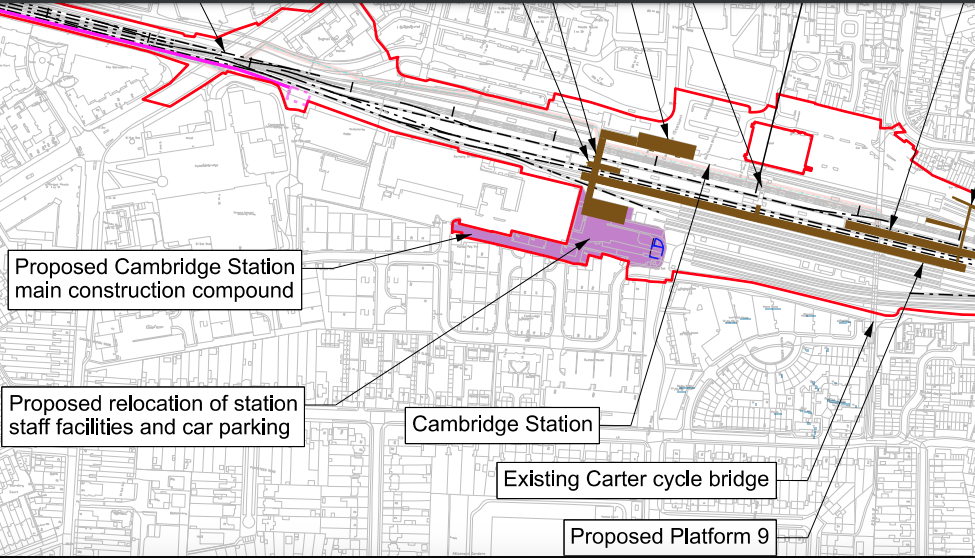
Above – p1 of the Cambridge Station section
The rest of the time we spent looking at an old map of Cambridgeshire proposals from 1945 that were abandoned.
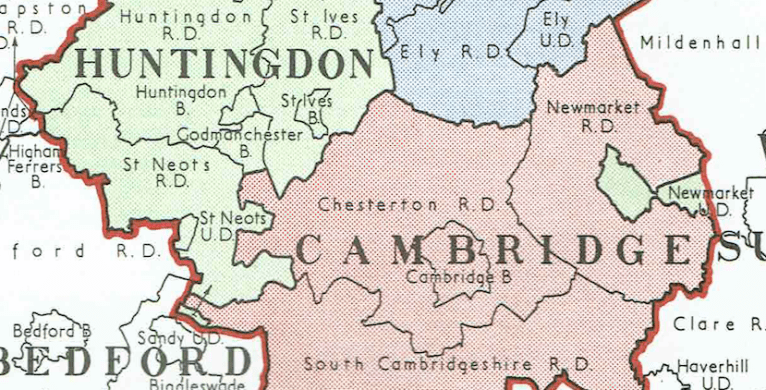
Above – from the History of Local Government for Cambridge in maps 1835-1958
Will they resolve the Newmarket issue and bring in the market towns over the county boundary but inside the ‘Cambridge Travel To Work Area’ into a unitary authority or the Combined Authority?
Local Government paralysis in the face of huge changes from the Ministers
At the moment it feels like ministers, their senior advisers, and the lobbyists have not gotten beyond principles and concepts. The principle that Cambridge must expand is one that comes from the previous government and has been continued by the current one. The only political party that seems to be questioning the dash for growth is The Green Party. This matters for Cambridge because they already have five city councillors at The Guildhall and I predict they will win at least two at New Shire Hall in the county council elections in May 2025 – which is less than five months away.
The problem is that we still don’t know what central government’s definition of Cambridge is as far as their policies are concerned. So all of the surrounding villages within say a ten mile radius cannot be sure how they are going to be affected. That makes it even harder for those rural areas – and the parish councils that represent them, to know how to make representations. Furthermore, given the mess that local governance structures are currently in, and given the controversial record of the Greater Cambridge Partnership, there’s understandable sympathy for switching to a ‘single council for everything’ while concerns remain about decisions being taken remote institutions without significant local-level representation. Which is also why ministers need to make a decision about the role of town and parish-level councils – the level that the SLCC represents. All the more important given that Cambridge is not ‘parished’ but may well need to be under a unitary system (I had a look at this here).
Which is why the list of dissertations researched and written by SLCC candidates here makes for interesting browsing.
The ones that stood out for me include:
- The Impact of Unitary Authority Creation on Town and Parish Councils, Adam Keppel-Green FSLCC
- Is there a need to improve relationships between local councils and the local businesses they represent? David Mears FSLCC
- Should the whole of England be parished? Ruth Mullett
- An examination of youth councils as a tool for engaging with young people in a representative democracy Julie Shirley PSLCC, 2023
- The purpose of local councils in England. Sheridan Jacklin-Edward FSLCC, 2022
Not that I’m expecting lots of people to start printing and reading off all of the above, but one of the topics that came up earlier was the need to have some sort of gathering in a venue that enabled people to look at a series of display boards and have conversations with people knowledgeable about each different issue and topic covered. Again bringing up the concept of having multiple shared conversations in the same place rather than the one-to-many ‘death by electronic illustrated-and-or-text-based-slides‘ type events.
Know any groups or societies willing to put something together?
If you are interested in the longer term future of Cambridge, and on what happens at the local democracy meetings where decisions are made, feel free to:
- Follow me on BSky <- A critical mass of public policy people seem to have moved here (and we could do with more local Cambridge/Cambs people on there!)
- Like my Facebook page
- Consider a small donation to help fund my continued research and reporting on local democracy in and around Cambridge.

 The Cambridge Town Owl