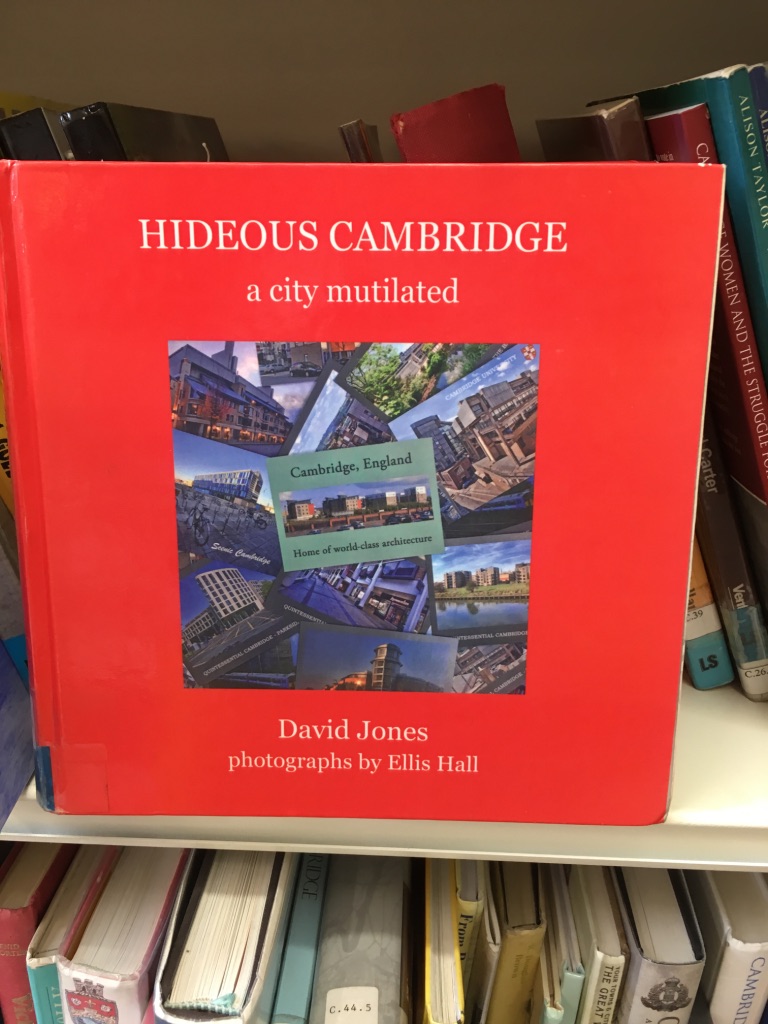
Pictured: Hideous Cambridge by Jones and Hall. Please can we avoid past mistakes?
I found out about it less than 24 hours before it was due to start, so booked a place and rocked up to see what it was all about.
Actually, I had to spend the whole event metaphorically ‘masking’ ADHD symptoms and minor chest/stent pains because the previous few days had been pretty full on with various document releases warranting multiple blog posts not least because otherwise they get missed out in this era where local news budgets and staff continue to be culled. Hence:
- On the Beehive Centre’s looming planning committee determination
- City councillor comments on East West Rail, and on our city’s annual housing completion statistics – the meeting livestream only having 20 views
- Numbercrunching Addenbrooke’s historical data on number of hospital beds noting it has not kept pace with population growth
That was followed by RailPEN’s first presentation of what they want to do with Cambridge Retail Park – which I’ll save for a separate blogpost as that is significant in itself.
Before I kick off, links to three things:
- I spend most time on Bluesky here, rarely using Birdsite
- I’m cross-posting to LI here which seems to have a very different audience to those of us bouncing off microblogging sites
- Thank you for your continued support – and if you can afford to drop a few pennies to cover things from daily cups of coffee through to books, to equipment repair, please feel free to do so
“First post-event impressions?”
The event would have worked well in front of an audience of local councillors, residents, community activists, and also teenagers and students either interested in the future of their city and/or working on extended projects. Not least because there were a host of misunderstandings about the planning system that could be cleared up by the guest speakers. At the same time the format would have needed to have been different. This was a traditional professional conference of expert guest speakers speaking to a room where more than a few people were taking copious notes from the speeches of the speakers (noting that such events can come with CPD accreditation – but you have to provide evidence). An event with a more diverse audience and broader aims would need to be more informal and have more breakout sessions/group conversations.
I didn’t get the sense that this was a room full of local people – rather it reflected one of the persistent problems with developers and the consultants they hire: Too many of them are based far outside of the area to the extent their knowledge of the issues and how they relate to their expert field is inevitably limited.
A couple of the delegates pulled me up on this point – saying that there’s a big risk that the consultants selected by Peter Freeman and team to work on the Cambridge Development Corporation and workstreams will in the main have little day-to-day experience of living and working in Cambridge, rather they will be experts in their field charged with applying that expertise but in the absence of knowledge of the local history and past attempts to do what the Minister for Housing Mr Pennycook has stated is Government Policy. Which is why anyone wanting to have a crash course in how Cambridge got to here from a planning perspective needs to familiarise themselves with:
- The Cambridgeshire Regional Plan 1934 (Davidge)
- The Cambridge Development Plan 1950 (Holford & Wright)
- The Cambridge Subregional Plan 1974 Part 1 (Parry Lewis)
- The Cambridgeshire & Peterborough Structure Plan 2001-03
- The East of England Plan 2010

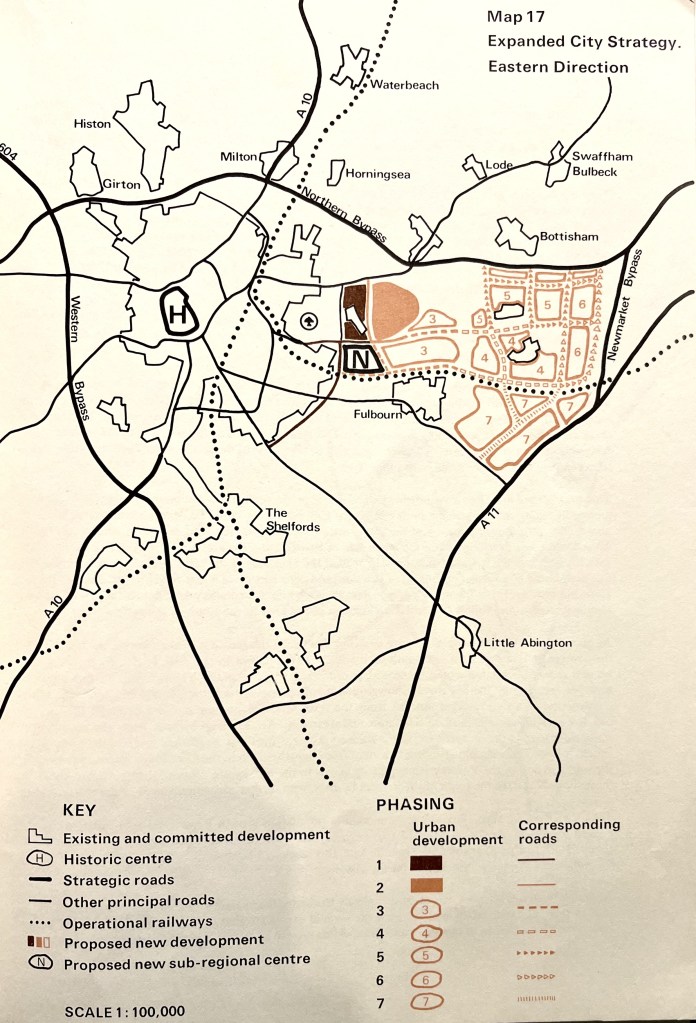
Above – proposals from John Parry Lewis from the mid-1970s to double the size of Cambridge by the Millennium – the plans being thrown out by Conservative-led councils despite support from Labour.
Note that The Minister instructed Mr Freeman to consider the expansion of Cambridge’s urban footprint in at least one direction. That means westward for the University of Cambridge – continuing the direction of expansion first set out in Holford and Wright in 1950, and either southwards or eastwards for the residential side, noting that the geographical assessments from that and previous eras (including Davidge in 1934) spotted a lot of the significant barriers to development (eg floodplains) which help make the case for the land being used for other purposes.
“What did Peter Freeman have to say?”
You’ll have to ask Wendy Blythe of the Federation of Cambridge’s Residents’ Associations as she was able to collar him and ensure that he was aware of the significant concerns that residents had – a cohort who seem to have been missing in the groups he has met with. (I was able to give him a copy of Hideous Cambridge by Hall and Jones) I hope she was able to persuade him to speak at a future event where he and his advisers can hear the concerns of residents, and then put those challenges to the developers.
“Is this the NIMBY/YIMBY thing?”
No. It’s actually far more complex and nuanced than that. At the same time, The Cambridge Green Party polled nearly 7,000 votes in Cambridge at the General Election 2024, the highest in the constituency’s history, but also a total that was exceeded by 30 other constituencies across the country, reflecting the public’s concern about the climate emergency.
The town planning profession cannot treat environmental concerns as something ‘to be crushed’ because when senior public officials try to impose things through compliant politicians without the consent of the people, the backlash can be furious as Cambridge found out the hard way 18 months ago with the now abandoned road user charging. And the root cause of that was the over-complicated governance structures that never carried democratic legitimacy with a poorly-informed public. The result sadly was the toxification of local politics resulting in far too many talented people who otherwise had nothing to do with the proposals resigning from their council seats in the face of a torrent of abuse. And it’s not like the town planning profession has not had its own problems either – local authority town planners also finding themselves at the sharp end.
“How can Mr Freeman minimise the risk of a repeat of the congestion charging furore?”
Publicity and transparency embedded in how his operation functions. That means fewer private/off the record meetings with well-connected politicians and lobbyists, and more events that are open and accessible to the public that involve the big interests concerned being subjected to scrutiny and cross-examination by the general public which will have to live with the results of whatever ministers sign off.
“Doesn’t that risk setting up property professionals as punch-bags/shock absorbers?”
If done particularly badly, yes. Which is why half the challenge is educating the general public beforehand so they are not thrown in at the deep end facing a wall full of boards that make no sense to anyone.
Town planning conspicuous by its absence in politics and citizenship courses
I moaned about it in this blogpost. Furthermore, I also asked what a children’s book on town planning might look like in this blogpost. Only I cannot find any in either Heffers or Waterstones in Cambridge. (Or online either). Challenge for town planners and the RTPI: Please can you write/commission a town planning book aimed at late primary/early secondary school age audience – similar to Usborne Beginners Politics here. Because if the publishers there can commission highly regarded introduction books on politics, economics, philosophy, and climate change, then somewhere within the town planning community there are the people with the means, motivation, and resources to add to that series.
A case study of where planning in Cambridge is going very badly wrong
Prior to the conference, I sat in on RailPEN’s presentation of their emerging proposals for the Cambridge Retail Park, which is on the north-western side of Coldham’s lane and opposite it’s now looming application for the Beehive Centre Redevelopment.
Collectively, town and transport planners, the developer and their consultants, and the politicians have failed to incorporate a rail-based solution to the huge transport problem that the development will create.
“Over 5,000 new jobs, with 2,130 entry-level to mid-level jobs that will require no specialist qualification and would provide on the job training”
The Beehive Centre Consultation site
Cambridge’s labour market cannot provide 3,000+ new graduate level and beyond workers for that single site – mindful that there are so many other new and expanding sites such as The Grafton Centre, the Biomedical Campus, Cherry Hinton Innovation, Fulbourn’s Capital Park, to name but a few. Therefore the workers will have to be shuttled in somehow. For whatever reason, RailPEN were not proactive in working with Network Rail to get a new suburban or light rail station around Coldham’s Lane Bridge which would have alleviated so many problems.

Hence my objection to the redevelopment of both The Beehive Centre and probably the Retail Park on the right hand side of the railway line (on both sides of the road bridge) because as things stand, RailPEN want to build two new multi-storey car parks on the retail park side to serve ASDA (which will move) and some of the other shops. Even though it will take several years to build them in the face of ministers confirming that new fossil-fuelled cars will be banned from sale from 2035. Ten years time.
“What are the transport solutions?”
I asked Mr Freeman to ensure his team meets with:
…to ensure the options for electrified rail-based solutions are properly scoped and considered.
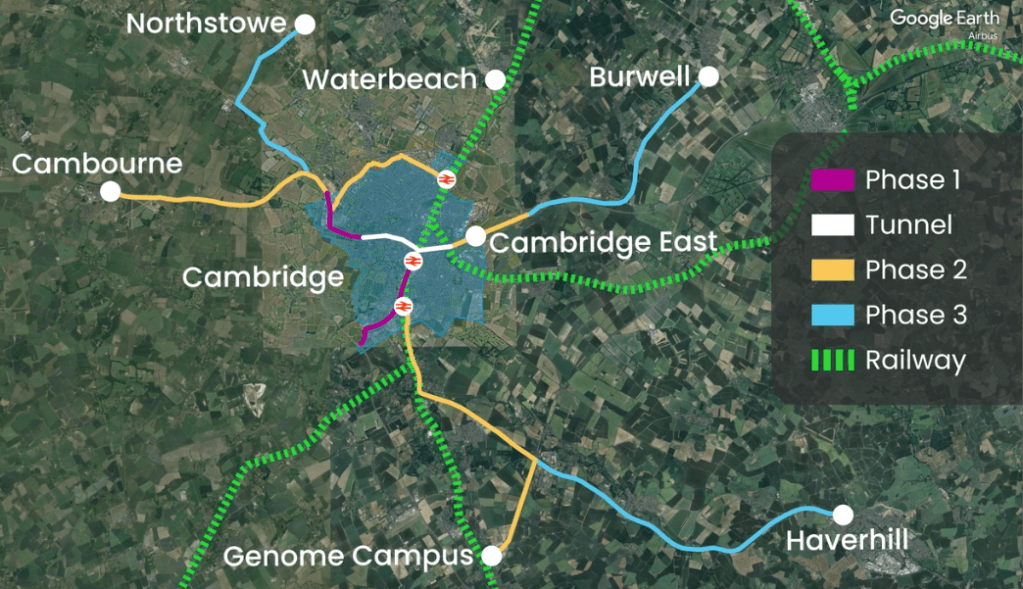
Above – Cambridge Connect Light Rail latest iteration: ***I want this one please! ***
As I mentioned in my inevitably garbled PQ in the Q&A session, I’m concerned that the historical knowledge of the city in a town planning context is limited within decision-making circles. After 15 years of austerity, the corporate memory of local councils and local institutions is no longer there. How will he mitigate for this?
And finally….
Mr Freeman in response to me reading out a short list of amenities that Cambridgeshire Horizons listed in their report of nearly 20 years ago, said councils should submit their ‘wish list’ of amenities that an expanded city will need in order to function.

Above – from Cambridgeshire Horizons (undated) – note the University of Cambridge should have built that swimming pool but chose not to. We’re still waiting for the Cambridge Sports Lakes too.
The risk is that we get the site-by-site amenities but not the ones needed to serve not just the city but the wider region.
“In short, expanding the Campus may well benefit UK plc, but what’s in it for nearby communities is less clear – proposed fitness classes and street food don’t really cut the mustard.” – Jervis
Above – John Jervis to RIBA which I had a look at here
My preference in terms of ‘next steps’ is to see Mr Freeman and team convening public events where the property interests and financial interests come face-to-face with the people of the city who have concerns that they want to raise. Best to get these up front early on in the process rather than when much of the work has been done.
If you are interested in the longer term future of Cambridge, and on what happens at the local democracy meetings where decisions are made, feel free to:
- Follow me on BSky <- A critical mass of public policy people seem to have moved here (and we could do with more local Cambridge/Cambs people on there!)
- Like my Facebook page
- Consider a small donation to help fund my continued research and reporting on local democracy in and around Cambridge.

 The Cambridge Town Owl