The announcement comes a few days after senior figures published a joint letter about Cambridge Growth in the Cambridge Independent
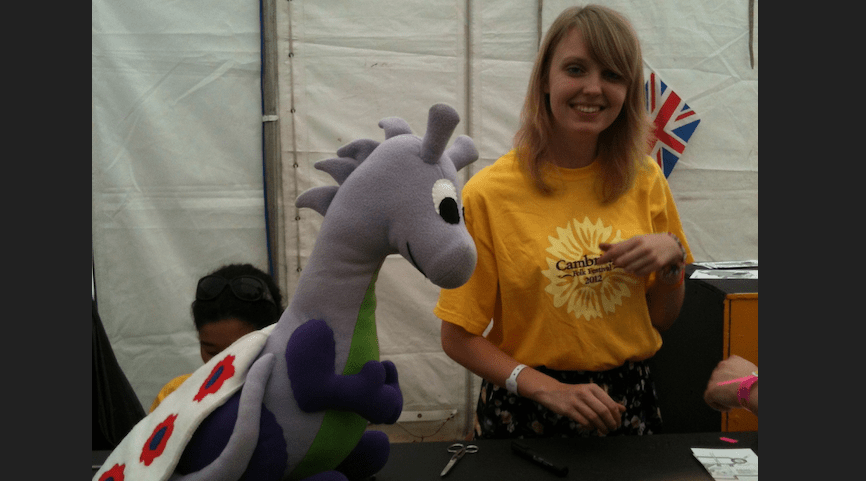
Pictured: Puffles the dragon fairy with a folk festival volunteer at the 2012 festival. In 2016 I filmed this short walk-through vlogpost.
On my LostCambridge blog I wrote this about the history of the festival with some video links to past ones. One of the videos includes an interview with the co-founder of the Festival Ken Woollard.
Fast forward to 2025 and you can read the Cambridge Folk Festival’s announcement here. See also coverage in:
This is on the back of the loss of the annual free Big Weekend Festival which was scrapped due to dwindling council finances combined with the refusal of those making their wealth in Cambridge to get together and re-invest their gains back into the city that they made them in. Put it this way, appeals by local government for sponsors have not found any firms or individuals willing to step up. What price civic culture? Furthermore it comes a month after the news that the 2025 Strawberry Fair – another large free arts and music festival in Cambridge was cancelled.
This inevitably gets the likes of me saying that the system of local taxation should be reformed so that councils no longer have to rely on charity and goodwill from those with the wealth who are unwilling to share it. The reality remains that those changes have to be made by central government and Parliament. This is not something the UK’s political system empowers local councils to do independently.
“What did the letter to the Government say?”
It was published in this week’s Cambridge Independent, but you can read the text and the signatories here on Cambridge City Council’s website. The list of institutions and their representatives who signed it are:
- Anglia Ruskin University, Prof Roderick Watkins, Vice Chancellor
- Babraham Research Campus, Derek Jones, Chief Executive; Jo Parfrey, Chair
- Cambridge Ahead, Dan Thorp, Chief Executive; Harriet Fear, Chair
- Cambridge Biomedical Campus Ltd, Dr Kristin-Anne Rutter, Executive Director; Laurel Powers-Freeling, Chair
- Cambridgeshire and Peterborough Combined Authority, Dr Nik Johnson, Mayor
- Cambridge City Council, Cllr Mike Davey, Leader of the Council
- South Cambridgeshire District Council, Cllr Bridget Smith, Leader of the Council
- Cambridge Innovation Capital, Dr Andrew Williamson, Managing Partner; Dr Edward Benthall, Chair
- Create Cambridge/Cambridge Junction, Matt Burman, Co-Leader Create Cambridge and CEO Cambridge Junction
- The Cambridge Pledge, Sara Allen, Executive Director
- Cambridge Science Park, Jane Hutchins, Chief Executive
- Cambridge United Foundation, Godric Smith, Chair
- Cambridge University, Prof Debbie Prentice, Vice-Chancellor
- Cambridge University Health Partners, Dr Kristin-Anne Rutter, Executive Director; Lord James O’Shaughnessy, Chair
- Cambridge University Hospitals NHS Foundation Trust, Roland Sinker CBE, Chief Executive; Baroness Sally Morgan, Chair Designate
- Innovate Cambridge, Dr Kathryn Chapman, Executive Director; Dr Diarmuid O’Brien, Chair
- Raspberry Pi Foundation, Philip Colligan, Chief Executive
- Member of Parliament for Cambridge, Daniel Zeichner MP
- Wellcome Genome Campus, Robert Evans, Chief Executive
- Wellcome Sanger Institute, Dr Julia Wilson, Director of Strategy, Partnerships and Innovation
The sad thing is that collectively we are all structurally disengaged from the institutions that supposedly run our city. Not even the most talented people in the world could make a decent show of the mess that is the governance of our city and county. Which is why I try to avoid targeting individual persons and instead go after institutions and structures. The reason being that if the structures remain in place, any one person gotten rid of will simply be replaced by someone else to do the same thing. Think of it when a minister resigns over a policy disagreement – in normal times the Prime Minister of the day simply replaces the outgoing minister with someone who will do their bidding.
“Cambridge is incubating the technologies and unicorns of the future with an economy that generates over £50bn of turnover per year and is a net contributor of around £1bn to the Treasury annually.”
Above – Cambridge Leaders to Government, 09 Jan 2025
Being that net contributor to The Treasury – this goes beyond the Business Rates contributions

Above – Cllr Mike Davey at Cambridge Guildhall, 06 Dec 2023
At the briefing just over a year ago, Cllr Mike Davey (Labour – Petersfield) gave this sobering take of how much business rates revenue Cambridge City Council retains out of the £120m+ it collects. Less than 10%. The county council and county fire & rescue service get another 10% share of the total, but that means over three quarters of the revenue collected is shared with the rest of the country.
Understandable given the huge inequalities but the overall result is that the link between local democracy and local taxation ceases to exist – as has been the case for a long time. Hence why compared with other countries the local government sector in England is so enfeebled: the range of taxes it can collect is far smaller, and the amount they can collect independently of central government is extremely limited. Hence why we really should not be comparing Cambridge with anywhere else in the world because we have the worst set up for municipal government any modern democracy could come up with.
“[What Greater Cambridge can do for Britain] must first and foremost be about people – their jobs, skills and community as well as their cultural, sport and leisure opportunities. New houses do not necessarily equate to good homes. What fits around them is equally important.”
Above – Cambridge Leaders to Government, 09 Jan 2025
The problem is those cultural and leisure opportunities have been collapsing around us. The University of Cambridge did not deliver on the West Cambridge Swimming Pool – one that could and should have been in place at least for the students, the people of Eddington, local schools, and the wider city to make use of it. Ashwells/Brookgate pled poverty to negotiate their way out of building a new archives centre at Cambridge Railway Station only for Brookgate to become one of the most profitable firms in the county, while Cambridge – which a representative of Savills describes as ‘the perfect small city’ cannot even afford to house its own civic and municipal archives in the city – they reside in Ely. On top of that, the major local decision-making for Cambridgeshire County Council and the Combined Authority take place in Alconbury and Huntingdon respectively – neither of which have direct fast public transport services and take over an hour each way anyway. Something to remember for those without cars and who like me have chronic health problems that limit their mobility.

Above – If you don’t have a computer and/or the knowledge on how to table public questions online, then you have little chance of putting your questions to your county council if you live in Cambridge. What was that about Cambridge being the greatest small city in the world?
Cambridge and Cambridgeshire – we need to talk about governance structures
One thing I’ve noticed in recent times is the dwindling of civic society commentators and participants. Last night at the Guildhall I was the only member of the public there in an agenda that announced which community groups were getting which grants of funding for which projects. I thought there would have been more interest. Ditto the debate on housing statistics and East West Rail – only 20 people viewed the meeting and only two of us turned up.
Our city is anything but the best – it’s broken. And I’m losing the faith in our collective ability to repair it.
On Sat 25 January 2025 is Cambridge Regional College’s open day (from 10:30am). I’m going along to ask them about civics and citizenship education because I want to ask them again about offering GCSE Citizenship (or whatever replaces it) to their 16-19 students as an additional qualification. (And then ask Mayor Nik Johnson to get the CPCA to provide the funding for it). Because I can’t help but feel that the solutions to the problems of today and tomorrow won’t come from my worn out generation or the ones that came before us. As this column in The i-Paper on Gen-Z’s working habits show, the old assumptions about employers looking after employees (for the majority of us) may not be what older generations thought they were or should be. Either way, I still say Join a Union!
If you are interested in the longer term future of Cambridge, and on what happens at the local democracy meetings where decisions are made, feel free to:
- Follow me on BSky <- A critical mass of public policy people seem to have moved here (and we could do with more local Cambridge/Cambs people on there!)
- Like my Facebook page
- Consider a small donation to help fund my continued research and reporting on local democracy in and around Cambridge.

 The Cambridge Town Owl