
If you missed it, There’s another chance on Tuesday afternoon (21st Jan 2025) from 2-7pm
I went along to the busy consultation event in Cambridge at the Clayton Hotel, both to get clarity on a few things, but also to alleviate the boredom that comes with spewing out lots of blogposts but getting little feedback online because of how social media platforms have all but zapped the conversational functions that they used to have around a decade-and-a-half ago.
An eastern entrance to Cambridge Railway Station
The chap standing by the board with the diagram on it said that lots of people had asked him why there was no provision for an eastern entrance on his diagram, and didn’t have an answer as to why this was.
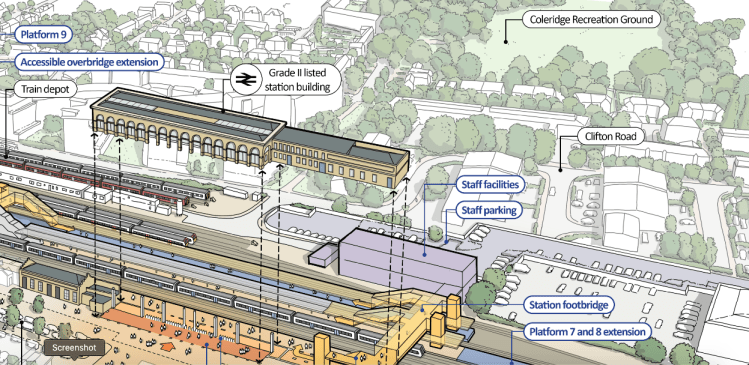
Above – from EWR, the lack of an eastern entrance has been formally raised by the local councils and Combined Authority. Which indicates that the next iteration will probably be amended to resolve this issue. (Mindful that Parliament will be legislating to give metro mayors greater strategic transport planning powers over rail services). Therefore I can wait until a formal planning application for a new station comes in.
Coldham’s Lane station for RailPen’s big developments
They said that there are some very complex engineering and track works that need to be done in the section around the Cambridge-Newmarket rail junction and Coldham’s Lane Bridge near the Beehive Centre.

Above – I’ve called for a new rail/light rail station to be built around this bridge – saying the case is even stronger given the recently-published plans for the Cambridge Retail Park from RailPen.
A proposed Cambridge East Railway Station
The lead engineer said there was a much greater chance of a new railway station being built east of the railway bridge over Coldham’s Lane.
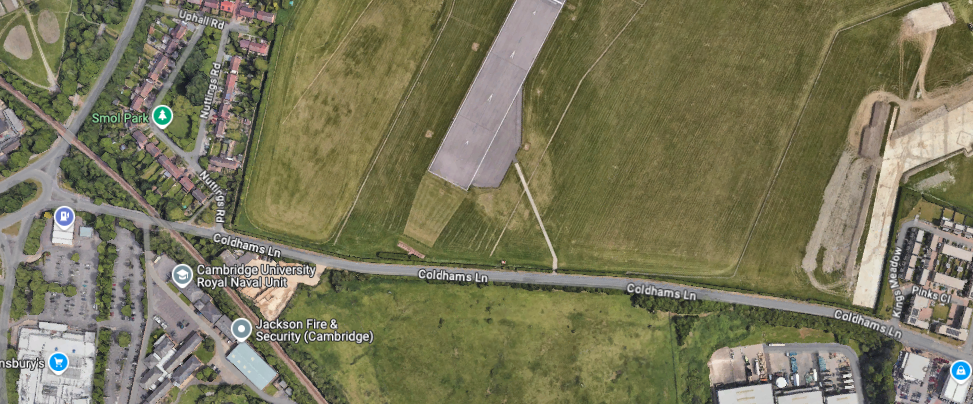
Above – from G-Maps here – the eastern section of Coldham’s Lane
I said that this would be ideal for a new urban centre for Cambridge as I wrote in this blogpost, with the vision of passengers exiting the railway station onto a large civic square north of Coldham’s Lane with a new city hall with council offices on the other side opposite, a lifelong learning centre on the Barnwell Road side, and a new large concert hall on the eastern side – thus ensuring that urban centre did not suffer the fate of The Grafton Centre by being over-dependent on one economic function. Basically the ecosystem of small independent outlets could be nurtured around the four anchor institutions, alongside some essential public services including a pharmacy, dentist, GP, pharmacy, and minor injuries unit.

Above – as I mentioned in this tweet, I’d want the entrance to the railway station to look something like this in Budapest, Hungary. i.e. not Network Rail’s ‘minimum viable cost’ design.
The lead engineer told me Cambridge East was likely to be of the size of Cambridge North, but could easily be designed so that aesthetically it would look very different on the outside.
There were people from a range of organisations and groups including
- Cambridge Approaches (against a southern approach and the huge cost)
- Rail Future East Anglia (in support – see from p6 here)
- Cambridgeshire Sustainable Travel Alliance (in support)
…plus a couple of councillors as well. That said, there wasn’t anything particularly new that I had not seen before. What was more important from my perspective was that lots of people attended, saw the proposals for themselves, and were able to put their questions directly to the representatives of East West Rail.
How do you ensure Political accountability for ministerial decisions on major infrastructure projects?
One thing I pulled a few of the representatives up on was when they started getting tangled up in the merits or otherwise of the Political decision on going with a southern entrance into Cambridge. Former Chancellor Jeremy Hunt MP confirmed in May 2023 that East West Rail would take a southern route into Cambridge. Several of the critics of East West Rail are campaigning to reverse this decision, but from East West Rail’s perspective, that decision has already been confirmed by ministers and the new government has not indicated it is willing to revisit the decision by the previous government. For the sake of residents attending consultation events, it’s essential that East West Rail and their representatives are fully-briefed on what are *Political* decisions taken by ministers – and ones that residents can contact their MPs over, and request that the latter ask ministers questions in Parliament on their behalf. The greater the number of residents that persistently contact their MP on a single issue, the greater the effort that MP is likely to make on their behalf.
Keep an eye on how local government follows up their representations to East West Rail
I wrote about them in this earlier blogpost – the councillors have some very strong views about the environmental impact which has been translated by officers into a series of proposed changes to the current plans. Expect to see at least some of these requested changes incorporated into the next iteration of the proposals.
The path along which led to how we got to here is still far too fragmented
The poor communication between different institutions and the lack of a wider historical and corporate memory is one of the reasons why costs have spiralled. Several longstanding campaigners who have followed this project for as long as I have but from a different geographical perspective (many South Cambridgeshire residents were at this event) told me of the various problems with other major projects that appeared to be being repeated. Hence one of the arguments of the We Own It campaign to renationalise the private utilities and essential public services is that the loss of corporate memory due to the system of outsourcing and contracting out is bad for communities – and all too often results in higher costs. Either way, institutions and individuals that should be talking to each other and co-ordinating their work are still not doing so – not effectively anyway.
This is why the restructure of local government in England and the creation of new unitary councils is ever so important. Can we put on our wish lists the functions, powers, services, and funding needed to enable sound local government in and around Cambridge in the future?
If you are interested in the longer term future of Cambridge, and on what happens at the local democracy meetings where decisions are made, feel free to:
- Follow me on BSky <- A critical mass of public policy people seem to have moved here (and we could do with more local Cambridge/Cambs people on there!)
- Like my Facebook page
- Consider a small donation to help fund my continued research and reporting on local democracy in and around Cambridge.

 The Cambridge Town Owl