
More meeting papers and things coming up for you to get your heads around!
I’ve started throwing lots of things onto my L-I page here as an alternative to the imploding Birdsite which I only pop back to every now and then until the big institutions freeze their sites there. What a shame. I wonder what the economic and financial costs are of all of those lost networks that people and organisations built up over the past 10-15 or so years.
Meeting papers:
- CPCA Transport and Infrastructure – 24 Jan 2025
- Cambridgeshire County Council Strategy & Resources – 28 Jan 2025
For those of you following the Hartree / Redevelopment of the Anglian Water Works at Milton, see the video of Cambridge City Council’s Joint Development Control Committee here, as the extended delays from ministers have paused further planning work on this. Also next door are the proposals from the Crown Estate for the Cambridge Business Park, which I’ve said the two together with the Cambridge Science Park should pay for a new public swimming pool on the garage site on Milton Road. But that’s up to councillors and residents in North Cambridge to lead on that or any other ideas they have.
Combined Authority Transport and Infrastructure Committee – buses and trains
There are three public questions at item 4, none of them from me. Which is a merciful relief for all concerned!
Definitions of success – what are the targets?
Have a look at item 8 – the Local Transport and Connectivity Plan item, and in particular the appendix to that item. It lists all of the ‘KPIs’ – the ‘Key Performance Indicators’. Ask yourselves if the descriptions look sound, and whether there is any existing data being collected to judge whether policies are successful or not. And then email your councillors if you’ve got anything you really want to ask.
Some of them make sense as things to improve on, for example: “Proportion of urban trips
under five miles taken by Public Transport” as opposed to taken by car. The problem is how you measure it. Page 7 of the appendix to item 8 is just one example of where the data collection methods throw up problems. For a start it inevitably means taking a sample of all of the car journeys under five miles, and then trying to figure out the number of journeys currently under that figure taken using public transport as a baseline. And then it gets messy. (When was the last time you were surveyed about your travelling habits, and did you respond?)
The monster study of Royston to Granta Park
Item 11 of the meeting agenda with 15MB of documents overall. The Stantec Document is over 200 pages, so good luck with reading that. The reason why this piece is important is because it reflects the lack of east-west transport infrastructure between villages and towns around Cambridge.

Above – how to get from Royston to Granta Park. p108/226 – noting the emerging proposed growth areas including that triangle of doom between Hinxton and Great Chesterford which is where the Wellcome Genome Campus is.
Back in May 2023 I had a look at a series of looped light rail lines from Cambridge heading to Haverhill and wondering if the proposed lines could be looped back to Cambridge in any way.
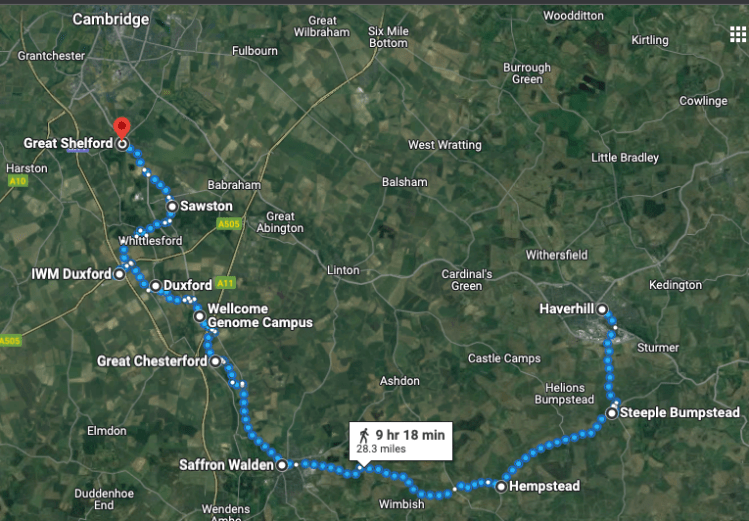
Above – how to extend a re-opened Cambridge-Haverhill line to loop back to Cambridge while at the same time creating new public transport services for Saffron Walden, the Wellcome Campus, Cambridge City Football Club at Sawston, and the Imperial War Museum at Duxford.
The idea is that the looped local lines would share tracks with other loops and/or existing railway lines – such as in this example linking the Wellcome Campus to Royston which would then rejoin the line back to Cambridge from Wimpole Home Farm via the new East West Railway Line. That would be my longterm alternative concept to what is being proposed
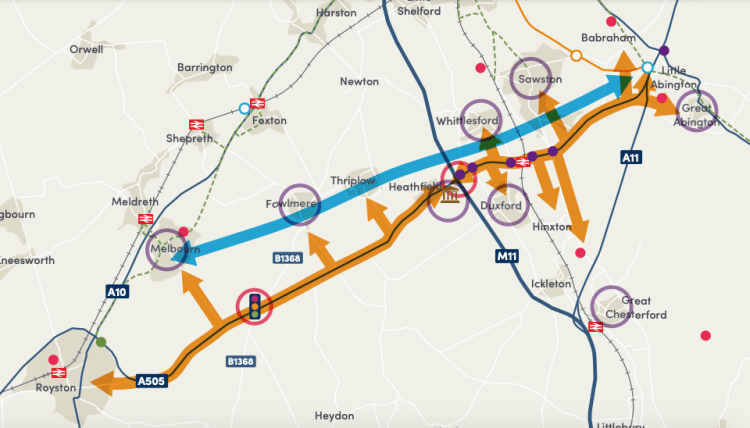
Above – Item 12 App A p11 – a bit of busway and a bit of more bus services plus an active travel route is their preferred option.
Again, given the wealth being generated, the future projected growth, and the number of people involved, I think the past few decades show an incredible lack of ambition – especially when you consider the huge sums spent over decades putting in place the fossil fuel infrastructure that we take for granted today.
CPCA on East West Rail
I’ve nothing to add to this earlier blogpost other than to say ‘watch the meeting’
Cambridgeshire County Council – the strategy updates
Blink and you might miss the important bits!
Item 6 App1a of the meeting papers for 24 Jan 2025 here
It’s the largest sized document in the list of appended files – therefore is the one likely to have the most diagrams in it. What it shows amongst other things are charts of where the county council’s money comes from (note the minuscule amount from business rates despite Cambridge’s huge wealth generated as 80% of what Cambridge collects is taken by the Treasury and redistributed nationwide which results in businesses complaining to councils about not getting value for money).
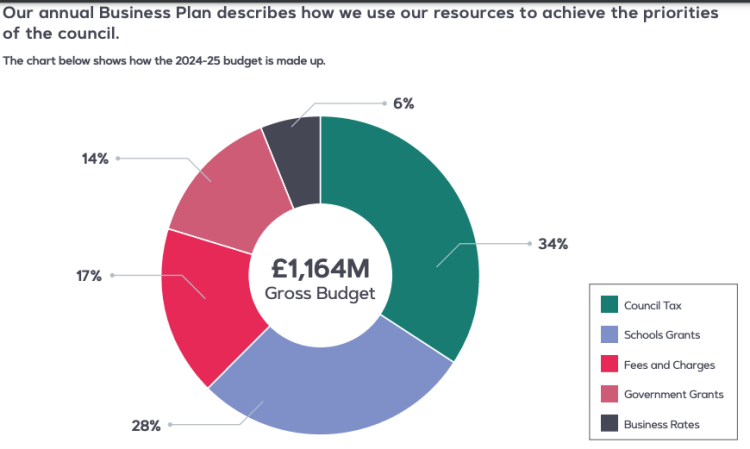
Above – Item 6 App1a, p34

Above – Item 6 App1a, p35 – what the county council spends its money on. Three quarters goes on social care and children/education
Which doesn’t leave much for anything else if the costs for the other two happen to be very high, as they are for so many parts of the country. And austerity has hurt. Badly.
“In September 2024, the Local Government Association, representing all councils in England, reported that local authorities collectively face an estimated £6.2 billion funding gap over the next 2 years. This is despite the estimated £24.5 billion in cuts and efficiencies councils, including Cambridgeshire, have been required to make between 2010 and 2023.
Above – Item 6 App1a, p2 – introduction from the Joint Administration Group Leaders
“Many people also told us they feel lonely or isolated, and mental health concerns are highest among our youngest residents.”
Above – Item 6 App1a, p3 – introduction from Stephen Moir, Cambridgeshire County Council Chief Executive
That doesn’t surprise me in the least, depressing as it is. The investments that the county council could have made have in effect been prevented by the rules imposed by central government and a succession of ministers. It remains to be seen what structures the new government brings in, and whether this will make a difference in terms of the much-needed investment in social capital that the Former Chief Economist at the Bank of England Andy Haldane told the RSA earlier in the week that the country desperately needed.
Food for thought?
Follow me on BSky <- A critical mass of public policy people seem to have moved here
Consider a small donation to help fund my continued research and reporting on local democracy in and around Cambridge.
On tackling loneliness? Opening a new city orchestra and community music school for adults like the Mary Ward Centre in London could go a long way – especially if it was located close to a major public transport interchange.
 The Cambridge Town Owl