
The Combined Authority’s Education and Skills Committee Chair confirmed that the tight spending rules on the devolved adult education budget means that a very narrow skills focus is all but inevitable – but could they push back for something better?
Part of me wonders whether the Cambridge& people should include a story about meaningful devolution of taxation and spending powers to a democratically empowered municipal council that governs Cambridge. Getting HM Treasury to agree to that? Now ***That is an impossible story!!!*** Yet as the former Chief Economist at the Bank of England states, something has to change because of the collapse in social capital formation that is having a huge negative knock-on impact that is also felt financially.
How to persuade ministers to relax their stranglehold on adult education and lifelong learning budgets
If anyone wants to email a peer in the House of Lords to ask a PQ to ministers to state what the Government’s broader lifelong learning policies are, please do! Because the latest response from the CPCA shows how restricted its options are on adult education budgets, as we found out earlier today.
With thanks to Cllr Iva Divkovic (Lab – Arbury) for following this up on my behalf at the CPCA’s Overview and Scrutiny Committee, the Combined Authority was pressed by her for more information on conversations it has had with the sci-tech sector on provision of lifelong learning facilities on the sites of large science and employment parks.
You can watch the video of the exchanges here
This is a textbook example of an elected councillor following up on an issue on behalf of a local resident, and holding the leading Political representative (in this case the Leader of Cambridgeshire County Council, Cllr Lucy Nethsingha (LibDems- Newnham) in her role as CPCA Employment & Skills Committee Chair) accountable for the decisions approved by her committee.
I emailed Cllr Divkovic, Cambridge City Council’s representative on the CPCA Overview and Scrutiny Committee to follow up my earlier public question on conversations between the CPCA and sci-tech industry on lifelong learning facilities. (See the video of the CPCA’s Employment and Skills Committee here).
My take was that my substantive question was not answered. I got a ‘line to take’ that was full of irrelevant (to me) information that might have been the sort I would have contributed to in my civil service days when a minister received a difficult question! (I know a dodged question when I see one – actually, most of the general public does too, so I’m not that special!)
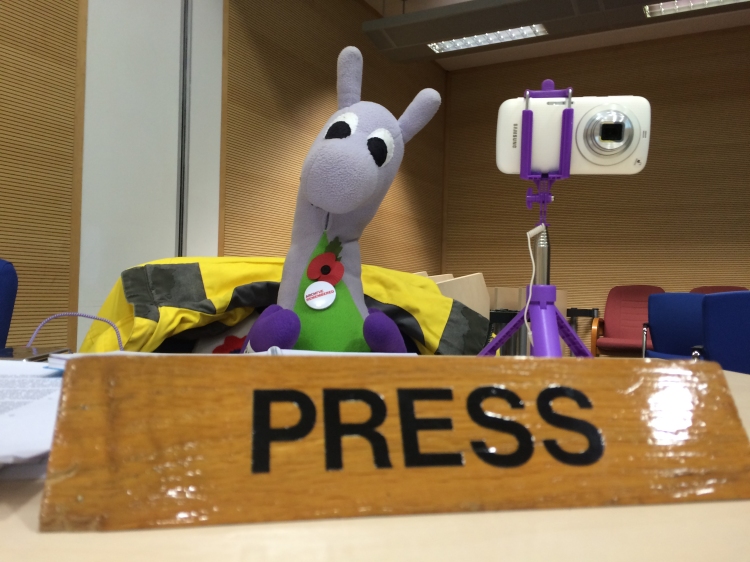
Above: No nonsense – Puffles the Dragon Fairy scrutinising politicians – here at South Cambridgeshire Hall
“Cambridgeshire’s lifelong learning offer is still far too narrow”
The title of an earlier recent blogpost. And now we have more clarity as to why this is: Central Government has imposed such stringent rules on ‘devolved’ budgets that the policy flexibility for combined authorities is actually very limited. Rather than being an independent tier of sub-regional government (for want of another term), we find (certainly in this case) that the CPCA is simply an extended administrative arm of Whitehall, where the policy decisions are really made. All the CPCA is tasked with is commissioning services from a series of separate institutions to deliver Whitehall’s priorities. The principle being that the competition to deliver those contract will magically ‘drive up services’ even though one big complaint from service providers is that such commissioning seldom accounts for their institutional running costs and essential support services.
The mindset and culture of the local administrative state is reflected by the bland, anonymous, identkit architecture and urban design of local government buildings
This was a very sharp observation by the Director of the V&A Museum Dr Tristram Hunt, who some of you may recall was Labour’s Shadow Education Secretary in the early 2010s. He wrote it in the final section of his book Building Jerusalem – the rise and fall of the Victorian City – which is essential reading for anyone following the English Devolution White Paper. If we are going to see the increased independence of local government from Whitehall dictats, then it will be reflected in the architecture, design, and location of their future buildings.
South Cambridgeshire Hall in Cambourne and New Shire Hall in Alconbury are textbook examples of local administrative state architecture. Both are buildings I despise with a passion. (It’s one of my ND+ personal traits – getting irrationally angry about trivial stuff that hardly affects anyone else)

Above – just to make me even more furious, someone gave this monstrosity an award
How that stands in contrast to my alternative vision for a second urban centre for Cambridge – a concept of which that’s all-but-essential given the Housing Minister’s plans for Cambridge.

Above – Peck and Stephens’ unexecuted design for Cambridge Guildhall, 1860
My concept involves having a quartet of civic buildings each with ornate twin towers around a new civic square:
- A new city hall for a new unitary council
- A new lifelong learning centre
- A new large concert hall
- A new railway station and public transport interchange.
One of the reasons why the CPCA is not interested is because the rules governing adult education capital spending does not extend to wider lifelong learning provision. This is despite the growing research base highlighting the impact lifelong learning provision can have on improved levels of mental wellbeing and reducing levels of loneliness in society.
“Where is the holistic approach to adult education and lifelong learning that research recommends?”
A question I asked back in August 2022. It’s certainly not within the existing structures of the adult education sector, nor does it appear to be within the culture of the local and sub-regional sector to fight for it. Not yet anyway.
“Don’t talk about ‘adult education’ when you mean ‘vocational skills to fill the chronic skills shortages“
So I stated back in November 2024 when asking what a world class adult education offer actually looked like. Only for all of the rhetoric about the UK and Cambridge being ‘world leading’ on stuff, there’s a lot of really significant things that compromise such claims – and too many decision-makers and influential institutions are too willing to ignore them.
“Invite the impossible” says Cambridge&
Here’s me moaning about ‘Cambridge&’ back in 2020 having been tipped off by Sam Davies MBE. Their filing history shows that they’ve morphed into Innovate Cambridge, while the Cambridge& thing appears to be just a promotional tool now – as they state here.
But given they are inviting the impossible, I wonder what they would make of the current issues on how Cambridge is governed. Whether city, county, economic sub-region.

If you are interested in the longer term future of Cambridge, and on what happens at the local democracy meetings where decisions are made, feel free to:
- Follow me on BSky <- A critical mass of public policy people seem to have moved here (and we could do with more local Cambridge/Cambs people on there!)
- Like my Facebook page
- Consider a small donation to help fund my continued research and reporting on local democracy in and around Cambridge.

 The Cambridge Town Owl