
The Advisory Council has been established and the council leaders represented on the Greater Cambridge Partnership along with the Mayor of the Combined Authority have ex-officio seats
You can read the report at item 5 of the S&R Committee here
The other two people named are:
- Baroness Morgan of Fitzwilliam College – a former Downing Street insider under Tony Blair in the early 2000s
- Dr Paul Leinster – Chair of Water Resources East and former CEO of the Environment Agency.
Interesting pair of people to have in terms of their background experience – both in terms of knowing Downing Street inside out, and also the Environment Agency’s issues too. At the same time if I were a councillor I’d want to know whether Lady Morgan was representing the corporate and financial interests of the University of Cambridge and its colleges, or whether she was independent of them. (Or alternatively, there also to represent the interests of the undergraduates present and future?)
Where did this all come from? i.e. the update report?
This all stemmed from a line of questioning from Cllr Dr Dave Baigent (Labour – Romsey) who insisted that council officers engaging with the proposed Development Corporation for Cambridge should appear before councillors on the Planning and Transport Committee given the impact any decisions any such body takes will be of interest to that committee. (See my earlier blogpost here – which also links to the video exchanges between Cllr Baigent and senior councillors)
“The establishment of the Cambridge Growth Company effectively replaced the “Cambridge Delivery Group” as the entity overseeing the governments ambitions since the projects inception.”
Above – Item 5 p2
“So we’re calling it a Growth Company now?”
Looks like it.
The report by Stephen Kelly, head of the Greater Cambridge Shared Planning Service also re-stated the Minister for Housing’s expectations in the latter’s letter to Peter Freeman.
“When it comes to the growth strategy, development on a more dispersed geographical footprint is perfectly acceptable, but one or more contiguous urban extensions of the city must be core components of the vision the Growth Company brings forward, in order to maximise the benefits of agglomeration… [and] must also build on and go further than local plans, in terms of scale, ambition and timescale…”
Above – Item 5 pp3-4
Fortunately, Prof John Parry Lewis in his 1970s study of Cambridge’s Economic Sub Region mapped out the extension issues for us half a century ago.

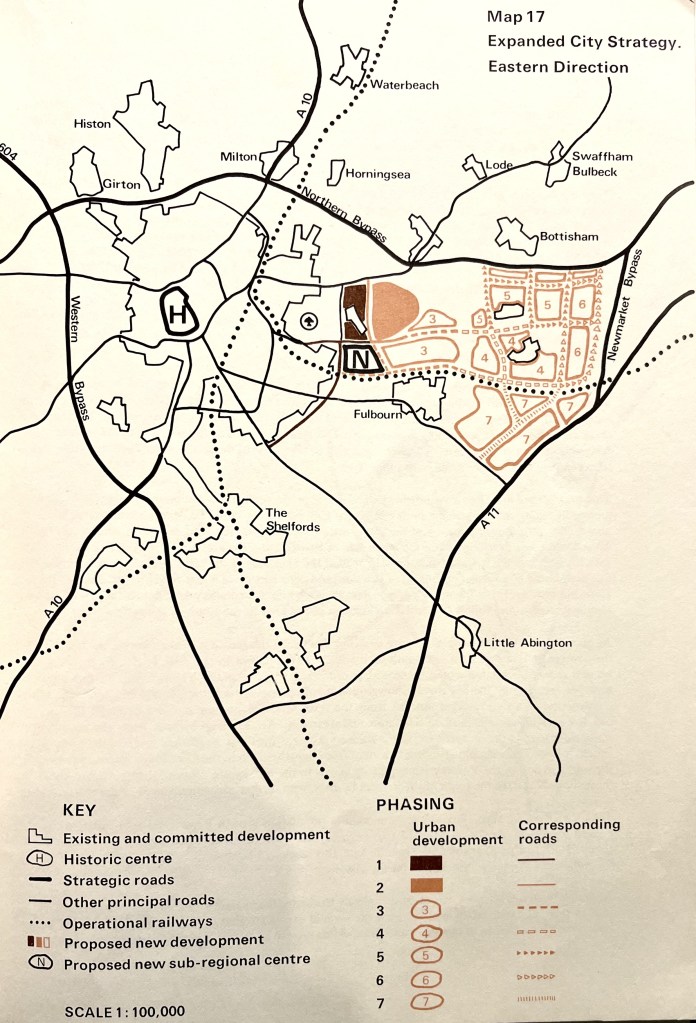
Above – both maps from JPL’s Study of the Cambridge Sub-Region (1974) HMSO digitised here.
You can also browse through the first half of part 2 of his study here. Note he also made provision for a new urban centre – concert halls, lifelong learning centres, new stations that I’ve been going on about? Something like that.

Prof Parry Lewis (JPL) from the Cambridge Evening News 27 Nov 1973 from the Cambridgeshire Collection, in Lost Cambridge here.
We still do not know what the Minister’s definition for ‘Cambridge’ actually is in terms of geographical area
That’s less of an issue for those of us (myself included) living within Cambridge’s 1935-era boundaries that we still have today for Cambridge City Council. It does however make a huge difference for the people of Huntingdonshire and East Cambridgeshire districts because although both are nominally outside of the Greater Cambridge Partnership boundaries, parts of their districts easily sit within Cambridge’s travel to work area. Which is why I think Lord Redcliffe-Maud’s recommended boundaries of his epic 1969 Royal Commission Report should be the starting point for negotiations.

Above – Redcliffe-Maud’s recommendations for unitary councils for Greater Cambridge and Greater Peterborough – see the report documents in the links from Lost Cambridge here.
“What else did Mr Kelly’s briefing report to city councillors say?”
The terms of reference – appended to Item 5, are also covered.
“The terms of reference for the Council indicate that the objectives of the Council are; “… to provide views and perspective to the growth company board on a range of issues relevant to the activities of the Growth Company, for example, transport, finance, community, business, innovation, and design/sustainability;”“
Above – Item 5 App1
“Sustainability could cover all manner of things”
If in doubt, refer back to the Bruntland Commission of the United Nations here. Is what is proposed going to mess things up for future generations in a really big way? If so, it’s not sustainable.
What happens next
Mr Freeman has about £10m to work with in running his company for the first year – the major task being to gather a huge evidence base for whatever his proposals may be. Hence going out to tender to get a consultancy to do this. The problem with such consultations is that no corporate memory is built up. I’d much rather have had the money handed over to Cambridgeshire & Peterborough Insight for them to recruit an in-house team that can then be employed permanently later on. Which reminds me – I still need to read The Big Con by Mariana Mazzucato and Rosie Collington on the consultancy rip-off.
You can ask a public question at this meeting so that I don’t have to!
As Cllr Thornburrow said at the recent Planning and Transport Scrutiny Committee, the council welcomes public questions. See details on how to do so here. You may want to ask about:
- What impact local government restructuring will have given it takes place at the same time as the work by the Cambridge Growth Company (CGC)
- When Peter Freeman will be meeting residents in public
- What transparency systems are in place to put on public record who he is meeting and what they are lobbying him to do (Looking at you, former MP for South Cambridgeshire!)
- How much officer capacity the work will require and if the company will be able to reimburse the council for the unbudgetted costs
- What the Government’s definition of ‘Cambridge’ is for the purposes of the Growth Company and its terms of reference
- How Mr Freeman will be working with local councils (parish/town/district/county) who are just over the border but who are well within Cambridge’s economic sphere of influence (eg Haverhill & Newmarket in Suffolk, Royston in Hertfordshire)
- How Mr Freeman will ensure the University interests and other corporate interests are subject to reasonable public scrutiny and are not kept secret from the public that will be directly affected by whatever position such institutions take
There are many others I could think of but my brain is frazzled. Either way, the promoters of all this growth must be up-front with the risks – especially the environmental ones as I wrote about here.
If you are interested in the longer term future of Cambridge, and on what happens at the local democracy meetings where decisions are made, feel free to:
- Follow me on BSky <- A critical mass of public policy people seem to have moved here
- Like my Facebook page
- Consider a small donation to help fund my continued research and reporting on local democracy in and around Cambridge.

 The Cambridge Town Owl