
The lack of comment from those firms and institutions supporting the Government’s announcement bringing back the OxCamArc regarding the risks and how to deal with them is striking
Some of you may have seen the comments from the opposition leader on South Cambridgeshire District Council, Cllr Heather Williams (Cons)
“The Chancellor is in trouble so she has come to the Cambridge cash cow and that in itself is worrying. Yes we are very fortunate to live in an area that has such potential, and we always have been contributors to the economy in current times, and we should always seek to maximise that, but what we heard several times is a real fear for democracy and local voices.”
So, what are the risks with this revived OxCamArc? Are there any?
Only I’m not seeing the much in the way of managing the risks in the comments from those supporting the revived proposals. Even when Michael Gove made his announcement 18 months ago, Savills hinted that the housing growth would need to be ‘…supported by appropriate infrastructure, community facilities, public open space and environmental enhancement.’ …which sort of sat a little awkwardly next to the praise for the proposals. It’s slightly different this time around with Bidwells here.
Policy risks
Back in 2013, the old House of Commons Public Administration Select Committee published a report about outsourcing policy-making functions to the private sector.
Public policy risk assessments – they must be undertaken in order to inform risk management processes
“All policy making carries risks: a lack of appetite for participation, disappointment arising from unrealistic expectations and the dominance of vested interests. Government must frankly assess and address these risks in relation to open policy making”
The first five words of that sentence should make all those concerned sit up and ask themselves what risks are associated with the policies that they are supporting. ‘How could all of this possibly go wrong?’
This all stems from an experiment by the Select Committee which wanted to crowd-source questions via Twitter (the olden-days version – you couldn’t do it today) and several of us including me via my social media avatar Puffles the dragon fairy (long story – but it started out life when I was still in the civil service when there were no specific social media rules for civil servants) sent in a series of questions on the hashtag #AskMaude – the Cabinet Office Minister Francis Maude. Watch the video here.
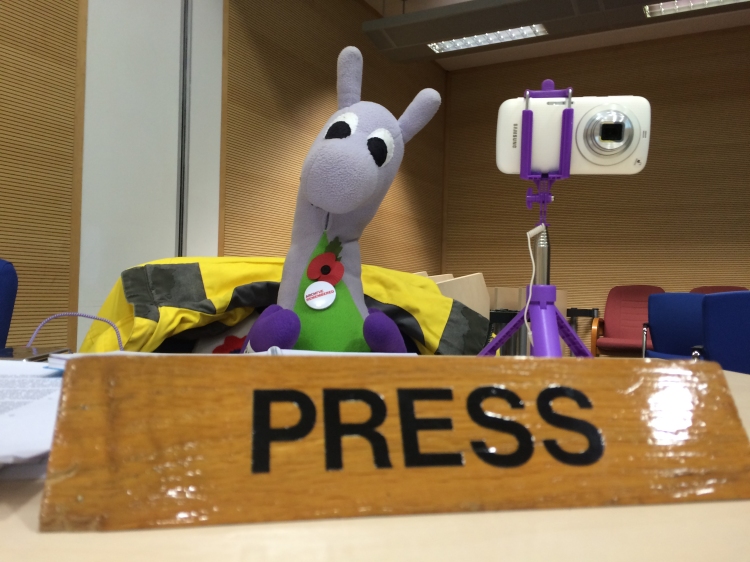
Above – @Puffles2010 – the dragon fairy at South Cambridgeshire Hall in Cambourne. Written at a time a third of that Commons select committee followed Puffles on Twitter. How times have changed?
I wrote up how select committees started using social media to crowd-source questions the following year. Sadly the takeover of, and the changing policies of the largest social media firms means that the full potential of such forms of public engagement may never be realised.
The OxCamArc March 2020
In a statement to the Commons, the then Communities Secretary stated:
“We are backing a broader green revolution, including plans to establish a net-zero development in Toton in the east midlands, which I hope will be one of Europe’s most exciting new environmentally sustainable communities. We are seeking to establish similarly high-quality and environmentally sustainable communities through up to four new development corporations in the Oxford to Cambridge arc: around Bedford, St Neots and Sandy, Cambourne, and near Cambridge.”
Above – Communities Secretary – Commons Hansard 20 March 2020 Cl 447
Not long after, the pandemic arrived on UK shores and normal policy-making effectively ceased until the 2024 General Election. Then in summer 2023 Michael Gove arrived and without telling anyone locally, dropped this.

Above – to which I responded that “Gove’s reported plans for Cambridge reflect the panicking thinking of a declining government out of ideas. And time.”
The personal dilema I had was that some of the architectural debates Gove was initiating and encouraging – in particular the themes coming from Create Streets, The huge problem I had with this was that the institutions driving this were being hijacked by extremists as a means for inflamming culture wars. i.e. associating architecture from previous ages eg Victorian and colonial eras as being a justification to bring back colonialism, or stating that the buildings somehow showed that those ages were somehow better or ‘more civilised’ than our present. (A quick browse through the British Newspaper Archive will reveal what the popular history books have missed).
At the same time, really controversial planning applications were coming through – I didn’t expect my responses to end up on the front page.

Above – the Cambridge News quoting me: “Cambridge Deserves better”. Quite. (This was later refused as an application by Cambridge City Council’s planning committee)
“Should we form an anti-ugly-buildings society in Cambridge?”
…I asked in that same blogpost. Only if someone else does it as I’m useless with committees!
“Cambridge, Southern Cambs, and Huntingdonshire: What could our collective responses be to ‘Supercharged Cambridge’?”
I asked this question back in July 2023 here. The issues and questions are even more relevant today. I can’t pretend to have any answers – just small local gatherings for people to talk things through to find out what they want to do, eg:
Part of the challenge is trying to engage a reasonable representation of our city, not just those who follow local politics and/or activists.

Above – This is from a report called “CLG Empowerment” by the Henley Centre which I acquired from a Freedom of Information request 10 years ago. It came with the disclaimer: “The results were a useful addition to the evidence pool, and informed community empowerment policy. However, the policy framework has now moved on.”
I discussed the above in this blogpost here
“What would that engagement look like from a pro-Arc perspective?”
Personally I think some of it should involve face-to-face public events where the public comes face-to-face with those firms that stand to benefit financially, with the council officers and civil servants observing the exchanges. Not least because there are a whole host of statistical claims that need scrutinising – the top one being the up-to £78billion in gains between now & 2035 from developing the OxCamArc mentioned by The Chancellor. That number comes from modelling commissioned by the political consultancy Public First and the pro-Arc group the Oxford Cambridge Supercluster. (Anyone want to find the data, examine the assumptions and crunch the numbers? Civil service statisticians should have done this already in principle before letting The Chancellor use it in a keynote speech!)
The opponents in the environmental sector are still around – having forced Gove to back down with his proposals
- Friends of the Earth
- The Community Planning Alliance – an online collective of independent local anti-development campaigns which you can see on a map here (alongside their Homes for Everyone report here)
- The Stop The Arc group here, originally formed to oppose the junked Oxford-Cambridge Motorway
…amongst others
Given how much of a bad press bats and newts have been getting of late, not surprisingly environmentalists have decided to give it a new life

Above – Team Bat – Team Newt, Community Planning Alliance
Which makes me wonder whether part of the PR battle for the pro-Arc side has already been lost. Maybe they should have asked that builder chap from the Millennium!
Could Citizens Assemblies be used?
Given the negative experience of them with the Greater Cambridge Partnership who I feel used the concept in bad faith (i.e. trying to use the process to justify an unpopular policy – congestion-charging) that ship has already sailed. That said, there are a significant number of alternatives that Involve UK (who run these things) have in their resources library here. There should be more suitable ones that can be applicable to different groups – from children and teenagers through to specialists in different areas, through to the wider general public that doesn’t follow politics day-to-day.
One individual who needs to address the residents of our city is Cambridge University’s Vice Chancellor. She didn’t mention town once in her speech at the start of the current academic year – a missed opportunity. Furthermore, the colleges should be doing far more to get their students literate in local democracy in Cambridge, and also familiar with what their colleges and their university is proposing.
Food for thought?
If you are interested in the longer term future of Cambridge, and on what happens at the local democracy meetings where decisions are made, feel free to:
- Follow me on BSky <- A critical mass of public policy people seem to have moved here
- Like my Facebook page
- Consider a small donation to help fund my continued research and reporting on local democracy in and around Cambridge.
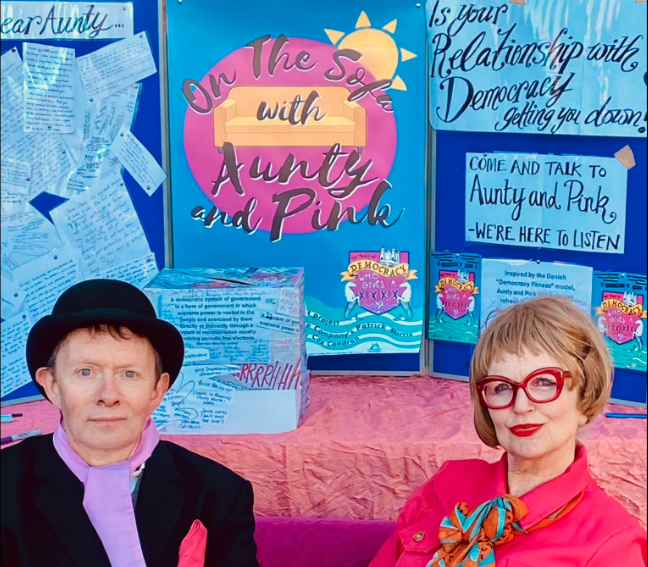
Want to talk about these issues with someone in Cambridge? The Trials of Democracy in Cambridge is back for 2025
“Aunty and Pink with be back outside the Guildhall with their inviting sofas and listening ears on Saturday February 8th from 11am – 12 noon.”
 The Cambridge Town Owl