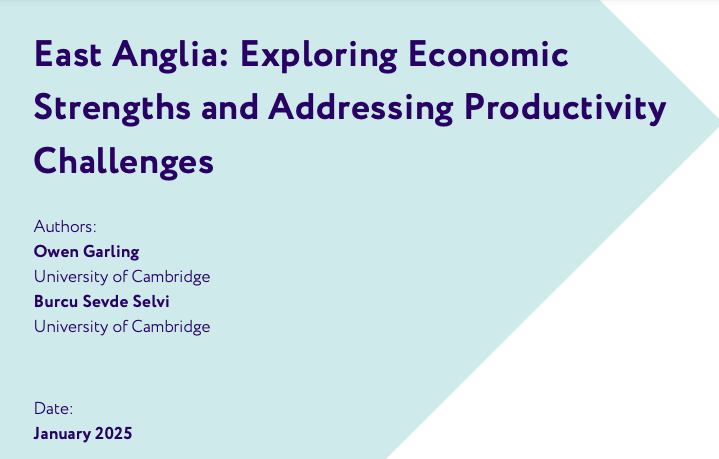
The research paper was launched earlier today and as the venue was local to me, I popped my head around to see what it was all about.
The guest panellists at the launch were:
- Dame Kate Barker, Economist
- Kathryn Chapman, Executive Director, Innovate Cambridge
- Oliver Paul, Interim Chairman, Suffolk Business Board
- Dan Thorp, Chief Executive, Cambridge Ahead
My top two takeaways from the event were:
- Dame Kate Barker spotted the social inequalities polarising our city’s young people – citing the differences between the affluent and well-resourced private schools such as The Perse and The Leys, vs some of our secondary schools. I wanted to shout ***I’ve got a local policy response to this!!!*** (ie this blogpost from 29 Apr 2024 learning from the Cambridge BID) …but I resisted the urge (not easy given by my ADHD/ND+ disposition!)
- Institutions are still not talking to each other, let alone co-operating to solve shared problems – something further aggravated by a sense that less affluent people have policies ‘imposed’ on them by more affluent and better-connected people who frequent public policy circles, rather than being co-designers in policies that help them solve their own problems.
That second point was something that former Cambridge social reformer and Save the Chidren founder Eglantyne Jebb taught me from beyond the grave in an interview she gave to the old Cambridge Independent over a century ago.
“I was a long time realising that the social reform on the part of the Conservatives is like charity in the hands of a Lady Bountiful – everything to be made nice and pleasant, but the ‘upper class’ is to be respected and obeyed. The corruption of elections first opened my eyes and I came to believe that no social reform could be of use that did not promote the independence of the people.”
Eglantyne Jebb in the Cambridge Independent Press, 08 July 1910 quoted in Lost Cambridge when she was a local activist for the Cambridge Liberals

Above – ‘Lost Cambridge hero’ Eglantyne Jebb, Palmer Clark in the Cambridgeshire Collection, taken in Cambridge, circa early 1900s
If you want a crash course in the social history of Cambridge 1800-1900, Eglantyne’s first three chapters of her (not so) ‘Brief Study into Social Questions on our town does the trick. Now for someone to cover the 100 years that followed!
If you want to know more about this incredible woman, see Clare Mulley’s biography of her
Time-and-time again we see public policy debates all over the country that talk about what to do about the social problems people on low incomes have to deal with, but precious few examples of the people meant to be helped actually being involved in the policy-making processes. I write this as one of those former policy-makers who has been one of those securely-employed (or so I thought) people mingling in the corridors of power being both overly-curious and perhaps lacking some of the self-awareness that comes with being in your mid-20s and lacking self-esteem as I was back then.
Part of it is the ‘middle class saviour’ mindset where you want to be doing – and seen to be doing good things for those less well off than you, and being praised by your peers and those in social circles above you for doing so. It’s something I grew up and absorbed through Church in childhood – politics not being ‘the done thing’ so our generation never learnt anything about using political processes for social good. Which is why whenever I approach any policy to do with the future of Cambridge, I’m wrestling with most of my lived years and all of the events that happened in it. It’s not just lines on a graph. As Dame Kate Barker said at a conference she was recently at, the high level economic statistics do not tell the stories of what’s really going on on the ground. And the decline of local media makes those stories even harder to amplify and share.
Insights into East Anglia – the missing local and regional historical links
I had a bit of a moan at the end about learning from local history having brought more papers and things with me than is sensible, but at least the audience found out about Buses Magazine after I held up a copy during Roxanne de Beaux of CamCycle‘s question. (Declare interest – I’m a longstanding member because in the olden days, every primary school child had to do cycling proficiency before they got to secondary school. I still have my sky-blue county council certificate somewhere). But my point was that so many of the problems being discussed by the panel were almost identical to the ones being discussed in Cambridge some 50+ years ago.
- Governance structures & boundaries? Redcliffe-Maud 1969
- Transport chaos? Cambridge Transportation Plan 1972-72
- Regional Planning? Throughout the 1960s & 1970s
Davidge’s first sub-regional (even sub-county) plan of 1934
I’ve linked to this superb study in Lost Cambridge here. In the olden days, such plans were written to be read. Today they are written for reference. And it shows in the latter’s corporate writing style.

Above – Davidge’s contour diagram of the old Cambridge County in 1934 – have a browse through his report digitised here – and spot his recommendation for a road bridge at Foxton over the railway line…that we are still waiting for!
The East Anglia Study – 1968
Harold Wilson’s Labour Government was slowly but surely putting in place the state architecture and structures for regional government. Part of that involved commissioning various councils, commissions, and committees to gather huge evidence bases. One of them was the East Anglia Study of 1968 – which you can read here.

Above – the East Anglia Study published by the Regional Economic Planning Council in 1968 – p35
You can see the pre-1974 rural district councils that pre-date the district-level councils we are familiar with today. Furthermore they start to hint at the unitary structures that Lord Redcliffe-Maud would recommend for Cambridge
Not surprisingly, Labour backed the restructures, while the Conservatives bitterly opposed them

Above – Redcliffe-Maud’s proposed unitaries for East Anglia, with a regional ‘province’ joining them for strategic economic planning. See Cambs Labour’s defence of the proposals from 1969 here.
This was followed up in 1974 by another regional survey – and it was this study that questioned the merits of Holford & Wright’s restriction of Cambridge to a population of 100,000 people
“The continuation of policies of village development, for example, would need to be matched by corresponding improvements to public transport into the city. There will also be difficulties in absorbing the growing pressures within the city itself. Both aspects have been the subject of a sub-regional study which looks towards the relaxation of present policies, and some encouragement of further growth, as a means of supporting measures to draw off these pressures.
Above – Strategic Choice for East Anglia, (1974) p64/66 pdf
We’re brought up to the more recent future by the East of England Plan of 2010 which you can read here, put together by hundreds if not thousands of people, signed off in March 2010 and then abolished with the swift stroke of a pen by Eric Pickles when the Coalition came in – and out went the regional offices including the one I started my civil service career in.
“What can we learn from those regional plans?”
I asked this question of the 2010 plan in this blogpost in the context of Cambridge. But for a region-wide analysis, there’s scope for a researcher to undertake a post-graduate qualification doing a comparative analysis of each of those strategies and compare them with the evidence bases being put together in our current age. Because more than a few of those problems will come back time-and-again. If we don’t get things right this time, we’ll be cursed to repeat them. Like when Anglian Water (then the public water authority) imposed a moratorium on house building in South Cambridgeshire because their sewage infrastructure was not fit-for-purpose – even though Cambridge City Council’s old Public Works Committee had warned them in 1965 in this report here.
A common factor in the histories? The failure of successive governments to take the people with them
And that’s where we are today. Which is why I wrote here that the promoters of the OxCamArc must be upfront with residents about the risks, and work with them to mitigate some of the worst aspects, and also compensate communities for the changes that will happen – for example with better amenities.
Even when people from ordinary residents through to local specialists such as the Smarter Cambridge Transport Group have come up with positive proposals to deal with shared problems, they have been faced by a toxic culture of ‘design and defend’ whether from developers, the Greater Cambridge Partnership, and even from ministers. When processes have been seen to have been manipulated in the eyes of residents (such as the ill-fated citizens’ assemblies commissioned by the GCP to try and build a case for congestion-charging), the people lose trust. That contributed towards the toxifying of local politics in Cambridge which resulted in too many high calibre and highly talented individuals leaving the scene altogether. Cambridge cannot afford to lose such high calibre people from participating in processes to decide the future of our city, county, or region.
So, what needs to change?
Most of the people in the room already knew that, and there was nothing new from the panelists that most of us had not already heard. From the fragmentation and over-complicated governance structures, to the lack of fiscal devolution in the Government’s proposals, to the failure of Cambridge’s employers collectively to invest in their own staff.
The thing is, I’ve been following, blogging about, and participating in many of the local things for around 15 years. Nearly all of the people who were around at the start have moved on one way or another. Where is the civic and corporate memory underpinning all of this – not just from a public policy perspective but from a residents’ perspective too? Where are the practical exercises that the public can really get involved in to the extent that their participation will mean something to them? For example pulling out maps and looking at where they think new cycleways or tramways could go, or where a new leisure centre could go, or what areas need to be protected and set aside for open green spaces?
That’s where the long-awaited Land Use Framework is welcome. While locally there are pockets of experts, historians, and politicians who are familiar with which bits of the county are not suitable for development – eg because they are on floodplains, it’s not something that extends much further. Hence some of the more colourful proposals on how Cambridge should expand that we’ve seen of late that take little account of physical geography.
From a town planning processes perspective, three things I’d ***really like to see***:
- Mandatory post-occupancy evaluations of medium-and above developments – noting Stephen Platt’s study here of Cambridge’s new neighbourhoods – I’d really like to have seen much more input from residents given the huge number of new communities about to be formed
- The pooling of employment strategies from large developers via the Combined Authority. The North East Cambridge Area Action Plan has four large applications/developments either under way or in the pipeline, but the strategies make little reference to each other. Surely it would make sense to pool resources and come up with a solution to our construction skills crises that is greater than the sum of its parts?
- The local town planning profession running some evening classes and workshops introducing us residents to the town planning system (as I asked Cambridge Ahead here). If you want to increase productivity, educate the residents on how to submit valid comments in response to applications – especially ones that strike out the really poor applications, but even more so those comments that can genuinely improve applications from being mediocre to very good.
The overall problem, as Cllr Seb Kindersley told Cambridgeshire County Council recently, is that lots of people are talking about Cambridge, but they are not talking to each other.
And solving that one is beyond my pay-grade as a chronically ill busy-body on Universal Credit who does not get out much. I’ll leave that one to the professionals! For the rest of us, I’ve organised a couple of neighbourhood-level informal gatherings for people who want to find out more and talk to others who may also have similar concerns.
If you are interested in the longer term future of Cambridge, and on what happens at the local democracy meetings where decisions are made, feel free to:
- Follow me on BSky <- A critical mass of public policy people seem to have moved here
- Like my Facebook page
- Consider a small donation to help fund my continued research and reporting on local democracy in and around Cambridge.

 The Cambridge Town Owl