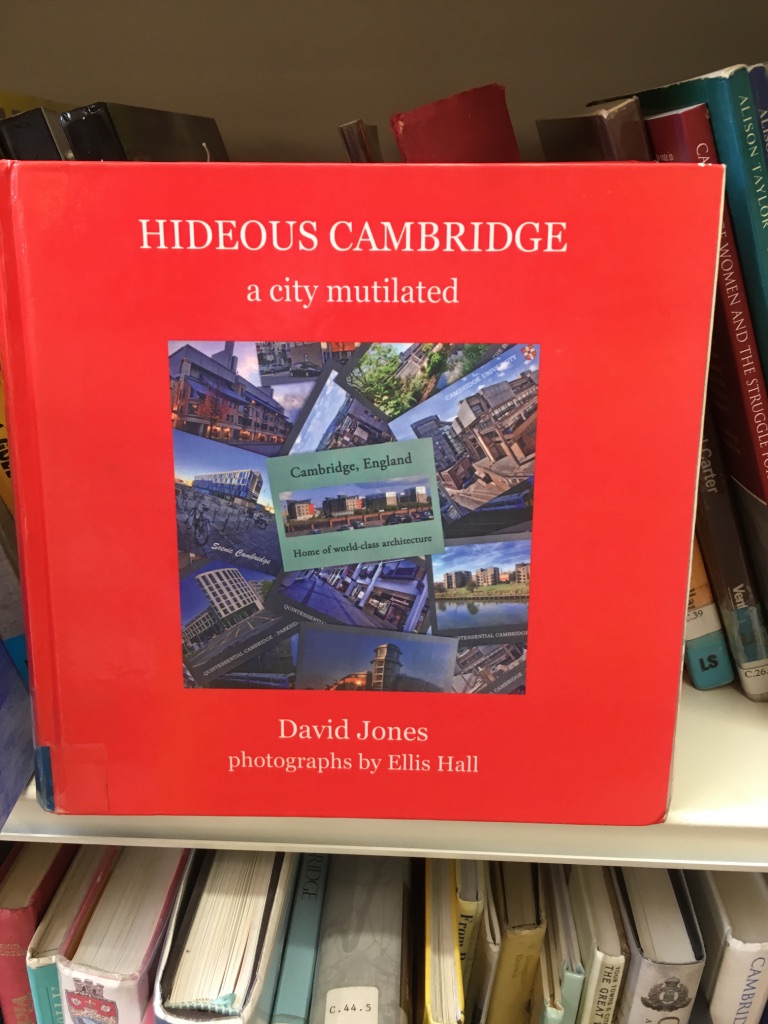
Cambridge City Council’s housing committee met earlier – there are a number of headline statistics that should be high in the consciousness of both the construction industry and in philanthropic/charity-giving circles
Cambridge City Council’s housing key facts
You can read them at https://www.cambridge.gov.uk/housing-research
Top ones that stand out for me:
- Cambridge City Council had 7,587 council homes at April 2024
- Cambridge City Council has 2,955 households on its housing needs register as of September 2024 (rising to 3,019 as of Feb 2025)
- Cambridge City Council assessed 1,007 applicants for homelessness support as being owed support under the council’s statutory duty between April 2023-March 2024
It’s one of those things where in an ideal situation, the headline stats would be read out, and they would be picked up in the local media and read out in the following morning’s radio bulletins and picked up in the print and online news.
Most people probably don’t know where to find their local council’s meeting calendar is online (it’s here). I guess even fewer know about the right to table public questions, let alone know how to make use of it. (See here)
Cambridge City Council’s Housing Scrutiny Committee
You can watch the meeting of 04 Feb 2025 here – mindful that for residents who are owner-occupiers (whether outright or mortgaged) are unlikely to feature in the issues raised. People who live in council housing or socially-rented housing on the other hand, it’s a very different story because this is one of the main forums where those residents can raise unresolved housing maintenance issues or neighbourhood issues with senior housing officers and executive councillors.
In this case the committee chair is one of my local councillors, Cllr Tim Griffin (Lab – Coleridge) who is also a recently-retired Professor of Computer Science at the University of Cambridge. That point I made in an earlier blogpost about the collective intellectual calibre of councillors we have in Cambridge? That.
Given the chronic inequalities in our city combined with the speculative frenzy in the private sector happening in the Cambridge property bubble, I’m uneasy at how for decades the political and economic structures have relegated housing issues for people in council/social housing and unstable/temporary accommodation to something of a niche issue where charities are expected to solve the problems rather than politics. It feels like it has only been in recent years that some public policy circles have been willing to take on the neo-liberal consensus that has dominated economics and public policy since the end of the Cold War. Last week another report was published warning about inequalities in society – this from King’s College London.
“A key underlying problem is the economic logic of perpetual consumption and perpetual profit, with the ideal of infinite growth confronting a reality of finite resources. New models are needed, based on principles that give equal weight to ecological sustainability and wellbeing as to growth and profit.”
Cambridge’s Housing Crisis
If I’ve interpreted the data correctly, Cambridge’s social housing waiting list is just over 3,000 households

…which is a slight rise over the past four months compared with the headline data in September 2024 (See Housing Key Facts – Housing Register applications and lettings)
The data on homelessness support (Housing Key Facts – Homelessness and Rough Sleeping) busts several myths about what insecure housing, homelessness, and rough sleeping actually is, and how it manifests itself. What does it mean for a place like Cambridge to have over 1,000 residents applying for support and being initially assessed as ‘being owed a statutory homelessness duty‘. As the House of Commons Library’s research note states:
“Authorities are legally obliged to take ‘reasonable steps’ to try and prevent or relieve homelessness among all eligible applicants and their households”
Statutory homelessness (England): The legal framework and performance (2024)
How does all of that square with the future growth of Cambridge?
The more I read about how the Eddington development was put together and driven through by the University of Cambridge with the support of Government ministers of the era, the more I loathe the place as a concept. That loathing however does not pass onto the people who live there and who have made it their home. Rather I think they deserved something better than what they got. The same goes with other housing developments in and around our city – recalling that four years ago, Cambridge MP Daniel Zeichner tore into the construction industry over its poor performance and poor construction standards in a speech to Parliament. And it doesn’t feel like it’s getting much better – as Brookgate’s flagship CB1 development and its social housing is showing of late.
As someone mentioned to me recently, I’ve been following (and in part living) Cambridge’s housing woes for 15 years so if anyone in the construction industry is feeling a little sensitive about some of the things that I write, it’s because in part Cambridge’s housing crisis defines me as a person – i.e. that grumpy so-and-so who doesn’t get out much (the joys of CFS/ME) and who had to boomerang back into the home of mum and dad after burning the candle at both ends in the bright lights of London.
Pride of place
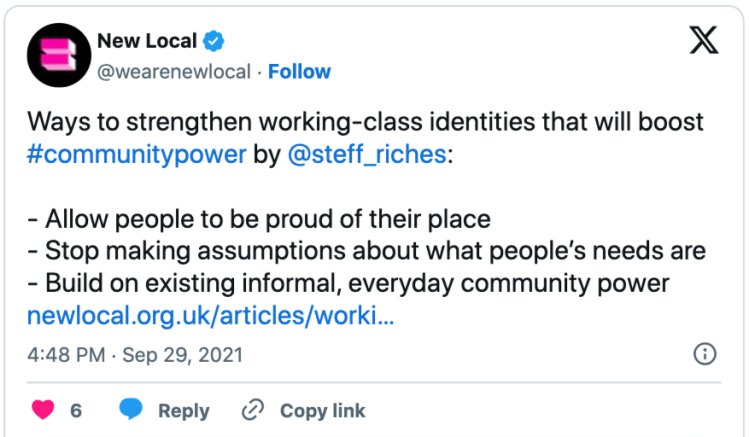
Above – Stephanie Riches’ article summarised in a snapshot
I wrote a commentary on her article here, looking at how the landowners had decided to build out what is now Darwin Green rather than set aside a significant plot of land for much needed open park space for the residents of Arbury ward – one of the largest areas of post-war council housing in Cambridge that by the late 1960s was showing signs of really poor urban design, and lack of community facilities.
On new design codes
There’s still time for you to have your say on the proposed design codes for Arbury and King’s Hedges. For those of you who don’t like reading stuff, have a watch of the webinar here.
For future expansions of Cambridge, I hope we don’t get a repeat of Eddington, Clay Farm, and other minimalist designs lacking in artistic detailing. I’m beyond bored with property professionals trying to convince me that something ugly is something beautiful, or that something that is not an interesting detail is, in fact, interesting. It just drives me into a frenzy and it’s not good for my mental health!
How do you avoid the culture wars while making the case for the sort of architecture that say the King when he was Prince of Wales, might have liked?
I’m still struggling with that – as I wrote in this blogpost Part of the problem is that no architects or developers have been willing to try out those more traditional or familiar designs from inspired by previous eras. At the same time, such is the scale of the housing crisis that it’s ever so easy for people who don’t like contemporary minimalist designs to be accused of being against all house building or not wanting homes for those in need. Which is not the case. The problem we now have is this from across the big pond.
There are a few more case studies that are now coming on stream – i.e. not just the former Prince of Wales and his much-lampooned Poundbury development which followed his infamous Carbuncle speech. Ironically, one of the buildings in his development, the Dorchester Fire Station was itself nominated for the Carbuncle Cup. Now that the wider development is over 30 years old, people have been evaluating it over the longer term such as in this article here. For there are a host of lessons to learn from it – good and bad. It’s also why I really want to see the routine commissioning of post-occupancy evaluations – dare I say it, make them mandatory for beyond-medium-sized developments, and ensure that the ‘lessons learnt’ are fed back into local and national policy-making systems.
The Welborne Garden Village proposals
You can see the documents clicking here and scrolling down

Above – it looks far more interesting than anything I’ve seen in Eddington
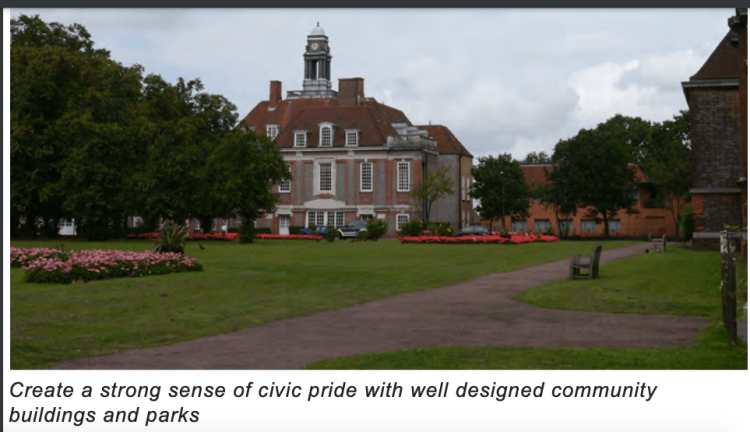
Above – I particularly like the concept of a strong sense of civic pride co-ordinating municipal buildings with open green spaces
Which is why Castle Hill in Cambridge with the sale fo Shire Hall is such a missed opportunity – the blame resting purely with the Cambridgeshire Conservatives who moved the county council’s HQ to Alconbury for in my view party political reasons – an error compounded by Labour’s Treasury Ministers with their refusal to overhaul local government finance systems.
Part of the problem is that Cambridge is a victim of its University’s economic success
Because as I’ve often heard many-a-time, Cambridge wouldn’t be much more than a large market town without the ancient colleges and world class research institutes linked to the University. With a population of under 200,000, Cambridge counts as a large town / small city according to the Office for National Statistics. Given that much of the growth above 100,000 has only happened in recent decades, had it not been for the University and the economic policies of successive governments, 100,000 may well have been where it stayed.
Both the current and previous governments decreed that the future of Cambridge – city and economic sub-region, was of national interest, and therefore its future was going to be decided ultimately by ministers – as the Housing Minister Matthew Pennycook made clear in his letter of 27 August 2024. This for me is also a sign for local campaigning groups to start lobbying ministers directly because ministers already have sufficient legal powers to do what they want regarding the future of our city. And if they don’t, well there are two looming bills about to be tabled before parliament in the next few weeks, so if there’s anything they don’t have, all they have to do is insert the required clauses.
Back to design codes – not sure who decided this one but it’s ugly!
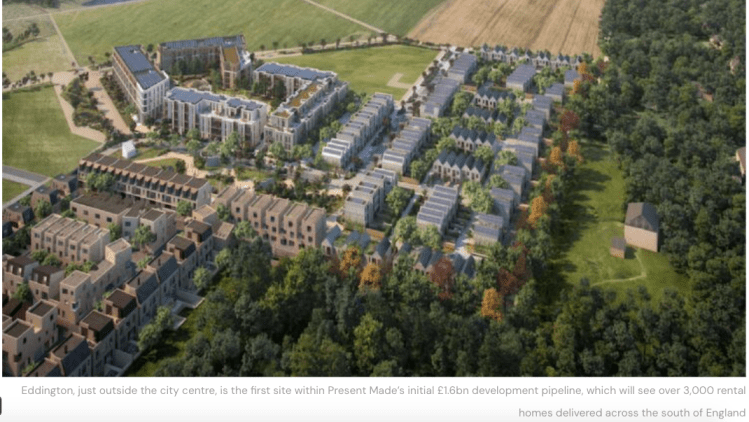
Above – via Cambs News – a new rental development financed privately for Eddington
I’m not sure who will be willing/able to splash £24k minimum per year on renting a place like that – mindful that Cambridge’s median salary before tax is just over £30,000. Which reinforces that sense of separateness from the rest of the city that this decision on council housing also reflected. And that furthermore exposes the huge tension not just across the city, but with the interested outside institutions who stand to make a fortune from it. Will Cambridge become ‘One City, fair for all’ as the electors have repeatedly indicated they want at the ballot box since the early 2010s – i.e Cambridge Labour’s vision (re-adopted in 2024 here), or is it one of exclusivity that can be branded, packaged up, and sold on the international property markets? Because if it’s the former, then Labour politicians need to have a look at the policy recommendations from Prof Josh Ryan-Collins of UCL and his research into housing demand, and get this in front of Treasury ministers and civil servants. Because otherwise the risk is that the sheer financial pressures will insist on housing designed and built for financial returns rather than designed and built for people to live in as their home.
If you are interested in the longer term future of Cambridge, and on what happens at the local democracy meetings where decisions are made, feel free to:
- Follow me on BSky <- A critical mass of public policy people seem to have moved here
- Like my Facebook page
- Consider a small donation to help fund my continued research and reporting on local democracy in and around Cambridge.

 The Cambridge Town Owl