
They didn’t label me a Guildhall Groupie for nothing! Turning up on a cold, rainy Monday evening to watch councillors debate the future of our city
The other thing that didn’t help my mood today was Cambridge University’s Vice Chancellor and Comms team putting their foot in it on all things town/gown. That or I’m a sensitive little snowflake
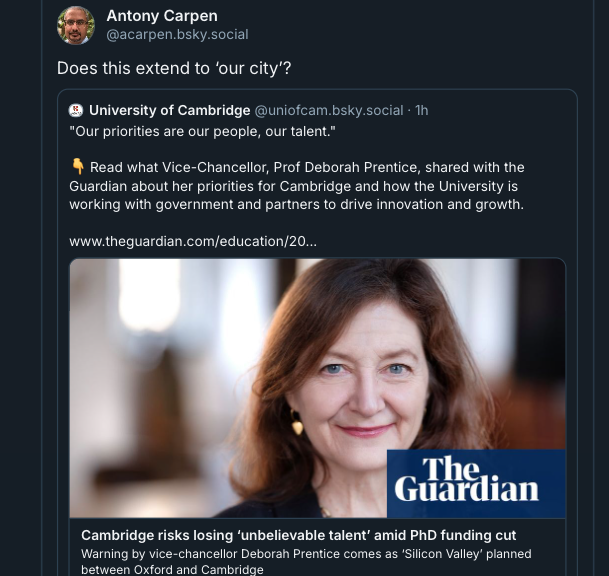
Above – from The Guardian 08 Feb 2025.
The thing is, one of her predecessors from over half a century ago took a much broader approach. But then maybe Sir Ivor Jennings was demonstrating his professional background as the former editor of the Local Government Chronicle.

“We regard Cambridge as part of our inheritance as members of the University. It is our duty to pass it on to our successors improved and not impoverished. It will not be unchanged, because every generation has to build and rebuild.
“This second aim has no direct advantage to the University, and some people may question why we have included it in as a second aim. We do so to give a recognition to the fact that Cambridge is more than a University, it is a City in its own right, and its significance as a regional centre has grown and will continue to grow.“
Sir Ivor Jennings in the Cambridge Daily News 01 June 1962 in the Cambridgeshire Collection
As I mentioned in this blogpost on Innovate Cambridge, the exclusivity does not sit comfortably with the democratically-elected council’s vision of ‘One City, Fair For All’. Interestingly, the movement from younger generations of Cambridge University students and researchers are showing much more awareness of what is happening in and around our city – you can meet some of them at this event on Weds 12 Feb 2025 where Drs Ruchit Purohit and Zhuozhang Li will be discussing Community Consultation for Quality of Life/ The Cambridge Urban Room. What makes these sorts of events interesting for those of us who grew up in Cambridge and/or who have lived here for a very long time, is that you get external perspectives on governance structures (local and national) which are all too easily missed out by most of us because the UK political system is all we’ve ever known.
Cambridge City Council and making developers pay up for investing in skills
You can watch the response to my public question from Cllr Mike Davey, Leader of Cambridge City Council here, plus my follow-up. Basically it was this blogpost turned into a public question, with my follow-up mentioning the House of Lords debate on lifelong learning. (See the transcript here, and/or watch the debate online here). In his opening remarks, Lord Jim Knight (former Education Minister in both the Blair and Brown Governments) started unpicking the big assumption that underpins the system of tuition fees in England: One that assumes there is a significant financial benefit over time to all graduates, and that over the course of their working life in that profession, they should repay the cost not only of the tuition but of living in the form of student loans. Yet even in the mid-1990s my generation was being told at school that the idea of a ‘job for life’ was over, and that we should expect to have to move jobs, professions, and so on – and have to retrain. I come back to Frances Coppola’s observations from 2013 on Bifurcation in the Labour Market.
There were so many things that I wanted to follow up on in that debate but couldn’t, so I dropped a request to one of the peers participating (Baroness Natalie Bennett (Greens)) asking if she could forward on a series of questions to the Minister for Education in the House of Lords. (Which she kindly agreed to).
Anyone can contact a member of the House of Lords asking them to contact a minister on their behalf regarding government policy.
See the contact details here. In most cases, peers are more than happy to forward on such correspondence – especially if it’s about policy detail and how the Government’s proposals affect the community of the individual writing in. In this case, because Baroness Jacqui Smith (former Home Secretary in Gordon Brown’s Government) has the policy responsibility for adult education and lifelong learning, she will be the minister signing off any correspondence/responses that her civil servants produce for her.
What makes my list of things all the more complex is because my query cuts across multiple policy areas. It’s not just ‘adult education and lifelong learning’ as a standalone policy that I’m asking about, but rather its past under-funding, and how in future it will fit into the Government’s plans for expanding Cambridge (which is Housing Minister Matthew Pennycook’s remit), and the chronic inequalities in our city – asking what additional financial freedoms ministers might be willing to grant to local government in Cambridge to increase substantially the resources available for adult skills and lifelong learning – which is the remit of the Chief Secretary to the Treasury.
The Combined Authority’s skills update
You can watch the item here along with the questions from councillors that followed. Although there are a number of interesting things happening in this sector in Cambridgeshire, for me it’s still on too small a scale. Furthermore, the fragmentation of the public sector inevitably limits its impact, something that the creation of unitary councils will hopefully counter. The slides on the spreadsheets will be available soon – there were some numbers that need closer scrutiny on what the spending is going on, and what it achieved. For example there are some sectors where there looks like there is a huge amount of potential, while other aggregated sectors (eg planning and construction) bundle together a huge range of professions and occupations.
Cambridge Growth Company update
Mr Pollock reminded councillors of the terms of reference set by the Minister for Housing to the Chair of the Cambridge Growth Company, which you can read here. Also, ICYMI there was Lewis Herbert’s extended interview with the latter, Mr Freeman, on Cambridge Radio which I wrote about here. In that radio interview, Mr Freeman said he had already met with Wendy Blythe, the Chair of the Federation of Cambridge Residents’ Associations, and arrangements are in hand for that federation to have its first large meeting following the appointment/reconfirmation of Mr Freeman by the incoming government.
Councillor Karen Young (LD – Queen Edith’s) requests Mr Freeman appears before councillors to take their questions
You can hear Cllr Young’s question in full here, and the response from Cllr Davey that as council leader he is the person councillors should hold accountable for anything that happens at the advisory committee meetings which are shaping what will eventually become the new development corporation.
There was also an interesting line of questioning from Cllr Tim Bick (LD – Market), about how a development corporation will sit alongside an emerging local plan. Note at the same time that Peter Freeman praised the Greater Cambridge Planning Service for commissioning and assembling an already substantial evidence base which by the sounds of it will make the job of Mr Freeman much easier. This is because the commissioning has been done by councils with the local knowledge rather than civil servants based in Whitehall. Having been one of the latter in a previous era, even with the best will in the world there is nothing a London-based civil servant can do that can match the local knowledge you gain from living and working in a locality. Certainly not in a white-hot policy environment anyway!
The risk of a consultants’ bonanza leading to a bland ‘could be anywhere’ future Cambridge
This was something else that Cllr Bick raised – which corroborated with something a couple of planning professionals told me about at the recent conference I went to last month with Wendy Blythe (mentioned earlier). The balance that Mr Freeman has to achieve is one that brings in the best in the world, and moulds that with the finest local talent that we have, made up of people whose families also have to live with the consequences of the work. That means not taking as given the speculative submissions that have already been sent in by land owners and developers, which if you follow my guide here, will show you what’s there.
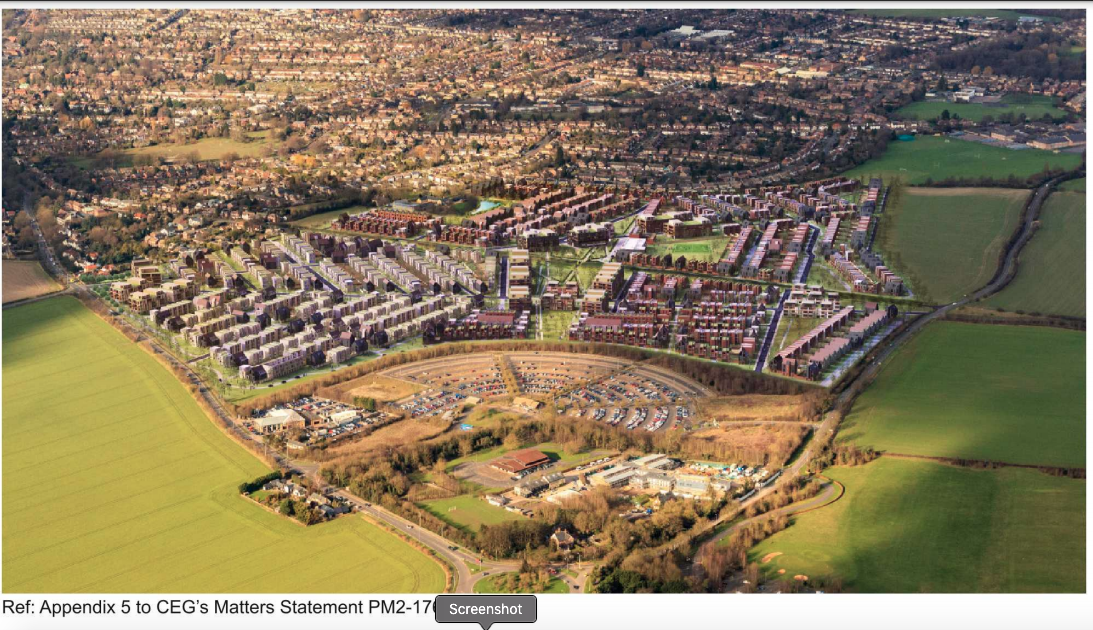
Above – Commercial Estates Group’s bland vision for the parcel of land by the Babraham Road Park and Ride, South East Cambridge
Is that really the best that contemporary architecture has got? Really? I’d like to think as a city we can demand better than that. And furthermore, that there are a critical mass of people within the construction industry who are willing and able to do much better than that and for a more competitive price as well.
Food for thought?
If you are interested in the longer term future of Cambridge, and on what happens at the local democracy meetings where decisions are made, feel free to:
- Follow me on BSky <- A critical mass of public policy people seem to have moved here
- Like my Facebook page
- Consider a small donation to help fund my continued research and reporting on local democracy in and around Cambridge.

 The Cambridge Town Owl