
The decision on whether to award or refuse planning permission will be taken by ministers, not by the local council
Image – Town and Country Planning in Britain (1968) HMSO – a reminder to ministers to bring in policies on lifelong learning to help the public learn about the planning system (and politics & citizenship in general!)
One of the objectors, Martin Lucas Smith tore into the developer over their move to get the application taken over by ministers just 17 minutes before councillors were due to commence their meeting to decide on the case.
“I think the tactic of getting this called in by central government just before the planning committee has even considered it, is a totally and utterly disgraceful, and is absolutely poisonous to trust”
You can see the guidance to the planning documents for this monster of a case in my earlier blogpost here.
The email chain from those documents show that at just before 10am on Monday morning, the Ministry of Housing, Communities, & Local Government sent an email to the Greater Cambridge Shared Planning Service – i.e. the local planning authority’s officers which support both Cambridge City, and South Cambridgeshire District Councils.
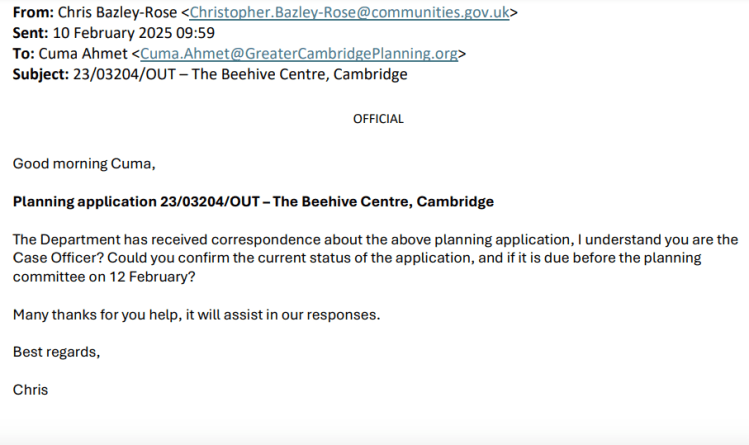
Above – the first sign that the Ministry had been lobbied by the applicant.
Less than 48 hours later, the Ministry confirmed that the Minister for Building Safety on behalf of the Secretary of State, the Deputy Prime Minister, had ‘called in’ the application to decide for herself whether planning permission should be granted, following an independent local planning inquiry.
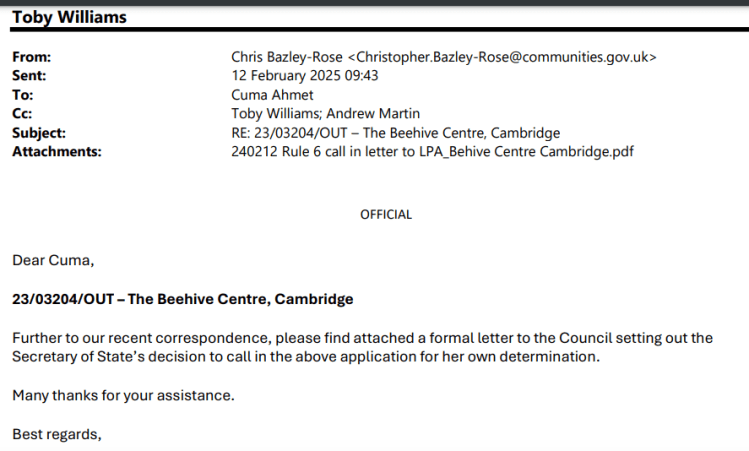
Above – as you can see the email arrived at 9.43am – with the meeting due to start at 10am.
The formal letter from the Ministry confirmed that the decision was taken by Alex Norris, the Minister for Building Safety and Local Growth – one of the junior ministers in the department. This is a standard practice where upon taking office, senior government ministers sign off delegated powers to their junior ministerial colleagues so that there is always a ‘duty minister’ available 24/7, and also where Cabinet Ministers delegate policy areas and the powers contained with them, to other ministers.

“So…what happens now?”
“Effectively this letter removes the council’s power to formally determine the application. It would mean that an inquiry would be held through an Inspector appointed by the Secretary of State.
“Whilst the council is unable to issue a decision notice, it does need to ratify what it would have decided.”
Above – Toby Williams of Cambridge City Council, 12 Feb 2025
“The applicant and the Inspector need to know what [the council] thinks, and we need to do all of that today”
Councillor Martin Smart, Chair of Cambridge City Council’s Planning Committee
And it was a very heavy meeting because as you can see from the video stream, although the footage starts an hour in, it goes onto over 7 hours and 30 minutes.
Meeting papers
You can listen to the summing up from the Committee Chair here.
Councillors voted a ‘minded to refuse’ notice for the looming planning inquiry for the following reasons:
“By virtue of the scale, massing, and positioning of the maximum building parameters, the proposed development fails to keep potential reductions in daylight and sunlight to a minimum in St Matthew’s Gardens, Silverwood Close and other adjacent properties and gardens. The extent and degree of harm would be both wide ranging, significantly adverse
and acutely felt by existing occupants.
“Many habitable rooms would feel poorly lit, colder, and gloomier, particularly where living rooms are concerned. Multiple gardens would also feel less pleasant and enjoyable, due to the significant increase in overshadowing that would be experienced. Moreover, the proposed development would be overly dominant and imposing on neighbouring properties, particularly in St Matthew’s Gardens and Silverwood Close, resulting in an oppressively enclosed outlook.
The overall harm to residential amenity would be significantly adverse and permanent, contrary to policies 55, 56, 57 and 60 of the Cambridge Local Plan (2018) and paragraph 135 (f) of the National Planning Policy Framework (2024).”
Above – item 5 para 31.1 p127 of the main report
In the notice letter from the Ministry, the issues that anyone wishing to make representations to the Planning Inspector on this case are as follows:

- Is the development consistent with Gov’t policies on building a strong competitive economy? (I ask: Is building a sci-tech park in a place with very poor transport access going to make Cambridge less competitive given the increased motor traffic build up?)
- Is the development consistent with Gov’t policies for ensuring the vitality of town centres? (I ask: What will the impact be of all of that motor traffic?)
- Is the development consistent with Gov’t policies on achieving well-designed places? (I note: Mindful that the independent design panel tore it to bits)
- Is the development consistent with the Cambridge Development Plan 2018?
- Any other issues that you could persuade the Inspector to consider as relevant
Over to the Planning Inspectorate it is then.
If you are interested in the longer term future of Cambridge, and on what happens at the local democracy meetings where decisions are made, feel free to:
Follow me on BSky <- A critical mass of public policy people seem to have moved here (and we could do with more local Cambridge/Cambs people on there!)
Consider a small donation to help fund my continued research and reporting on local democracy in and around Cambridge.

 The Cambridge Town Owl