…says Emma Cooke of the Quality of Life Foundation in response to the Newtowns taskforce’s interim report. Also, on radical leadership and empowering communities
You can read Ms Cooke’s blogpost here which is a reminder of the importance of health and wellbeing being designed into communities. Which also reminds me of Stephen Platt’s evaluation of recently-built neighbourhoods in and around Cambridge. How do the two compare?
“What does the interim report say?”
It’s mercifully short – six pages, two of which are full images. The big thing: Roadshows.
“….the Taskforce will be running a series of events to understand what the public think the core components of new towns should be – to further test the principles we have published today. This will help ensure new towns are grounded in the views and experiences of those who live there.”
It also states:
“Each new settlement should contain at least 10,000 new homes, as set out by the
government – but likely significantly more where achievable. This is more than the
private sector is currently bringing to the market independently and will facilitate a
new system-wide approach to building large settlements.”
Otherwise, there’s nothing that people familiar with housing issues did not know about or haven’t seen before on paper. It’s turning it into built environments that have been the challenge.
Jess Studdert is back with more ideas
Some of the most interesting ideas (see their publications here) have come out from the organisation that Ms Studdert now leads – the latest one from the New Local Think Tank is on radical leadership

“We need to shift the question away from asking our residents “What’s the matter with you?” to asking them “What matters most to you?” Kim Wright, Chief Executive, Brent Council
Above – Studdert et al (2025) quoting Kim Wright at the London Borough of Brent – who has my uncles Ray and Denis to keep happy! Poor souls!
There’s a really interesting take that for me has huge implications about pay structures and class structures.
“It sounds quite simple to talk about Radical Leadership, but many people have grown up in a traditional management setting. You get recruited because you’re a good planner or engineer, then you get promoted because you’re the best planner or engineer, and then you get to the top of the pile and it’s expected that makes you a great people manager and a great developer of partnerships. But this isn’t always the case.”
Andy Ferrier, Chief Executive, Test Valley Council. in Studdert et al (2025) p9
It reminds me of one of my former permanent secretaries telling us that the higher up in the civil service you go, the less policy work you do, and the more planning (people and resources) and risk management you do instead. Especially once you get into what was at the time called the ‘Top 200’ of permanent secretaries and directors general. I didn’t know if I wanted to be in charge of all of those people – and budgets too!
The statement by Mr Ferrier reflects what for me feels like a middle-class insecurity regarding social status. The idea that you have to be ‘in charge of someone’ or of people in an hierarchical institution. It was only as I was heading out of the civil service that people were talking about much flatter management structures – mainly because the way people were using social media at the time to bypass traditional hierarchies were overturning inflexible structures. Hence conversations along the lines of:
- “How do you know so-and-so?!?”
- ***They follow my dragon on Twitter***
You couldn’t get that today as I reflected on the rapid rise and fall of said site
In my fast stream days I remember feeling that artificial pressure to get to the top – fast, and feeling I was being pushed too fast. Which was one of the reasons why I asked to come off the programme. I didn’t see myself as having the calibre, aptitude or mindset needed to be a senior civil servant. And with hindsight, one of the things that those of us who did not complete the Fast Stream as it was back then have in common, seems to be neurodiversity. Some of the roles we found ourselves in and the tasks that we had to do made perfect sense from an outsider’s perspective/on paper – not least because it got you the exposure without the direct responsibility / being the weakest link, but those very tasks exacerbated (by their very nature) the struggles often associated with say ADHD. Which meant that some of the things that we really excelled at were skills and talents that our teams were never really able to harness because the institutions at the time were completely unaware.
“Is there anything missing in the report?”
To sum it up in a sentence, it’s responding to a community’s lack of capacity to meet local government at the halfway point.
There are a host of reasons for this – and a host of barriers to overcome. This was explained to me by a mother who stopped off at my pop-up bookstore in autumn 2023.
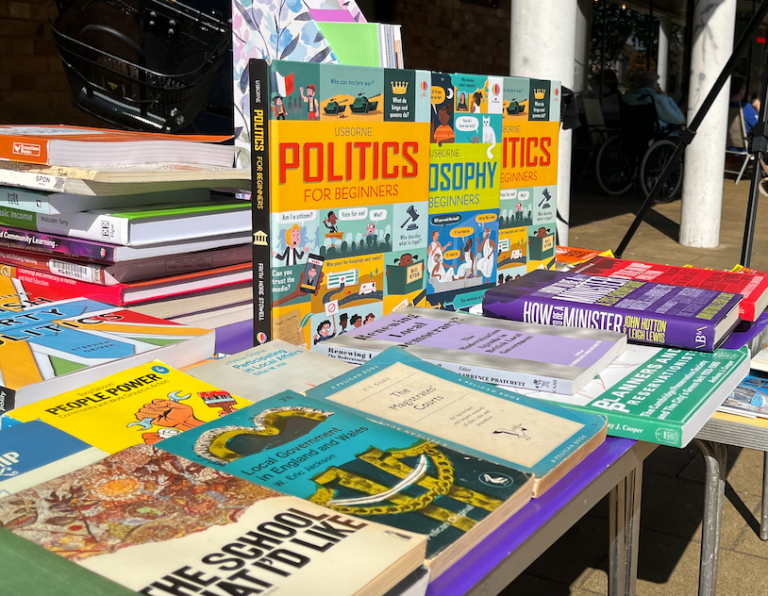
Above – trying to persuade people to buy books about politics, democracy, and citizenship. It failed spectacularly!
“That’s a really interesting book – I just don’t have time to read it, that’s all.“
…she said to me. (See my blogpost here). “We need to acknowledge the pressures of time that local residents face.“
That may mean re-thinking our collective approaches to community centres and the services we want them to provide if we want parents with young children to engage with even the most straight forward of public engagement events. Who can look after the children while the adults are trying to get their heads around the very complex topic of town planning? Just because someone might be an intellectual does not automatically mean they can process a huge amount of information on a subject they are unfamiliar with and suddenly be an expert in it. When you consider the amount of time, reading, work, and effort involved in analysing the huge pile of documents with the Beehive’s redevelopment application only to see it swiped away by central government at the last minute…exactly.
On the importance of civics and citizenship education
Ms Studdert and her fellow authors make the point for me.
“In local government this means focusing on the community at all times, ensuring everything the organisation does benefits local people and looking for opportunities to enable people to be active citizens and share power with them.”
Those opportunities for local residents to become active citizens and to share power will be extremely limited so long as the opportunities to learn about the basics of politics and democracy are non-existent.
I come back to Qasir Shah’s paper for UCL from 2020 (which I wrote about and linked to here) about the lack of citizenship education opportunities for people who grew up in the UK as UK citizens. I.e. not the much-criticised Home Office scheme for immigrants looking to acquire UK Citizenship.
At a Cambridgeshire level, the Combined Authority has shown absolutely no interest in even exploring the concept of citizenship education for adults because as Cllr Lucy Nethsingha stated in this CPCA meeting here, the powers the CPCA has are very, very limited. This is because ministers set the constraints on the funding ever so tightly that no course or workshop that any delivery organisation offered could hope to meet the criteria for vocational skills. And given that HM Treasury still refuse to budge on devolving tax raising powers, don’t expect any change of policy in the near future.
Which brings me back to the biggest of the barriers holding back the ideas that are coming out of the networks that Ms Studdert and colleagues are in
It’s HM Treasury.
It’s the structures, systems, attitudes, cultures, and mindsets within that institution – combined with the extraordinary power as a department of state it has over all of the others, that can make or break a major policy area (even manifesto commitments), and even the careers of secretaries of state who cannot get their policies past an all-powerful Chancellor.
And one of the most policy-exposed ministers in the whole of government at the moment is the Minister of State for Agriculture, Food, and Fisheries. Who happens to be the MP for Cambridge, Daniel Zeichner MP.
Because his biggest stakeholder policy-wise are farmers. And they have been continuing their protests against the Prime Minister, causing him to cut short a visit over policies not decided by Mr Zeichner as the minister in charge of the policy area, but because of changes in finance policies set by The Treasury. And even as a mid-ranking Minister of State in the Labour Government (which in the grand scheme of things should be an influential place to be), even Mr Zeichner is struggling to make an impact on that current crisis in his policy portfolio.
Who would be an MP or a Minister?
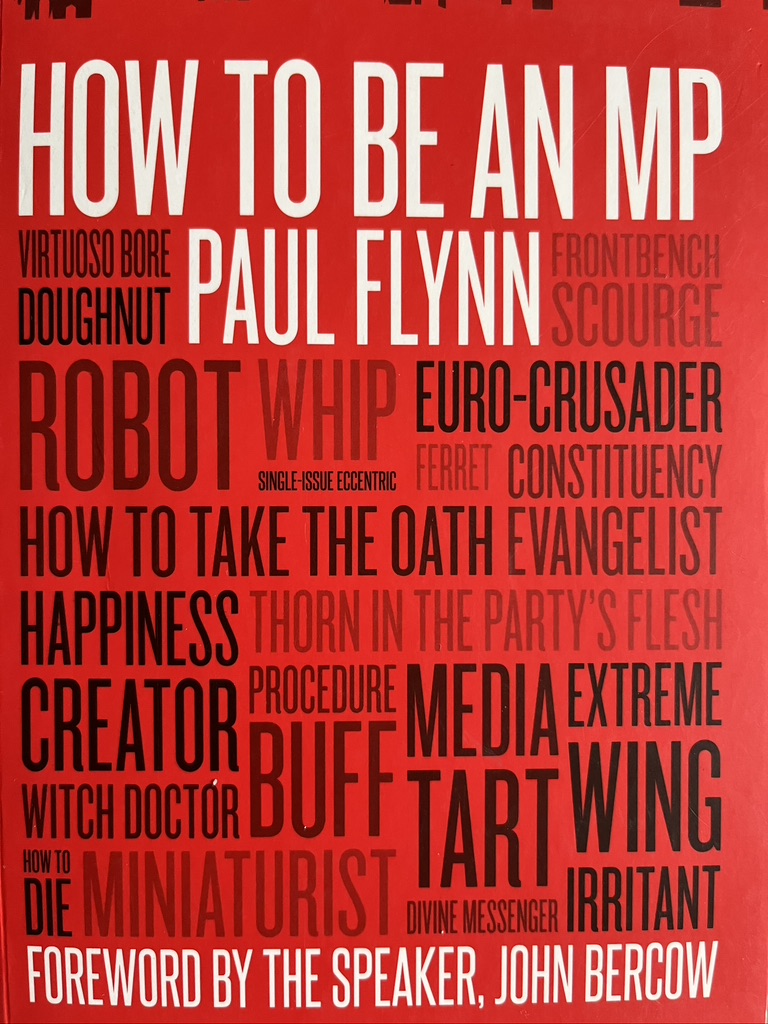
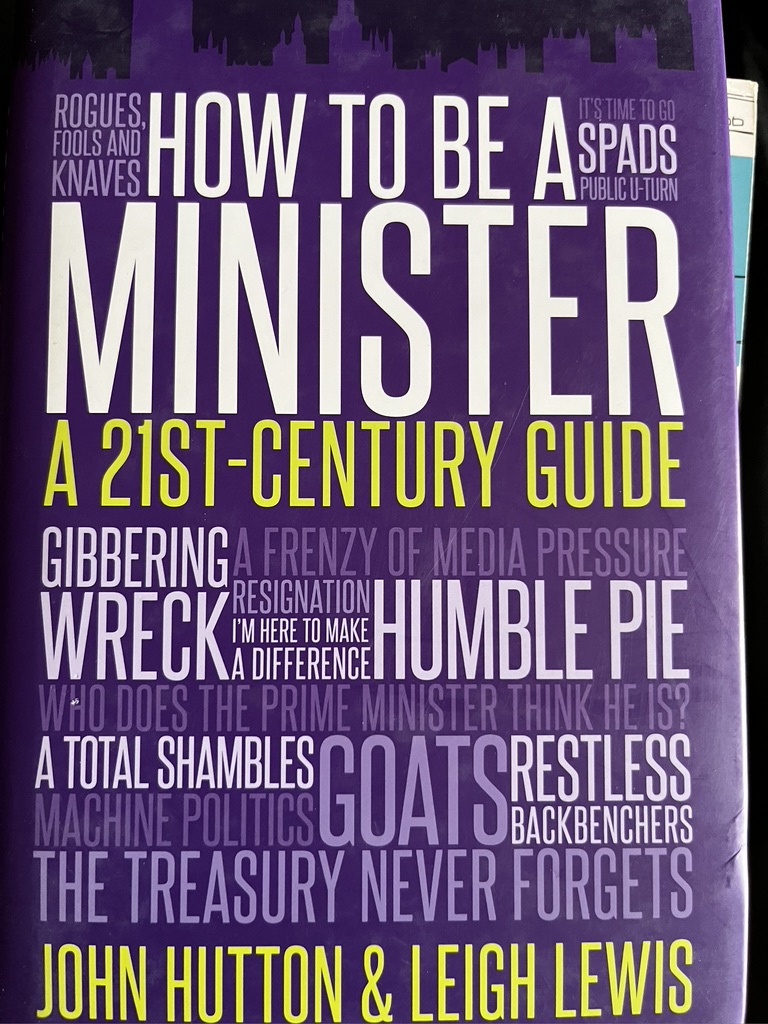
Above – How to be an MP by the late Paul Flynn (one of my first Twitter followers) and Hutton and Lewis’s book How to be a minister, from 2014
Food for thought?
If you are interested in the longer term future of Cambridge, and on what happens at the local democracy meetings where decisions are made, feel free to:
- Follow me on BSky <- A critical mass of public policy people seem to have moved here
- Like my Facebook page
- Consider a small donation to help fund my continued research and reporting on local democracy in and around Cambridge.
Below – For anyone who wants to become a teacher of citizenship

 The Cambridge Town Owl