
“Whatever you think your answer is, it’s what you are doing right now”
Image – we need to get more citizenship teachers trained up
In the second half of my previous post I pondered on this point. Following the developments of recent days, it looks like the European Union heads of government (any any other states invited along) are going to decide on Monday in Paris what their new strategy should be in response to the iron brick that was dropped in front of them by the US-VP.
“Won’t somebody do something?!?!”
What if that somebody is you?
You.
Reading this.
The one small one-off action, or the one small change of behaviour that you would not normally do, that also makes you feel a little uncomfortable / puts you just a little bit outside of your comfort zone?
Make politics sociable again – it’s meant to be part of civic society
The children & teenagers showed everyone how to do it back in the summer of 2019. Who is going to encourage or empower them again this time? And what has become of those generation of teenagers who are now of university age? One of the most powerful speeches of that era was by Australian climate activist Jean Hinchliffe below
Above – Australian climate protests from 2019
I’m asking now while it’s still very cold outside so more of us can start thinking and talking before things like the county and mayoral elections are upon us.
“What can we do given that we’re not superheroes?”
In the 1980s we had Captain Planet, but today such figures seem lacking!
As I mentioned at the end of my previous post, don’t make the mistake I’ve made many times of trying to take on too much only to suffer from activist burnout. At an early stage – and something that doesn’t involve much physical effort, is to have a look around to see who is already active and in which areas. This could mean:
- Finding out who your elected representatives are, and reading up on the functions the institutions they are elected to actually carry out.
- Finding out who is already active in your area – so in/around Cambridge we have Cambridge Resilience Web that co-ordinates this.
- If you’re not familiar with the local history of your area, find out about it (see the BALH’s directory here) and ask yourself: “How did my geographical community get to ‘here’?” (I.e. the situation it finds itself in now. Who made what big decisions and when?)
It’s not easy to encourage/implore people to save something that at a local day-to-day level has very little visibility
Go into your local library (assuming they have not been closed!) and have a look at the politics section. See how many/few books on politics there are – ones that introduce how our society is governed, and how those that govern are held accountable for their decisions.
In Cambridgeshire, the situation is grim – and it’s one of those things where despite asking questions both online and as public questions at meetings, I get a stonewall-of-a-reply. From the purchase suggestions that don’t seem to get through (try it yourself and see if you are more successful – for example see of you can get books from the excellent Usborne for Beginners series for older primary/younger secondary school children stocked. Only they cover things like politics, law, business, climate change, and more. Furthermore, having these books at libraries also makes it more likely that their parents will take notice too – especially those from generations that never covered the topics during their school days.
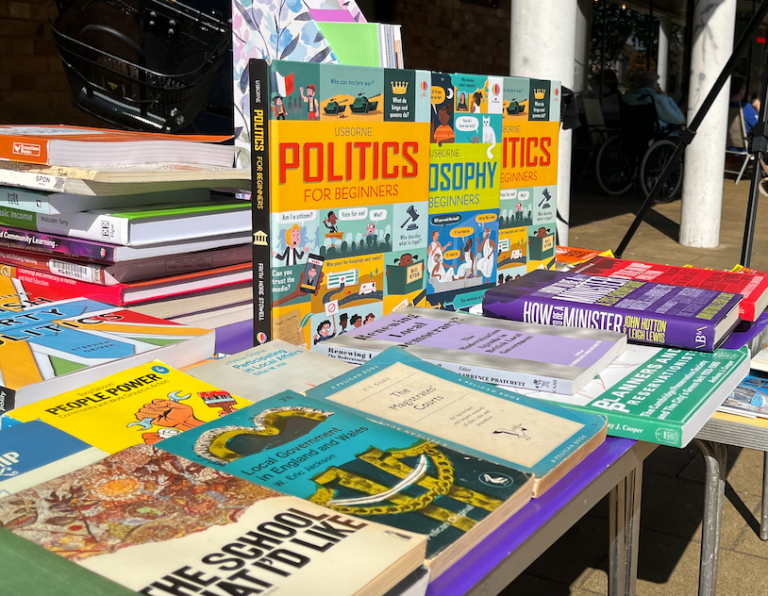
Above – books from my pop-up shop from autumn 2023
I had absolutely no idea what would go and what wouldn’t because I’d never done anything like this before. But the learning and conversations were really useful. Especially on the lack of time to get involved in anything being a huge barrier for working parents – who at the same time indicated they knew they also had a responsibility to take more notice. But then if institutions of the state are not even going to make the effort to meet parents half-way, what hope do they have?
Learning about big political issues from… children’s books!
Every month I go into one of the big bookshops in town to buy myself (and more often than not, something for my niblings) a book or two on what I consider complex subjects and/or things that I was not taught at school but should have been. Such as the brilliant How Everything Works, which is in the same spirit of David Macauley’s epic The Way Things Work, originally from a previous generation.
I also stumble across a lot of second hand or ‘abandoned brand new stock’ that is sitting in warehouses gathering dust and go very cheaply – such as the politics titles from World of Books which you can get 4 for 3 for books under a fiver.
And then once you are done with them, donate them to a local library (which often have booksales and are essential for people on low incomes), bookshop or charity shop – especially the ones in residential neighbourhoods where variety of content on their shelves is inevitably much narrower
Hence these days I tend to find myself donating more books to local charity shops than buying – a strange reversal from times gone by! That doesn’t mean getting to stuff them with party-political/religious/inflammatory propaganda! Quite rightly you’ll get called out for doing stuff like that. (Thinking of the leaflets that get left on bus seats that only create more work for hard-pressed drivers).
And that said, it’s probably harder to find party-political books and pamphlets anyway because so many policy documents these days are not printed and marketed in the way that the old Penguin Specials were in the mid-20th Century. That’s something also reflected not just in the decline of bookshops (especially small/independent ones) but also the decline of WHSmith-style shops that might otherwise display the copies in prominent places when selling them.


Above: – The Motor Car and Politics in Britain, local government in England and Wales (see a selection of digitised old books here), and the same with Town Planning.
I’ve started stacking up on books in preparation for the next series of democracy & local government workshops
The idea being that at the end of each event (which I normally book a community room in a library or neighbourhood centre) everyone gets to take away a book from the crate I bring along on the back of my bike. Because there’s only so much content to get through. (And interestingly, not everyone does take one!) I hope to have some new dates up soon – just awaiting responses from venues.
Because once you’ve done the background reading, it’s good to talk (as Bob Hoskins once said in that phone advert). What we’ve not had, and what I hope we can rediscover, is that spirit of public meetings trying to shape the future of our city – sort of like we tried a decade ago only this time younger generations need to be at the forefront. The only times I have seen this have been:
- The anti-globalisation movement around the Millennium (predominantly left-wing in those days, against the WTO/IMF/World Bank)
- The anti-fees protests of the the early 2010s
- The climate emergency protests of the late 2010s
Now that I’m not one of those early 20-somethings, part of my challenge is also to figure out how to ensure whatever I organise locally is something that is of interest to, and accessible to all.
If you are interested in the longer term future of Cambridge, and on what happens at the local democracy meetings where decisions are made, feel free to:
- Follow me on BSky <- A critical mass of public policy people seem to have moved here
- Like my Facebook page
- Consider a small donation to help fund my continued research and reporting on local democracy in and around Cambridge.
Below – For anyone who wants to become a teacher of citizenship

 The Cambridge Town Owl