
Ministers cannot expect towns and cities to create socially sustainable (or even ecologically sustainable) communities while existing structures that enable the large scale extraction of financial value are kept in place.
Image – Radical Leadership by New Local – we’ll need some of that if things are going to improve
I originally spotted the quotation below, thinking it was going to lead to a blogpost about Newtowns. But having spent so long both in the policy area and in my own neighbourhood, the disparities between what the content of the research paper vs my own lived experiences became too difficult to avoid.
“Good to see that New Towns Task Force thinking is focusing on social infrastructure, community engagement and long term stewardship, health and safety. We contributed to one of the roundtables facilitated by the Design Council, raising those exact points. But we also need to think about Social Capital and Belonging and the less tangible things that make communities thrive.”
Which is all well and good. But we’re beyond the stage where those in policy-making circles can talk about these things amongst themselves. They need to be taking them to the property and developer conferences and networking events, and to the big finance networks and challenging them directly. Because otherwise yet another generation of well-meaning academics, researches, and policy-makers will come up short just as we did with my generation in the 2000s.
“We’re also wondering how communities living near possible New Towns are going to be engaged as potential sites are announced –
- how are we going to assess which have the social infrastructure and community capacity to support expansion at scale?
- How are neighbouring communities going to be impacted?”
There’s just as much value in measuring levels of social infrastructure and community capacity in settlements and neighbourhoods – if only to establish a baseline of where we are and find out the gap that needs to be covered to get to the ideal that their report identifies.
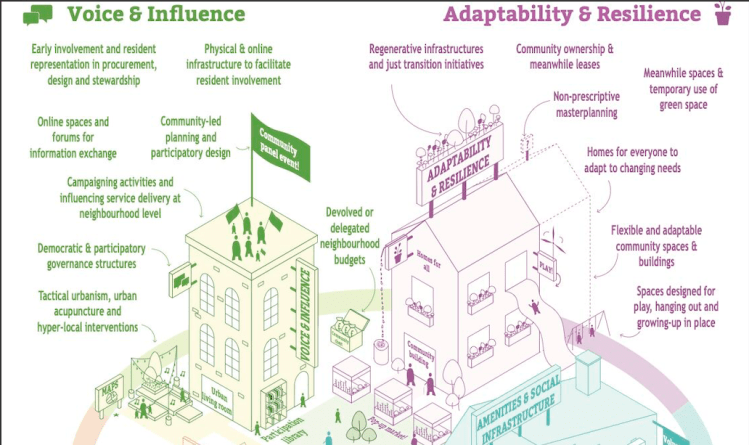
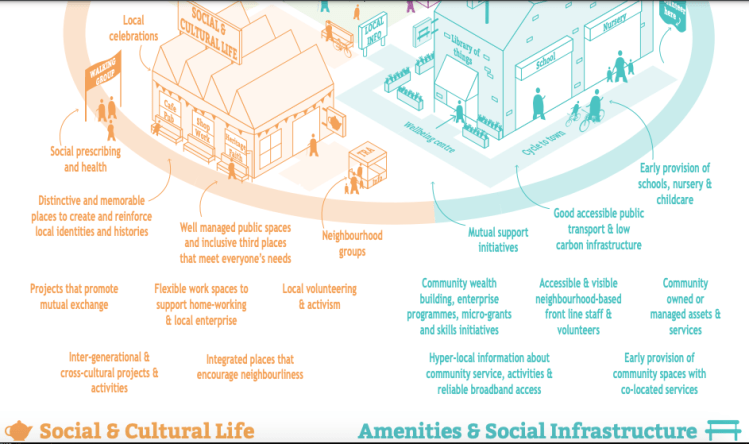
That report – on socially sustainable communities is definitely worth a browse – if only to get some picture of the ideal that the authors think communities should work towards. Furthermore, and as I have done below, compare what the diagram on p3 shows with their framework and see how it does or does not apply to where you live or work.
The inevitable problem with all of these types of reports is…
…they don’t deal with the biggest barrier in the sector, which is the profit motive – especially if a key player is particularly driven by commercial pressures above all others, such as in Brookgate’s case studies at Cambridge Station and Cambridge North. I only use them because they are prominent locally. Chances are every other settlement with similar developments can find examples that sound familiar. Hence my problem as I’ve said before is not with individual firms, but with the legal and institutional structures that generations of decision-makers, lobbied heavily by powerful interests, have put in place.
Changing the system – and the political mindsets too
Until ministers can get a grip on the system that enables firms like Brookgate to do what they have done both at Cambridge Railway Station and at Cambridge North Station, and until they choose to strengthen local government institutions including on raising revenue independent of HM Treasury, then sadly well-meaning studies like the ones below can only ever have a limited meaning and impact – because local communities will for ever never have the powers to implement the nice and interesting things that other countries seem to do so effortlessly in comparison. (Although effortless it is anything but!)
Can you have a socially sustainable community that has extractive capitalism at the heart of its economy?
Let’s take a look at the diagram on p3 of the Social.Life report, revamped for 2025
“Social sustainability is a process for creating sustainable, successful places that promote wellbeing, by understanding what people need from the places they live and work. Social
sustainability combines design of the physical realm with design of the social world – infrastructure to support social and cultural life, social amenities, systems for citizen engagement and space for people and places to evolve.”
Now let’s apply the above to somewhere random like…Cambridge
Let’s take each heading in turn and see how in my very partial view the city compares:
Voice and influence
- Early involvement and resident representation in procurement, design, and stewardship
- Online spaces and forums for exchange
- Physical and online infrastructure to facilitate residents’ involvement
- Community-led planning and participatory design
- Campaigning activities and influencing service delivery at neighbourhood level
- Democratic and participatory governance structures
- Tactical urbanism and hyper-local interventions
- Devolved or delegated neighbourhood budgets
You could do one of those area spiders-web-type diagrams and Cambridge would fall short on all of these – in particular on participatory design where a landowner – especially one based far away (such as with the Paddocks in south Cambridge – eg only works through consultants from London or elsewhere) is hyper-focused on returns on income, so will only do the bare minimum needed to get planning permission.
Adaptability and Resilience
- Regenerative infrastructures and just transition initiatives
- Community ownership and meanwhile leases
- Non-prescriptive masterplanning
- Homes for everyone to adapt to changing needs
- Meanwhile spaces and temporary use of green space
- Flexible and adaptable community buildings and spaces
- Spaces designed to play, hang out, and growing-up in place
You only need to look at the city council’s waiting list of over 3,000 households to know we’re failing on this. There are some examples of use of meanwhile spaces – Together Culture and Cam-Skate being two excellent case studies which are worth visiting. The problem is that they are the exception, not the norm. We need their examples to become the norm. And that cannot be done without existing and future landowners reassessing their institutional values, and the human decision-makers who work for them reassessing their own personal values vis-a-vis communities their day-to-day work affects.
Social and cultural life
- Social prescribing and health
- Distinct and memorable places to create and reinforce local identities and histories
- Well-managed public spaces and inclusive third spaces that meet everyone’s needs
- Projects that promote mutual exchange
- Flexible work spaces to support home-working and local enterprise
- Intergenerational and cross-cultural projects and activities
- Integrated places that encourage neighbourliness
- Local volunteering and activism
- Neighbourhood groups
You only have to look at the case studies in Hideous Cambridge published in 2013 to see examples of failures to create the distinct and memorable places to create and reinforce local identities and histories. Furthermore, the huge cuts to local government budgets mean that the soft human-level activities that should be ongoing over extended periods of time – such as evening classes and hobby groups, have inevitably crumbled with a number not able to reform after the lockdowns.
The aggressive acquisitions of properties for Air BnB, the buying up of properties designed as residential homes for student accommodation or land in residential areas as aparthotels, and the intrusive advertising of private schools on public transport have the cumulative impact of polarising the city rather than overcoming the barriers. One interesting comparison is how former Mayor of Cambridge Mrs Jean Barker, wife of Leys Headmaster Alan Barker, was a governor of Cambridge state schools during her time as a councillor in Trumpington. Do we have any similar examples of governors of the high profile private schools in Cambridge fulfilling similar roles at state schools – especially in our less affluent parts of town, and being able use their influence and connections to bridge the gaps between the two and having a very visible impact in doing so? (I ask that both as a genuine question and also a wider, long term challenge for the whole city).
Amenities and social infrastructure
- Early provision of schools, nursery, and childcare
- Good accessible public transport and low carbon infrastructure
- Mutual support activities
- Community wealth building, enterprise programmes, micro-grants, and skills initiatives
- Hyper-local information about community service, activities, and reliable broadband access
- Accessible and visible neighbourhood-based frontline staff and volunteers
- Community-owned or managed assets and services
- Early. provision of community spaces and co-located services
After 15 years of austerity, everywhere will be starting from a very low base. The skills initiatives which are still constrained by HM Treasury mean that the initiatives will never go beyond the small impacts that they have because local and regional government remains in such a feeble state. The implosion of social media/big tech for all of the reasons we are familiar with means that some of the tools that showed huge promise in the late 2000s are no longer there. A huge missed opportunity globally.
The state has retreated for party-political reasons. It’s not possible to have a government run by a party with a ‘small state’ political philosophical values, bringing in policies based on the dogma of a particular economic school of thought (NPM – privatisation and outsourcing) and then expect accessible and visible neighbourhood level frontline staff who are clearly working for the community and not some outsourcing multinational firm that has many of the diseconomies of scale that ‘big state’ also had in the 1980s.
As for community-owned assets, how do you even begin to build up a network and stock of these in a city where we have a land price bubble?
If you are interested in the longer term future of Cambridge, and on what happens at the local democracy meetings where decisions are made, feel free to:
- Follow me on BSky <- A critical mass of public policy people seem to have moved here
- Like my Facebook page
- Consider a small donation to help fund my continued research and reporting on local democracy in and around Cambridge.

 The Cambridge Town Owl