
Only that’s what a recent study from Gallup indicated (if that link doesn’t open, look for the Leadership needs of followers here).
Image – A sense of purpose – from the Adult School Union’s annual scheme of work for church-based lifelong learning courses from the last century. Have a browse through the civics & democracy-based lessons in this compilation.
In the various sports/leisure/hobby activities that I’ve done over the decades, one of the common themes has been that the professional instructor in charge of us is someone who did not go down an academic route into their career via university. By the nature of the places I live and have lived in, many of the people are graduates and/or experts in their field. Yet when it comes to the hobby or leisure activity, the trust between the learners and the instructors is total. As is the hope. We’ve got some idea that the finished result will give us some sort of satisfaction, knowing that if we do our bit collectively, what we produce will be greater than the sum of its parts.

The results are all the more striking given the news in recent days of the sense of hopelessness in international politics – and the redrawing of geopolitical maps
Given the looming elections in Germany and the instability in other EU countries, ironically it’s the UK under its still relatively new leadership is in a better position than it has been in the last 15 years to provide that much-needed stability – noting Helene von Bismarck’s comment here about the French President’s emergency summit needing the presence of the UK and Norway. (Hence Dr Bismarck’s relief that the UK PM is going – see also the BBC here). It’s easy to forget the Political chaos (self-inflicted by the Tories as they sought to resolve internal party splits) that we in the UK have lived through. The day after the general election result was announced, both the new Defence Secretary John Healey and the new Foreign Secretary David Lammy were on flights to European allies to send a message that ‘The Grown-ups are now in charge’.
Communicating competence and stability is one thing, communicating hope is quite another
And being able to communicate and deliver all three at the same time… …is something that I don’t think any Prime Minister has ever been able to do when viewed from the perspective of the time they were in government. It’s only been in the decades after that perhaps we begin to appreciate the challenges of the eras that they were living in – perhaps aided by our collective partial memories of what things were really like at the time.
If Combined Authority Mayors are going to get more powers devolved to them from central government, then they will inevitably have higher profile roles in political life. Which of the candidates can communicate a sense of hope for the future?
Now that we know who is getting what for the local elections in England on 01 May 2025 (around ten weeks time – so not far away!) we know that there will be four metro mayoral elections (including Cambridgeshire and Peterborough) this May, with another nine new combined authority areas coming up for election alongside their county councils in May 2026 – which will include Norfolk and Suffolk. So expect more than a few Cambridgeshire political activists to head eastwards for campaigns there!
“Who is in the running for Cambridgeshire and Peterborough’s vacancy?”
With Nik Johnson not restanding, Labour are currently holding a selection contest for the vacancy, although Cllr Anna Smith (Lab – Coleridge, Cambridge City Council) is the only candidate who has declared her candidacy so far. The Green Party is currently fundraising to see if they can raise the artificially-high £5,000 deposit (Blame George Osborne for that one) in order to stand a candidate. We don’t know if Labour ministers will table the necessary legislation to switch the voting system back to what it was (second preference) rather than First Past The Post – which is what the Tories in government changed it to after their candidate James Palmer unexpectedly lost the CPCA election due to the transferred second preferences from the Lib Dems to Labour back in 2021.
The Tories have already selected the former MP for Peterborough as their candidate, while the Liberal Democrats have selected their group leader on East Cambridgeshire District Council as their candidate. There are various online rumours about whether TeamNigel’s group will stand a candidate and/or whether any other independent candidates may put themselves forward. But the deposit is a massive barrier.
It’s hard to communicate a message of hope in an election for public office that has so few independent powers
The retreat of the state as the direct provider of public services since the late 1970s has been a huge factor in this – as has the centralisation of powers, particularly throughout the 1980s. There’s a pamphlet / video presentation waiting for someone to make comparing what councils used to be able to do back then that they cannot do today.
- Can local government survive? (1981)
- Go local to survive (1984)
- Paying the price of privatisation (1987)
- Councillors in crisis (1991)
Above are some historical pamphlets you may want to browse through. See also Katherine Allsop’s wonderful explainer on local and central government from over 40 years ago here. I’d love to see a new generation of younger writers and illustrators creating their own version of this for today’s current and looming proposed structures.
“How do you turn debates on potholes into something inspiring?”
How do you try and inspire anyone who has just seen their council tax bills rise again, with little respite on the horizon for a local government finance overhaul? Talking to someone I used to work with during my late teens at the local supermarket, she reeled off a list of issues that different people in our neighbourhood were having – and how increased council tax bills were not going to help. One of the reasons why successive governments allowed local government to increase precepts and bills is that its the councils that get blamed by the voters, not ministers. As a result, the financial burden of social care commitments have fallen on the lower earners because council tax is a regressive form of taxation; wealthier people pay proportionally less of their income on council tax bills than those on low incomes.
It’s one thing having little hope, and it’s quite another to be promoting fantasy policies with no means to pay for them – or even worse, promising to reduce taxes?
Much will depend on the powers and funding that ministers are prepared to devolve – and in particular any announcements over the next few weeks. It remains to be seen how closely the new government will stick to the conventions of not making any big policy announcements that could influence the local elections.
On a message of ‘hope’, one of the things there has been a lot of publicity about of late is apprenticeships and skills. But the UK is starting from an extremely low base. The Cambridgeshire & Peterborough Independent Economic Review of 2018 (see here, scroll down to the bottom) has some ***really sobering findings*** in it that in the grand scheme of things have had little progress made against them. Obviously the pandemic played a huge part, but the chaos in Whitehall compounded the inactivity.
In the progress update from the Cambs Chamber of Commerce published in August 2024 (delayed by the general election) there are a host of issues also picked up there. One easily-missed statement is around soft skills – from p69 / p93.PDF here.
“The [Skills Imperative 2035] study noted that very few of these skills would be useful in isolation, and that young people and adults, in the workforce or seeking to re-enter the workforce, would need to develop a rounded package of complementary and transferable skills to ensure their future success.”
The Skills Imperative 2035 study was funded by the National Foundation for Educational Research.
They are also putting together an even greater evidence base, with new publications being listed here.
With such an intense focus on skills, there is a risk that policy makers won’t see the benefits of the trees because they are too focused on the wood
And as a result, politicians and candidates risk reeling off lines to take and lists of statistics that simply will not connect emotionally with the wider public – especially if it does not resonate with their day-to-day lives. Furthermore, all of the consultations that have been done poorly and in bad faith has had a cumulative negative impact on the willingness of the public to get involved in future ones because, quite understandably to them the deal has already been done. Which in the case of the Beehive redevelopment application being called in, showed why Martin Lucas Smith was spot on to slam to RailPen at Cambridge City Council’s planning committee for lobbying heavily for such a call-in. As Mr Lucas-Smith said, the move has poisoned trust between the community (especially those that had co-operated to improve the quality of the plans). And even worse for the developer, they have to go through the process all over again with the same neighbourhood when they bring forward their proposals for the Cambridge Retail Park. Where they are proposing two new multi-storey car parks in a ward that has three Green Party Councillors and is likely to get a Green Party county councillor in three months time.
We know there is an almighty skills challenge ahead – as this WEF2025 paper shows.

Above – Future of Jobs Report 2025 – In times gone by I’d be dismissing the institution out-of-hand – I still have huge reservations about their lack of transparency and unwillingness to engage with opponents
But this is one of the striking findings: the proportion of people in workforces who by the year 2030 would not be receiving any upskilling in an era where the deployment of technology is making redundant the use of human workers – such as on supermarket checkouts. (With the loss of social capital that is still to be appreciated).
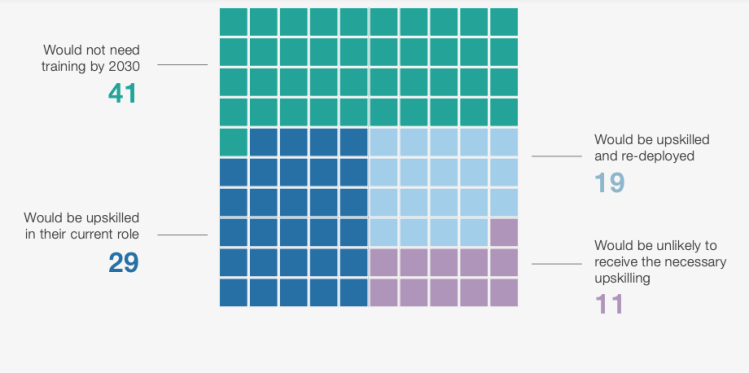
Above – Future of Work Report (2025) p74
If the politicians and candidates broaden the skills agenda to wider wellbeing of people and communities, they may find they can come up with new policies that can deal with the skills challenges at the same time as a host of other issues.
One big challenge is existing jobs being made obsolete by automation. Few are talking passionately about the challenge of retraining and re-skilling the existing workforce – in part because it’s in the ***Too big to deal with*** box.
“Roundtable attendees identified seven main barriers to successful transitions:
- Workers’ time and money
- Government and employer investment
- Information and awareness
- Psychological barriers to re-skilling and changing careers
- Geography (including transport and housing)
- Limited strategic workforce planning
- Management capability and training
These barriers can be overcome, but doing so will require a collective and sustained effort from government, employers, education providers, unions and wider civil society.
NFER 2024 – Skills imperitive 2035 p4
The problem here is that a host of the policy solutions fall outside the remit of the policy team charged with making a positive impact on adult skills indicators. Especially housing and transport barriers.
Andy Haldane’s investment in social capital again
I come back to this blogpost on the RSA and their research into social capital, and the illustration featuring the Beveridge Report of WWII fame.

Above – the five giants.
In a system of commissioning public services which is how the adult education and skills policy area functions (i.e. the Combined Authority does not provide the services directly themselves), the traditional method under ‘New Public Management’ theory might involve allocating five separate pots of money – one to take on each giant, go out to tender with a series of criteria to assess the offers that come back, select and allocate accordingly. But amongst many other barriers, the amount of money on offer is never enough to meet the need. Furthermore, the separate pots inevitably create silos where each jealously guards what few funds they have been provided with.
This is one of the reasons why I come back to creating places where people choose to be
The chance of creating a new second urban centre provides that opportunity to deal with multiple challenges at the same time.
This is because such a new quarter will inevitably need to have excellent public transport and active travel networks, and also have medium-high density housing within walking distance. Looking at the numbered bullet-points from the Skills Imperative Report above earlier, Government & Employer Investment alongside Geography (Transport and Housing) are covered – especially if as I have suggested such a new quarter has a new large and inspirational lifelong learning centre as part of it.
The lifelong learning centre in a new civic quarter – creating a place where people both want to be, and also can have various needs met at the same time
(Note my proposed location – on the airport site, is next door to one of Cambridgeshire’s most economically-deprived wards).
For example:
- having doctors surgeries, dental clinics, and a minor injuries unit all located within the new quarter – thus improving people’s health
- having a free or substantially discounted creche for learners at the lifelong learning centre – thus removing the barrier of affordable and available childcare
- having an extended canteen providing a range of low price but nutritious and tasty meals into the late evening (eg as an alternative to unhealthy fast food outlets while providing more stable, alternative employment at better pay for those working in the industry) – thus improving people’s health and potentially increasing their disposable income at the same time
- As I’ve mentioned, have the new large & beautiful concert hall opposite the lifelong learning centre as the anchor institution for an entertainments and nightlife quarter on the other side – because life shouldn’t be all about work, work, work.
- Having institutions such as/similar to MakeSpace Cambridge, Together Culture, and/or the Cambridge Makers having facilities/workshops within the lifelong learning centre to enable people to try out a range of different things – especially if they have to retrain in a new sector, so that they can make an informed choice. Or simply to learn/keep up a hobby – essential for mental wellbeing and combating loneliness.
Once you have got a critical mass of the people that you need to be there, and for them who want to be there, that’s much of the hard work done.
The challenge is articulating it to give hope to people you want to make the most of it, and whose wellbeing you want to help improve, while trying to convince the policy advisers (I used to be one of them!) and the decision makers (fortunately I wasn’t one of those because I’d have been far too indecisive!) that the numbers and the business cases stack up. Because as I’ve said, the new urban centre concept comes as a package with four anchor institutions:
- A new city hall for a unitary council (where decisions are made)
- A new lifelong learning centre
- A new large concert hall
- A new railway station and public transport interchange
….all around a new civic square. If you can create a situation where your lifelong learners are mixing with the local councillors and council officers, using the same public transport systems, and even going to similar shows in the entertainments quarter at or behind the concert hall, that helps break down the barriers. Take any one of the four away and the whole thing collapses.
So, which candidates wants to borrow these ideas for their manifestos?
If you are interested in the longer term future of Cambridge, and on what happens at the local democracy meetings where decisions are made, feel free to:
- Follow me on BSky <- A critical mass of public policy people seem to have moved here
- Like my Facebook page
- Consider a small donation to help fund my continued research and reporting on local democracy in and around Cambridge.
Below – For anyone who wants to become a teacher of citizenship

 The Cambridge Town Owl