
Come up to Cambridge and engage with residents groups, community groups, arts organisations and environmental campaigners. Because you never know, you might find some new supporters in unexpected places.
Create Streets revamped their proposals for Cambridge earlier this month – you can see them here. I had a look at their previous plans a few months ago. See:
“How do we avoid a culture war?”
I wrote about it here. I don’t want my home town to have its name dragged through the mud more than it already has been. But when you’ve got a brand name like ‘Cambridge’, everyone wants a piece of it. And as I wrote in August 2024, and again in October 2024, municipal leaders have their work cut out trying to deliver the City Council’s inclusive vision of One Cambridge Fair For All when so many large financial interests stand to make their fortunes from promoting our city as exclusive.
The report from Create Streets has both something we can work with, but also requires significant changes and improvements from a residential perspective
Things have moved on very quickly since my blogposts in December 2024. In particular:
- We have a much more clear timetable about local government restructuring and the creation of a new Cambridge Unitary council – which Cambs Unitaries has been calling for in light of the chaotic mess of a structure we currently have – noting initial responses to ministers have to be returned by 21st March 2025(!!!)
- We have a much more clear steer from the Minister for Housing and Planning, Matthew Pennycook MP on the growth of Cambridge’s urban footprint – which he states he wants to be in at least one direction. (For me this means the westwards expansion of the University of Cambridge’s functions, and the southward or eastward-related extensions for residential areas, the latter as proposed by John Parry Lewis in 1974)

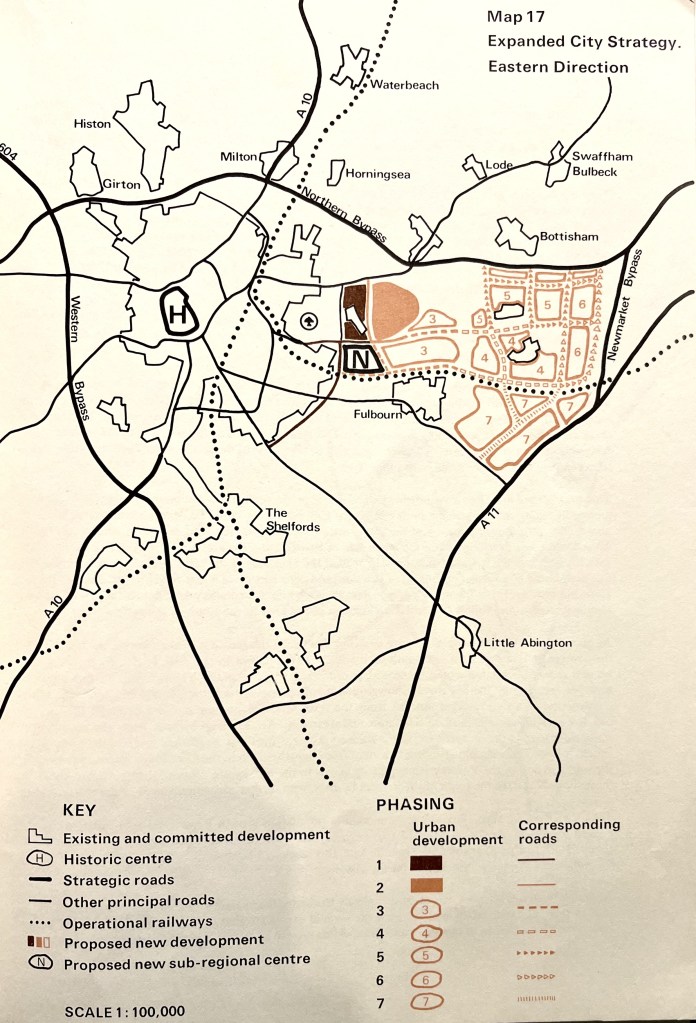
Above – John Parry Lewis whose ‘question’ I wrote about here.
When we look at the two (rejected by the county Tories) options from JPL and compare them with the revamped offer from Create Streets, we can see some similarities with the southward expansion.

Above – Greater Cambridge 2050 Vision (2025) Create Streets, p10
Given how the development options have been bought up by speculators amongst other people – many with pre-existing detailed plans containing the sorts of designs most Create Streets supporters would find awful, a political mechanism would need to be found to prevent the worst of the designs being constructed. Because for example the Commercial Estates Group has already got their vision for something awful already sketched out.

I described their vision as:
“Bland identikit designs, no clear civic centre for the development, small ‘pocket parks tacked onto the edge of an already large area of predominantly residential neighbourhoods with few substantial facilities of note and even fewer architecturally inspiring buildings that people want to spend time in and around.”
CTO 22 Sept 2021
Expand Cambridge Station, or build a new large Cambridge East Station?

Above – an AI/vision/concept of an expanded Cambridge Railway Station which would take out the existing 1845 original station building. Create Streets (2025) p11
Given my depressing piece from 2016 about the awful and ugly developments on my side of town around Cambridge Station and how a small number of splendid chaps from a range of developers made quite a lot of money from mediocre constructions, I quite like the idea of someone coming in and overhauling the place to do a much better job than what we currently have. Given the record of the construction industry as exposed at Grenfell and as Cambridge’s MP Daniel Zeichner publicised in his speech to the House of Commons here back in 2021, I wouldn’t be surprised if the facades and the interiors of those buildings all had to be stripped back in the next few decades because of such woeful building standards.
A second urban centre for Cambridge
Given my proposal for a second urban centre for Cambridge here, anchored by:
- Cambridge East railway station (along the Cambridge-Newmarket line by the rail bridge over Barnwell Road and Coldham’s Lane)
- A new large city hall for an empowered municipal council
- A new large concert hall that is much bigger than the Corn Exchange, spilling out eastwards to a night life/entertainment quarter
- A new large lifelong learning centre spilling out westwards over Barnwell Road onto Coldham’s Common
…one option is to move the existing 1845 railway station building out to a new site for Cambridge East, and rebuild it brick-by-brick, thus creating space for a new grand central station for Cambridge.

Above – an AI/vision/concept of Cambridge Station having a Kings Cross-style glass-and-steel roof. Create Streets (2025) p11
I quite like the concept, mindful that those of you with eyes for detail will be able to spot the various weird looking things that the AI program has created. (Windows are often a giveaway – as are the consistency of curved arches!) That said, this is where I think AI could be used as part of the process to come up with themes for visions, but then where humans should then take over and convert the theme into something that both makes sense at scale and also abides by the laws of physics, civil engineering, and materials science! Because let’s face it, if any of you have done the Cambridge-London commute, you’ll know how miserable Cambridge Station is. And that’s before mentioning this hideous carbuncle outside of the station which should really be sent back to the creator.
The Create Streets wider vision does not account for the existing emerging local plan allocations
We can see that in the map on p12 (detail below) which does not label the Airport site (above the purple British-Rail-purple-iconed station furtherest left).

Above – Create Streets (2025) p12
Scroll further up and you’ll see that neither Cambridge North Station (controversially granted planning permission by the previous government, overruling objections over water resources from the Environment Agency) nor Darwin Green are shown as built out. With the Census 2021 showing Cambridge within its 1935-era boundaries having a population of over 145,000, the addition of over 10,000 new homes on the airport site and over 10,000 new homes on the North East Cambridge Site, plus the homes still due to be built out at Darwin Green and Eddington, will probably bring Cambridge’s population to above 170,000. (Assuming 2 people per dwelling as an overall average).
**Three new contiguous neighbourhoods with 183,000 – 214,000 homes by 2050**
The Minister for Housing told Peter Freeman, Chair of the new soon-to-be Development Corporation that he wanted the pattern of growth for urban Cambridge to happen along ‘least one new contiguous’ line. So two or more. Combining the emerging plans with these proposals from Create Streets would give a total population of much more than 214,000.
Which raises a whole host of issues including:
- Resources – is the UK producing enough bricks (and other building materials) to meet the demand?
- Climate emergency – how do you build all of that without so much as releasing a molecule of carbon dioxide or methane?
- Community cohesion – how do you reverse the fragmentation and polarisation of our city that we currently have? (Andy Haldane on Social Capital again)
- Sound democratic institutions, structures, systems and processes – noting back in 2022 I complained about the weak institutional links between local councils and health services – something that needs resolving in the devolution processes
- Regional facilities that don’t require people from the northern side of East Anglia to have to go to London. And noting that at the same time, not everything actually needs to be in Cambridge.
Newtowns
This is also where Newtowns come in, because we’re due to get a few round here on top of Cambourne, Northstowe, and Waterbeach Newtown. I’m expecting one at Six Mile Bottom, and possibly another two between Cambridge and Bury St Edmunds. Unless there is a pre-existing large historical attraction (country house with exquisite gardens, ruined abbey or ancient castle), any newtown will need to build something that will attract people to it from outside lest it becomes a dormitory town for the workers on Cambridge’s science parks.
Controversially, the vision of Cambridge only being for a wealthy and intellectual elite serviced by workers who commuted on from outside was a vision put forward by Prof Jeremy Sanders back in 2014. Most of us had forgotten about it until Cllr Sam Davies reminded us of the document that contained the visions of Cambridge in 2065.
‘Town’ is missing at the heart of the Create Streets proposals – but it doesn’t need to stay that way
All four of the light rail/tram lines are named after university figures, not town figures. Florence Ada Keynes and Clara Rackham have got stronger local history cases than Alan Turn and Rosalind Franklin – not to take anything away from the greatness of the latter two whose contributions went far beyond the places that they lived and worked in. With Florence Ada Keynes – our first woman councillor elected in 1914, later our second woman mayor, she spent most of her adult life here in Cambridge – as did Clara Rackham, the latter who as we found out in Mary Joannou’s wonderful biography of her, turned down both the offer of the mayoralty (she would have been the third or fourth woman – Eva Hartree later becoming the third in 1946), and also an OBE that Winston Churchill offered to nominate her for when he was Prime Minister.
As for the Darwin line, you could probably name it collectively for anyone sharing the Darwin surname – whether the three knights (Francis, George and Horace), all sons of Charles, Maud and Ida (daughters-in-law), or even grand daughters Gwen (later Raverat) and Margaret (later Keynes). But that would require a level of local historical knowledge that most people in our city don’t have – and I certainly did not have until I started researching the history of my home town after the EU Referendum result.
Let the children of our city shape its future too!
As I’ve asked town planning professionals and networks repeatedly, please can we have new books on town planning that’s aimed at children and young adults? Ideally something that fits in with the Usborne Beginners series that also covers politics and law (amongst other big topics – AI is due to be released in July!)
The Book of Cambridge
One thing the children can teach us old grumpy people (I should get club membership) is to have fun in the process.
“Cambridge Junction, in collaboration with Cambridge Room and Cambridge University Press & Assessment are excited to launch the Book of Cambridge, the culmination of a unique project made with children from primary schools across Cambridge.“
“Who was the Bridge of Sighs built for?!? That’s right! Tourists!
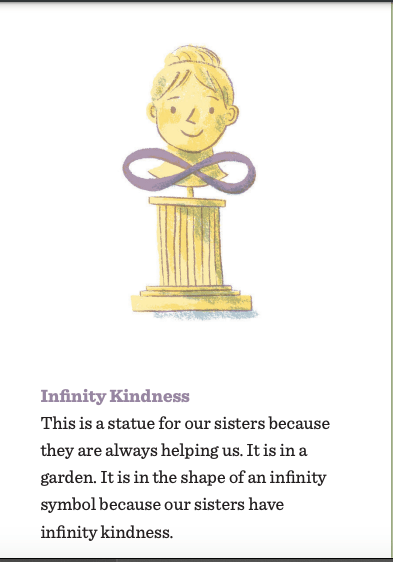

Above – can we have an infinity kindness statue as well please? From the Book of Cambridge
Cambridge Past, Present, and Future – Cambridge’s local civic voice member organisation
For me, Cambridge PPF is one of the top institutions to get in touch with. Ditto the Cambridge Federation of Residents Associations, Rail Future East, Connect Cambridge Light Rail, the Cambs Sustainable Travel Alliance, and the Cambridge CVS.
For those of you who want to get involved with party politics, the four main parties at Westminster are also represented on Cambridge City Council (Labour, LibDems, Greens, Conservative) and you can find contact details here. The ones most interested in town planning are on the Transport and Planning Scrutiny Committee listed here.
There’s also:
- The Cambridge Forum for the Construction Industry
- Cambridge Architects
- Cambridge Ahead
- Cambridge Network
“What if I’m against the huge expansion of Cambridge?”
Get involved in party politics – The Cambridge Green Party is particularly strong on this point. Alternatively, the Cambridge Friends of the Earth Group which has been going for nearly half a century, and some of the groups mentioned in Cambridge Resilience Web have also been campaigning on the problems created by such rapid growth.
As the politicians found out the hard way with the congestion charging proposals from the Greater Cambridge Partnership, don’t pretend that opponents to the plans for growth do not exist. They do. And for many, it’s their homes and communities that are being affected in a very big way. People employed to deliver on Government policy, don’t ignore those concerns. Engage meaningfully with them and make meaningful changes and improvements to your proposals. Otherwise Cambridge may become the new Newbury – and a new meme for direct action environmental protests. And in the middle of a climate emergency, that risk is even more likely than it was in the early 1990s.
Above – 20 years after Newbury, a series of protests that put a stop to major road building projects in the UK for the next two decades
If you are interested in the longer term future of Cambridge, and on what happens at the local democracy meetings where decisions are made, feel free to:
- Follow me on BSky <- A critical mass of public policy people seem to have moved here (and we could do with more local Cambridge/Cambs people on there!)
- Like my Facebook page
- Consider a small donation to help fund my continued research and reporting on local democracy in and around Cambridge.

 The Cambridge Town Owl