
When this “World in 2040” report was published back in April, I don’t think the authors could have imagined a scenario that has happened since the end of October 2024 actually happening.
I wrote about that report here, noting what it suggested about the difference between a state and a private education. On the report itself, you can read the summary brief here, and access the link to the full report too. The thrust of the report is that the UK needs to accept it isn’t the Great Power of 120 years ago, and can only make an impact if it works better with other countries and global institutions, and also practices what it preaches. And this is the situation that the Prime Minister Sir Keir Starmer will be finding himself in when he goes head-to-head with the US President in public for the first time. We got some hint of what he will face with the French President heading over earlier today here.
The US votes against a UN General Assembly resolution that was backed by most of the EU
One for historians of international politics: when was the last time the USA, Israel, North Korea, and Russia all voted the same way on the same UN resolution? Only that’s what happened earlier. Furthermore, the conduct of the US Government in the run up to the general election in Germany resulted in not only scathing comments from the Chancellor-elect, Friedrich Merz, but also a new impetus from the incoming German Government about making the EU less dependent on the USA for its security.
And that’s the existential risk for the EU – that the governments in charge of the two Cold War superpowers are now hostile to the existence of the EU.
Ironically, the more extreme elements in the pro-Leave side in the EU Referendum in the UK made it clear that they saw the UK’s vote as just the start of attempts to bring down the union. The net result – at least in the medium term, was to create a huge incentive for the EU nations to stand together as one against the UK Governments of Theresa May and Boris Johnson. Combined with both the war in Ukraine, and the CV19 pandemic, the EU has been forced by circumstances to work together far more closely than many of them could have anticipated a decade ago. Which also puts the EU in an interesting position in the current circumstances because the experiences of the past decade put it in a much stronger position than it might have been in even back in 2016.
Don’t think what’s happening in the US (or even in Germany with the second largest party being the far right), cannot happen here
For a start, we’ve already seen how (again, ironically) the language and campaigning tactics and even resources are now crossing national boundaries effortlessly. We can see that also in the language that TeamNigel’s MPs are adopting – words and phrases normally only mentioned in parts of US talkshow discourse but now being repeated in the media bubble in that part of the internet. Even worse, the Conservatives – lacking in high calibre politicians in Parliament, and lacking a political rudder similar to where they were in the late 1990s, are jumping on any bandwagon that happens to be passing.

Above – the British Newspaper Archive picking up on newspaper reports about the then Conservative Leader of the Opposition William Hague (later David Cameron’s Foreign Secretary) jumping on passing bandwagons
Which is why when the Tories promoted their party leader as some great defender of civilisation, the whole thing felt so farcical that the only thing I could picture was a small group of die-hards responding with all the self-awareness of the comically-cringeworthy Captain Bertorelli (brilliantly acted by Gavin Richards) from the UK 1980s Sitcom ‘Allo ‘Allo.

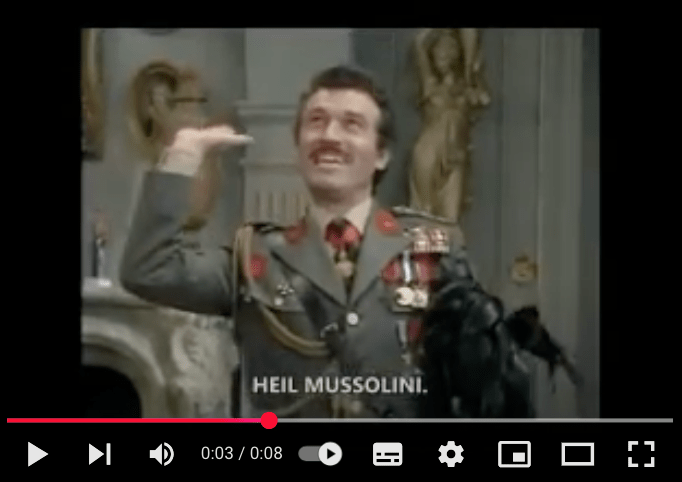
Above-left – a widely-ridiculed advert from the opposition party, and above-right, a widely-ridiculed ficticious Italian liaison officer depicted in 1940, based on awfully-outdated stereotypes.
As a quick aside, one of the reasons attributed to Italy surrendering in 1943 was that Mussolini took their country (then still a monarchy under Vittorio Emmanuele III) into a war allied to a country/regime the people had no particular affection for, fighting an enemy they did not hate (and outside of imperial ambition, had no politically compelling reason to be fighting – if anything quite the opposite given the UK’s dominance of the Mediterranean). Denis Mack Smith’s damning biography of the dictator from 2001 is worth a read – The Sunday Times concluding in its review:
“The particular merit of Mack Smith’s Mussolini is that it reveals his extraordinary bloodthirstiness as a war leader, combined with an equally extraordinary incompetence in the same role…one of the most severe indictments of Mussolini ever penned“
Above – The Sunday Times quoted on the book’s back cover
It’s a quotation I’ve adapted to describe the political career of Boris Johnson:
“The former Prime Minister showed extraordinary ambition and ruthlessness in his desire to become Prime Minister of the UK, only to demonstrate extraordinary incompetence in the same role.”
Above – feel free to quote me on that!
Which is also why the report by the Association of Electoral Administrators (AEA) on the 2024 general election is ever so important – because the legislation underpinning some of the shortcomings was tabled by Boris Johnson’s Government having been incorporated into a general election manifesto that he knew in advance he was going to win. (Hence a whole host of other controversial promises were thrown into it)
If we are to strengthen our democracy to deal with the inevitable onslaught that we saw Germany have to deal with, this report by the AEA is essential reading.
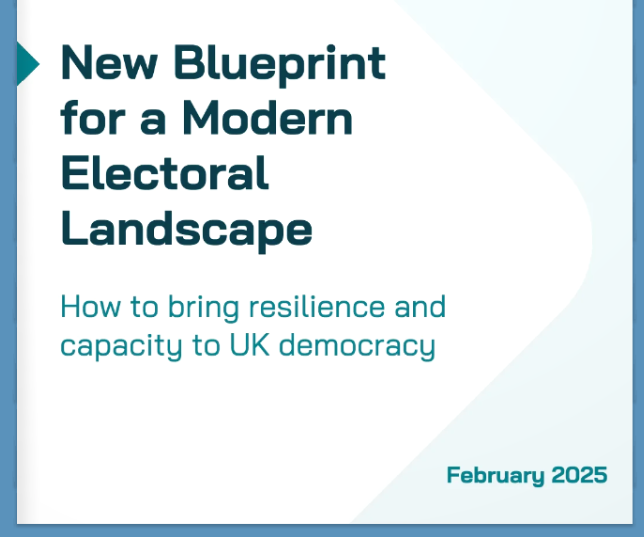
Above – the AEA’s report – after which you may want to contact your councillors, your MP, and any election candidates too.
This is one of those areas where someone like me contacting a councillor won’t make much difference. My opinion isn’t representative of anyone other than myself – as I often state at the start of public questions I table at The Guildhall.
If the integrity of elections is something you think is important enough for you to take a one small one-off action, then dropping a short email to your councillors asking them to read the report and give their views/opinions (and asking what they/their party will be doing in response to the recommendations) is not a bad way to start. Simply because it only takes a few minutes but it lays down a marker for local politicians at a time when they could probably do with more people corresponding with them on local issues.
“What does the AEA report recommend?”
- An independent Royal or Parliamentary Commission review of core election delivery processes.
- A review of all existing electoral law to produce a single Electoral Administration Act which respects devolved nation differences.
- UK and devolved governments to work collaboratively on electoral matters to limit divergence.
- An urgent review of electoral funding and funding mechanisms.
- UK Government to review supplier capacity to identify and mitigate against potential risk.
Above – AEA (2025) p3 – headline recommendations
They also have a series of more detailed ‘technical’ recommendations – 57 of them over four pages (!!!) which reflects how utterly broken our electoral system is. And if our electoral system is broken, we can hardly expect to have a splendidly-functioning government, or a sound House of Commons strong enough to hold ministers to account.
“Anything particularly interesting in the recommendations?”
Remember receiving one of these in the Police and Crime Commissioner Elections?

Above – PCC Cambridgeshire & Peterborough Statement of Candidates 2024
“Nope. Well…may have seen one somewhere but it can’t have been that memorable if I’ve forgotten!”
The principle is sound though – having candidate booklets. See if you can find your candidates from last year’s elections here.
“At Police and Crime Commissioner elections, candidate addresses are available online, with a print version available on request. We believe similar provisions should apply to all polls where a candidate booklet is required, removing the need for a printed version to be sent to every household or elector.
“If this is not implemented, it is imperative legislation for polls requiring a printed candidate booklet to be sent to every elector be amended to every household instead, reducing the cost to the public purse.”
Above – AEA (2025) p39 – on candidate booklets
I quite like the idea of one booklet per household and also publicising the online versions widely. At the same time, this would need to go hand-in-hand with other major changes – for example following Scotland’s example of enabling residence-based voting for anyone with the right to live in the UK, irrespective of immigration status. ‘No taxation without representation’ and all that. (See the Migrant Democracy Project here if you’d like to campaign for this). Note again I think this should also be joined up with a renaissance in citizenship education for resident adults too.
“Anything missing?”
It’s outside of the remit of the AEA, but I’d like to have seen something about democracy education for adults in there. Because ultimately if we want the most representative possible elected representatives serving in local and national councils, assemblies and parliaments, then having an informed electorate is essential. Informed about all of the candidates standing, informed about the political parties, summary histories and values, and an understanding of the powers and competencies of the public offices the candidates are contesting.
But then that would require a renaissance in adult education. Something a top 20th Century astronomer had something important to say about.
If you are interested in the longer term future of Cambridge, and on what happens at the local democracy meetings where decisions are made, feel free to:
- Follow me on BSky
- Like my Facebook page
- Consider a small donation to help fund my continued research and reporting on local democracy in and around Cambridge.

 The Cambridge Town Owl