
The House of Commons Committee on Housing, Communities, and Local Government pushed Jim McMahon MP further on empowering more revenue-raising powers and spending
This follows the grilling that his ministerial counterpart received in the Lords
Image – the logo from the Layfield Commission on Local Government Finance 1976 – if only because we could do with another one on this subject.
You can watch some of the select committee proceedings here, which cited the visitors’ levy in Edinburgh and also in Manchester. But the Manchester example in particular required the consent of the industry. It’s not mandatory.
“These are routine requests for what I would say are marginal requests…The Government wants to look at taxation in the round”
Jim McMahon MP, Minister for Local Government to Commons HCLG Committee 25 Feb 2025
Following the point above, the Minister conceded that Austerity 2010-24 hit neighbourhood services badly
As a result, the public saw the rapid decline of public services while at the same time seeing the significant rise in council tax bills.
The impact of this has in part played into the hands of TeamNigel (whether as UKIP, BrexitP, ReformUK) because they have never been responsible for running a council and delivering public services. If all that the public sees are declining services combined with rising council tax bills, not surprisingly they will either take their anger out at the ballot box or simply turn away from local democracy on the grounds that things remain the same whoever gets into power.
Labour’s position is particularly challenging because of the state of both public services and public finances left behind by the Conservatives. Yet at the same time there is only so long that they will be able to blame the Conservatives for. Even more so if central government is seen to be favouring wealthy and/or controversial interests (especially ones that a critical mass of their hardcore supporters *and* opponents to their left know about!), or where there are alternative sources of funding that can be targeted towards wealthier consumers – eg frequent flier levies / corporate jet flights. Not that such revenues alone would be enough to take the strain of local government services.
The complaint from fast-growing regions is that not nearly enough of the wealth created is reinvested back into services and much-needed new infrastructure.
I’ve mentioned this many times before – and it’s not helped by the complete separation of institutional decision-making within the state between the training and employment of doctors and dentists vs the decisions on housing growth, whether local development planning or individual planning applications. Furthermore, the proponents of growth have failed to take the residents of the places facing that growth with them – let alone share the proceeds of the growth.
Land value taxation
One of the alternatives to property-based taxation is to tax the value of the land. This is something that the Conservatives have resisted successfully for the best part of over a century.
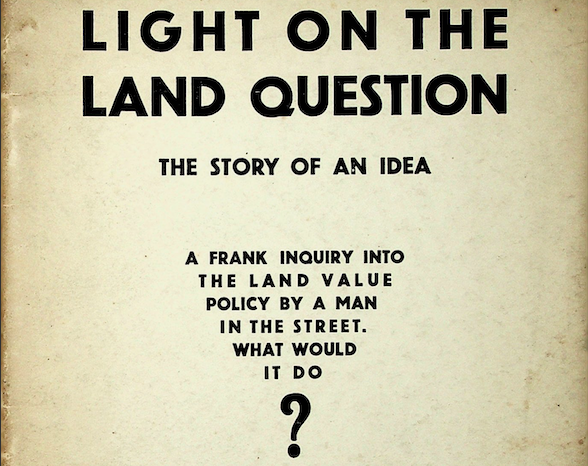
Above – a short guide on land value taxation – from the late 1920s
The Scottish Land Commission also produced this guide which also raised a number of practical considerations on p4
“Awareness and understanding of land value tax is currently low, making it difficult to engage in a well-informed public debate about the potential implications. International
experience shows that this has been an important barrier to successful implementation elsewhere. As such any moves toward implementation should be accompanied by efforts to raise awareness and promote a well-balanced public debate.”
Scottish Land Commission – Land Value Tax (2018), p4
Other alternatives such as a local income tax have also been proposed (See some alternatives from decades gone by here) whether locally-set or a simple allocation of a percentage of total income tax which then gets distributed by a formula grant (i.e. based on demographic and economic indicators including average incomes and average life expectancies – which helps explain why filling in the census is ever so important!)
The lack of civic education and political literacy makes it easier for Labour’s opponents
I’ve lost track of the number of social media posts blaming the city council for potholes. Hence the simplification of the structure to unitaries (which the Cambs Unitaries Campaign will be discussing on 08 March) will need to be accompanied by policy changes to deal with what feels like a growing disparity between local taxation and public service provision
Central government limits on local government tax rises
This is a relatively recent phenomenon, brought in by Margaret Thatcher’s Government in the mid-1980s as she sought to crush the independence of local government and in particular those councils that were rebelling against her government’s policies. This publication from the mid 1980s by the National Union of Public Employees – later to merge to become Unison, explains why the policies were so controversial.
The other light that the NUPE document shines a light on is the range of services and independence that councils once had compared with today. We’re now in a world where councils ‘commission services’ from ‘external providers’ whether charities, not-for-profits, or multinational corporations that specialise in the provision of outsourced services. I’m not entirely sure what the pro-market pro-efficiency argument is of having over-large institutions with monopoly power not suffering from diseconomies of scale – something that was often thrown at the large over-bureaucratic state functions at the time.
Changing technology and ways of working since the 1980s
The pamphlet from the Conservative Policy Centre on Privatisation 1979-1994 is worth a browse, if only to compare what was still something of a public policy experiment compared with the subsequent 30 years of experience. How well did Michael Heseltine’s predictions hold up? These included:
- Choice for customers
- Competition amongst suppliers
- Improved productivity and efficiency
- Employee participation and wider share ownership
- Value for the taxpayer
- Clarity of purpose for the Government
Above – Heseltine (CPC 1994) quoted in CTO Sept 2023
Given the significant developments in things like communications technology and computer processing power – along with the significant changes in our economy that in part have been driven by the invention of the standardised metal box that is the shipping container, to what extent do the benefits that Heseltine and co stated still hold true? Or was there something to be said about the assumptions on how ministers and MPs meant to act in terms of subsequent policy-making? In particular the prevention of large firms emerging to crush what was meant to be a competitive market?
I’ll leave those questions for the public policy academics – mindful also that the new Government’s policy is to promote co-operatives in the delivery of public services. (Shaped by the significant number of Labour MPs who were elected on a Co-operative Party ticket, including a number of ministers – one of whom is the Minister for Local Government!)
Every so often I’ll write on a wider public policy issue that goes beyond Cambridge, such as here
- Follow me on BSky <- A critical mass of public policy people seem to have moved here
- Like my Facebook page
- Consider a small donation to help fund my continued research and reporting on local democracy in and around Cambridge.
Want to know more about politics and democracy but don’t want to read a heavy text book? Have a browse through the Usborne For Beginners series which also includes law, climate change, and will soon have artificial intelligence as well!

 The Cambridge Town Owl