
The Campaign for Better Transport called out the omission on rail upgrades more generally
Image – Team Bat, Team Newt (after the two creatures came in for blame on recent developments)
Last year I wrote that the Climate and Nature Bill did not go far enough. Essentially it looks like a series of things that should be policy commitments, not something you need to legislate for – not least because there are no penalties for non-compliance. See also Lauren MacDonald’s masterclass from 2023 and 2024 vs Equinor – all the more powerful given what the oil companies are now doing.
The role for rail – or the lack of in the report
The Campaign for Better Transport did not mince its words
“We are disappointed that the CCC does not see a role for rail in this due to the length of time it takes to deliver rail infrastructure improvements. Making rail more affordable is the main factor that will help more people travel by train more often, and with reforms to the fares system due this Parliament, this is something the Government could focus on to help increase rail use.”
Campaign for Better Transport, 26 Feb 2025
I agree. Furthermore, we are nowhere near treating the climate emergency as an actual emergency similar to the demands imposed on the economy during wartime. Even though the Prime Minister announced yesterday his major policy change on defence spending (which will ramp up production on arms), the investment needed in supply chains that was achieved in wartime – along with the production increases, was phenomenal.
Admittedly the UK would be starting from a much lower base if it were to get steel-making up and running again, some of the latest research on technologies to produce low to zero-carbon-emissions steel look interesting. Furthermore, there’s a national security argument for keeping essential manufacturing capacity going – and having the continued demand for the production of metal components to use for transport infrastructure seems like a reasonable compromise to have, even though I’m under no illusions as to how complex it can be from switching from manufacturing for wartime to manufacturing for peace time.
The UK – with a lot of help from allies, built a significant light railway network to keep the trenches and the soldiers in them supplied during the latter part of the First World War
“By late 1916 construction of lines was under way, and between January and September 1917 the average tonnage conveyed weekly on light railways operated by British and Dominion forces expanded from barely 10,000 tonnes to more than 200,000 tonnes. The network was to grow to some 2,000 miles of track.”
Above – Imperial War Museum, transport and supply during WWI
2,000 miles of track in just under 2 years? Impressive – although it’ll never be comparing like-with-like. During wartime they had to contend with the threat of air raids and long range artillery barrages – along with the challenges of building through land ploughed up by the previous years of warfare. Today, how would you go about building a surface light-rail network on already-clogged-up roads? (Noting the expense and complexity of tunnelling).
Such was the success of the light rail system that Cambridge MP Eric Geddes (who was brought in by Lloyd George to overhaul munitions production before being parachuted into the safe seat of Cambridge – his predecessor Almeric Paget being kicked upstairs into the Lords as Baron Queenberry) went onto praise the system of light rail especially for agriculture, saying that the UK should build similar networks in a speech at Cambridge’s guildhall in December 1918. This was the same speech when he made his infamous ‘Hang the Kaiser’ remark. A shame everyone forgot about the light rail bit!
To give you some idea of how detailed the networks were, one map from E.C. Garbett survives – have a look here at the network around Ypres.
“The Railway Operating Division (ROD) was a division of the Royal Engineers formed in 1915 to operate railways in the many theatres of the war. It was largely composed of railway employees and operated both standard gauge and narrow gauge railways.”
Above – Australian Army Museum of Western Australia
It’s worth noting that just as today the UK could not be self-sufficient in producing the components needed for new light rail systems, so the same was true in WWI – the Imperial War Museum noting that UK suppliers could not meet the demand from the armies of France and the British Empire at such short notice – hence getting supplies from the USA, and then having Empire forces (in this example, Australia) to run the network!
That wasn’t the end of it either
In 1944 the Light Rail Transport League published their post-war vision for UK urban transport – you can read it here
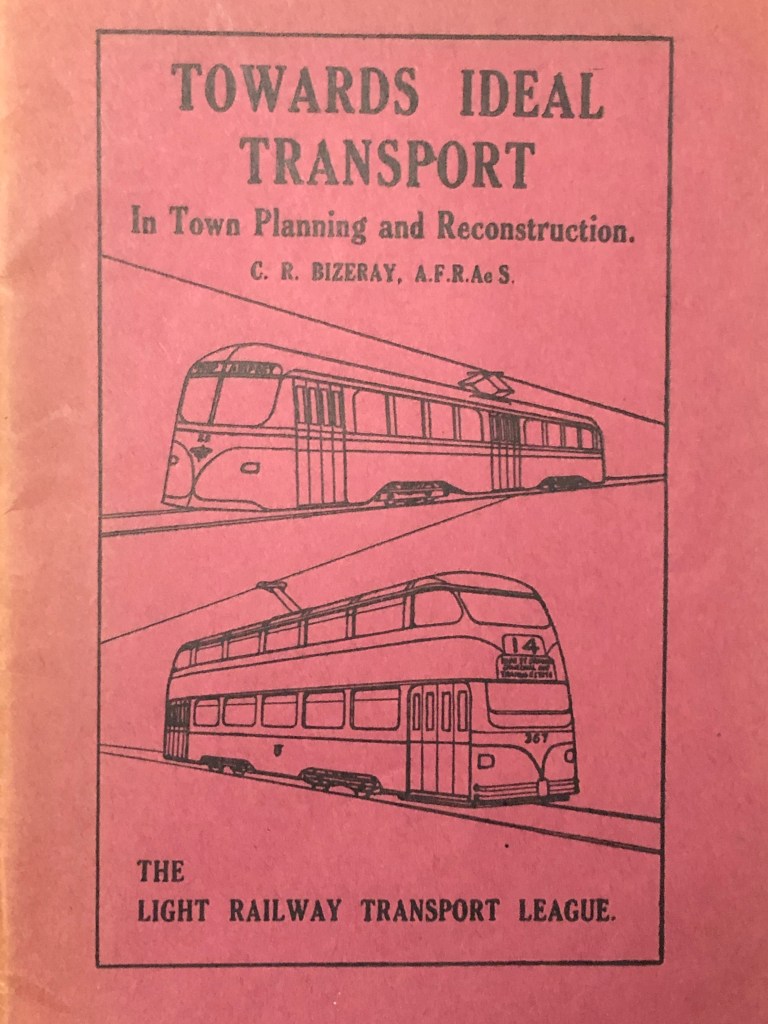

Above – by the LRTA 1944 – and also see the modern day version of the magazine by the LRTA here.
“So…who needs to do what to get trams and light rail included?”
You can do the following:
- Email the Climate Change Committee and ask them why trams and light rail don’t feature
- Send an FoI Request to the Climate Change Committee asking what correspondence they hold regarding light rail and tramways
- Email your MP asking them to get an explanation from the Energy Secretary or the Transport Secretary for this omission
- Email your MP asking them to request the Transport Secretary make a policy statement to Parliament setting out what the Government’s policy and approach to new tram and light rail networks in towns and cities in England (it’s a devolved matter for the rest of the UK) is.
Can’t really complain too much about the Climate Change Committee if central government has not shown a lead on trams and light rail. Noting that one former transport minister in the previous Conservative government spoke highly of such modes of transport.
Which also reminds me – meetings Cambridge & Cambs residents can ask tram-related questions on
- Highways and Transport Committee – Cambridgeshire County Council – Tuesday 04 March 2025
- Planning and Transport Scrutiny Committee – Cambridge City Council – Tuesday, 25th March, 2025 5.30 pm
- Transport and Infrastructure Committee – Combined Authority – Weds 05 March 2025
Want to know more about trams and light rail?
See former Transport Minister Norman Baker’s article here. His ten point plan is:
- Government to set a target for growth in the use of light rail in its Transport Decarbonisation Plan
- Government to identify towns and cities that have no light rail network and work with local transport authorities to remedy this i.e., Leeds, the biggest city in Europe with no light rail system
- Government to redirect a portion of the £27 billion road building programme to pay for light rail schemes
- Government to streamline the 1992 Transport and Works Act to make it easier and quicker to get light rail schemes up and running
- Light Rail Standards and Safety Board to review barriers to investment and encourage standardisation within the sector and cut costs
- Government to allow local areas to use the equivalent of the French ‘versement transport’ to allow local transport authorities to levy local business that will benefit from a light rail system to help offset the costs
- Light rail sector to share best practice to bring down costs of new schemes. For example, Edinburgh’s scheme cost £71 million per km against an average of £20-£30 million per km
- Light rail promoters to consider very light rail schemes which cost less to install
- Government to help fund integrated ticketing between light rail, heavy rail and bus in all towns and cities where light rail schemes exist
- Department for Transport to produce an annual statement to Parliament on progress within light rail.
Above – from the Campaign for Better Transport 12 July 2022
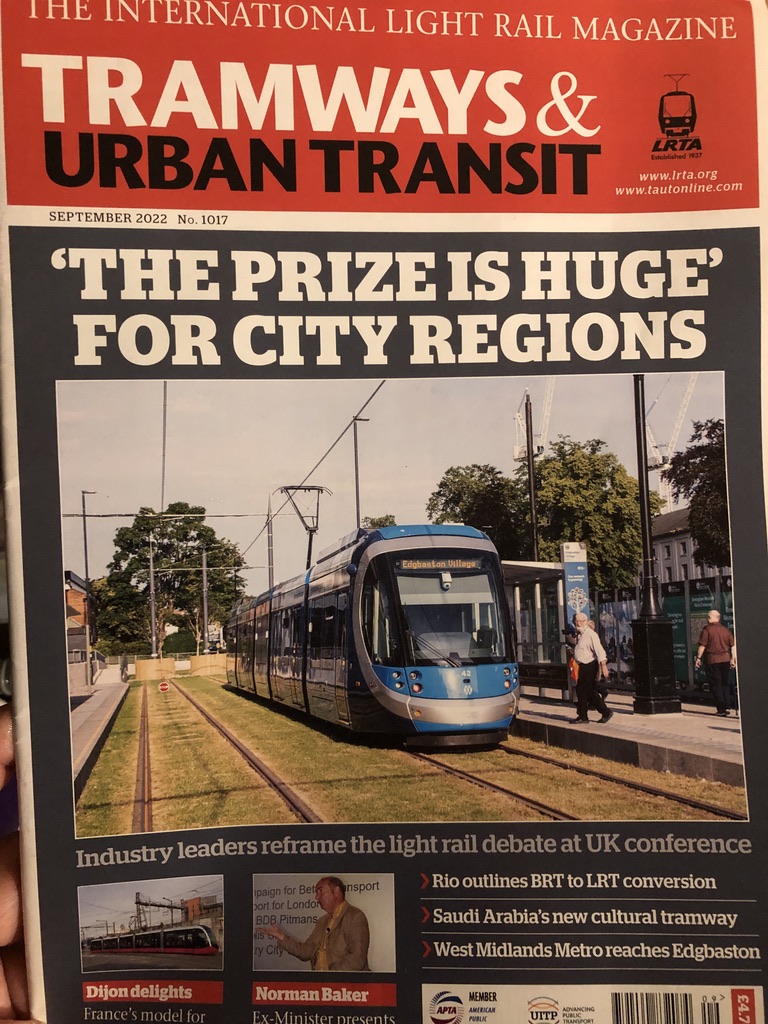

Above – and if you want to get your own back copies, see a sample here, and also the LRTA’s bookshop here.
And that’s not to forget…
Do support both of the above! And hopefully we can get light rail into the debates at the looming county council and CPCA mayoral elections – only we didn’t at the general election, nor did anyone discuss citizenship education much.
I sometimes blog on national policy issues as well as local things. If you are interested in the longer term future of Cambridge, and on what happens at the local democracy meetings where decisions are made, feel free to:
- Follow me on BSky
- Like my Facebook page
- Consider a small donation to help fund my continued research and reporting on local democracy in and around Cambridge.

 The Cambridge Town Owl