
I was going to go with Trumpanzees go ape-s–t but thought better of it.
One member of the US Congress was particularly scathing of the behaviour of his head of state towards the Ukrainian President – behaviour that has had the effect of galvanising the responses of EU heads of government in the hours that followed.
To put it mildly, it feels like we’re living through a time when we’re seeing the moving of global tectonic plates, where previous assumptions we had about some international and global institutions no longer seem to apply – while others are having to recalibrate hastily.
If you’re looking for historical parallels for a mentally unstable head of state causing international crises, the closest I can find is that of Kaiser Wilhelm II
If you want to know why, the epic study by R.K. Massie in his book Dreadnought, Britain, Germany and the coming of WWI, explains much about how The Kaiser’s mental instability did much to destabilise European politics – and how European monarchies (plus France and a couple of other republics) responded to try and insulate themselves from the fallout. In the case of The Kaiser – Queen Victoria’s eldest grandson (Queen Victoria’s eldest daughter, Vicky, married the dashing Prussian Crown Prince Friedrich), his relationship with the UK Royal Family shaped German foreign policy in that era as much – if not more than economic and political rivalries.
- Queen Victoria – ‘Dearest Grandmama’ – not a bad word shall be said about her. Similar perhaps to the current president and the late Queen Elizabeth II
- King Charles III – the former Prince of Wales – he had a notoriously poor relationship with his nephew, The Kaiser, not made any easier between 1888-1901 where according to royal protocol the latter outranked the former, but not within family circles where he was still a nephew, not ‘an Imperial Majesty. The two also had very different political views and lifestyle choices – perhaps reflecting the differences of opinion on the climate emergency between the current King and US President
- William, Prince of Wales – the Duke of Cambridge – as we saw when at the request of the British Government he met the President in France at the reopening of Notre Dame Cathedral in Paris. It was also one that was inevitably scrutinised over in detail, and extensively quoted in the celebrity press. Yet at the same time, the then President re-elect was effectively the more senior figure in age – similar to The Kaiser who was six years older than Prince William’s great-great-grandfather, George V – the latter ironically having a closer relationship with his Russian first cousin Tsar Nicholas II (their mothers, the eldest daughters of the King of Denmark were sisters).
In some regards the British Prime Minister enjoys the benefit of the existence of the Royal Family which carries influence in international diplomacy. It’s not just the political relationship that matters between a US president and a British Prime Minister – the presence of the monarch is also an additional consideration as Sir Keir Starmer demonstrated.
An example of Queen Elizabeth’s stabilising influence – and ‘what if?’ Gordon Brown had not lost the 2010 General Election?
Another example of where the late Queen had a significant influence (at least in the short term) on the media coverage of a visiting president was when President Sarkozy of France arrived for a hastily-arranged state visit at the request of the then PM Gordon Brown back in 2008. The media coverage swept away the negative headlines and photographs from the front pages.
“Nicolas Sarkozy yesterday applauded the acres of admiring British media coverage of his wife during the first day of the state visit, saying he felt justice had been done after a week of “wretched” press over here and in France. ”
Angelique Chrisafis – The Guardian, 28 Mar 2008
In the short-medium term that also meant informally that the French President owed the British Prime Minister Gordon Brown, a favour. The two politicians had known each other for years – Gordon Brown as Chancellor having got to know Sarkozy when the latter was French Finance Minister – the EU meetings of national finance ministers that were seldom reported in the British press. Perhaps one of the strategic errors of the Blair/Brown years was not promoting in the media every major meeting that UK ministers other than the top few had, thus helping normalise the principle and routine of working with the EU and partner states – and the concept of ‘pooled sovereignty’.
“European leaders unite behind Ukraine following Trump-Zelenskyy confrontation”
Within hours of the live broadcast ending, the official accounts of a series of heads of government of EU nations were posting messages of support for the President of Ukraine, along with the President of the EU Commission here. There was some disquiet that Sir Keir Starmer didn’t post anything earlier this afternoon, but then several hours later the President of Ukraine arrived in Downing Street as reported here by the BBC in time for the summit of international leaders on Sunday. A reminder perhaps that senior politicians don’t need to be bounced into taking very important decisions by the demands of 24-7 media channels.
“Starmer will welcome European from:
- France,
- Germany,
- Denmark,
- The Netherlands,
- Norway,
- Poland,
- Spain,
- Turkey,
- Finland,
- Sweden,
- the Czech Republic and
- Romania
- and the presidents of the European Council, European Commission and NATO Secretary General.”
It’s not just European leaders who will be at the summit either. Canada’s outgoing Prime Minister Justin Trudeau will be attending as well – mindful of the inflammatory comments from his returning neighbour to his south.
“Steve Hewitt, an intelligence researcher who teaches Canadian studies at the University of Birmingham in England, said the fact that Trudeau is going to the summit sends a message on whom Ottawa sees as its partners.”
Dylan Robertson, CBC News Canada, 01 March 2025
I wouldn’t be surprised if Mr Trudeau had an audience with King Charles III either before or after the summit – it’s easy to forget that Canada is one of the Commonwealth Realms of which The King is head of state. Note the royal protocol is that when members of the Royal Family are outside of the UK in Commonwealth countries where the King is head of state, it’s not British ministers who advise them but ministers of the country they are in. It’ll be interesting to see if the Prince of Wales is scheduled to undertake a high profile visit to Canada in the not-too-distant future.
A reminder of the importance of the European Union to the security of smaller countries
The data from Eurostat shows the EU’s combined population is around 450 million people as of 2024. Which is around three times that of the Russian Federation at just over 145million.
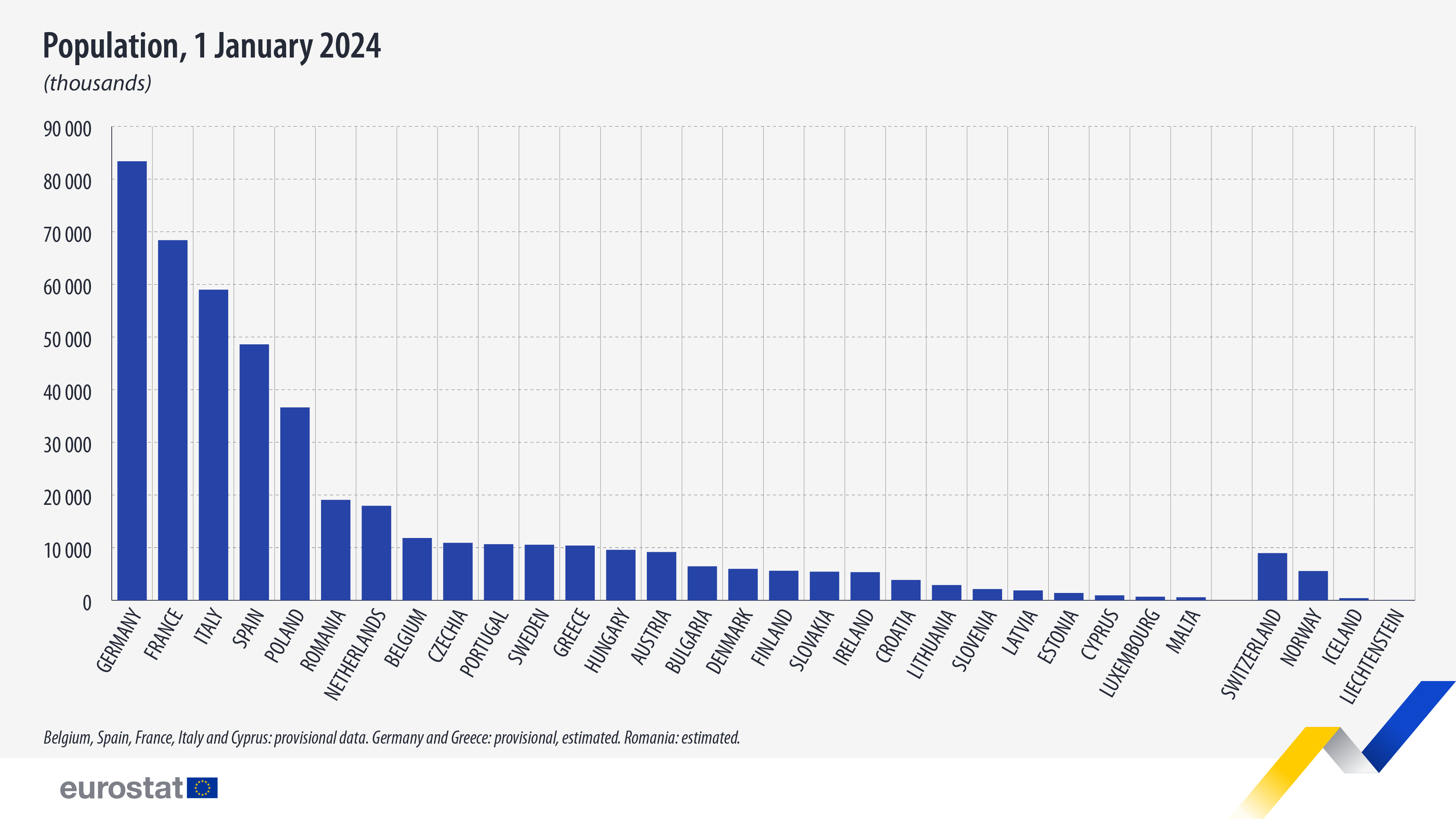
Above – from Eurostat for 2024
It was this point that the Prime Minister of Denmark made at an EU summit calling not only for increased military spending, but a re-assessment of the eastern borders, and also the interview with former UK Defence Secretary Ben Wallace on the EU’s need to increase defence spending so that it is less dependent on the USA for security. The rapidly changing geo-political situation may have concentrated minds.
A new industrial strategy?
It’s not as if countries can flick a switch and suddenly start cranking out the military hardware. For all of the technological advances that we’ve seen the videos of in recent years, the process of increasing capacity will require a whole host of considerations on economic and industrial policy. And taxation policy too – will we see greater pressures for new taxes on the wealthy given the huge inequalities in society?
If we were to compare the US to the EU, the latter has a much wider range of weapons systems that makes procurement and manufacturing less efficient. Therefore, expect any increases in production to go hand-in-hand with the rationalisation and consolidation of the variety. Secondly, as France24 reported back in Sept 2024 here, the EU is too reliant on overseas (especially US) suppliers. While in the short term the moves by the new US Government might result in a stream of new contracts from the EU, in the longer term it almost certainly will result in a reduction in the share of defence procurement going to US-based firms simply because EU-wide security requires it.
It’s not just about building the factories that make the components – those workplaces will also need to have high levels of security too – something that does not come cheap. And it’s not just espionage that security services will have to be aware of, but anti-war protesters as well. While the majority of people may either support or not have strong feelings either way of expanding manufacturing capacity, the prospect of such manufacturers making huge profits off of the back of such an increase in spending at a time of huge income inequalities won’t go down well at all politically. Furthermore, such profiteering was a consistent theme in previous eras dating back to the First World War. Best to come up with policies now before it happens rather than making a move after the headlines have been published.
Turns out 24 hours can be a very long time in politics – one where changes that normally take decades can happen almost overnight. Who knows what the next 24 hours will bring in terms of announcements? (Hopefully not more war and violence – the world could do with some good news for a change)
 The Cambridge Town Owl