The centrist Reform think tank (i.e. NOT TeamNigel’s outfit) made a series of recommendations on strategic or combined authorities – and I concur with many of the conclusions.
Browse through their report here – and note the 13 recommendations on page 6
The Cambridgeshire & Peterborough influence
Both the Chief Executive of the Cambridgeshire & Peterborough Combined Authority, and the Chief Executive of South Cambridgeshire District Council were interviewed for this piece. Both have had experience of trying to overhaul what at times has been an utterly dysfunctional institution – one that as I warned back in 2016 in an interview with Dotty McLeod of BBC Cambridgeshire, had major design flaws because there was no evidence that due process had been followed in the policy-making process.
This was reflected by the Best Value Notice that was issued against it by central government in January 2023, and one that was only recently removed in late 2024.
One of the major challenges that Cambridgeshire and Peterborough faced was – and still is, party-political. A Conservative Government and a Conservative-led County Council for Cambridgeshire had incorporated Cambridge City Council – a council that rarely elects Conservative councillors – into the new structures.
The council housing funding concession from ministers – something other areas did not get at the time
The Chancellor, who was a big proponent of Combined Authorities, conceded to a request from Cllrs Kevin Price and Lewis Herbert for substantial funding for new council houses in Cambridge given the waiting list. (See Councillor Price speaking at a housing demo in Cambridge back in 2015 here). Thus The Treasury handed over £70million to fund at least 500 net new council houses on pre-existing low-density sites, with additional revenue coming from market housing in developments built to higher densities. As of 2023 the city council exceeded the target, although such is the dreadful economic context that the waiting list is still over 3,000 households. This is despite the increase in the number of homes available as the new housing developments have been completed.
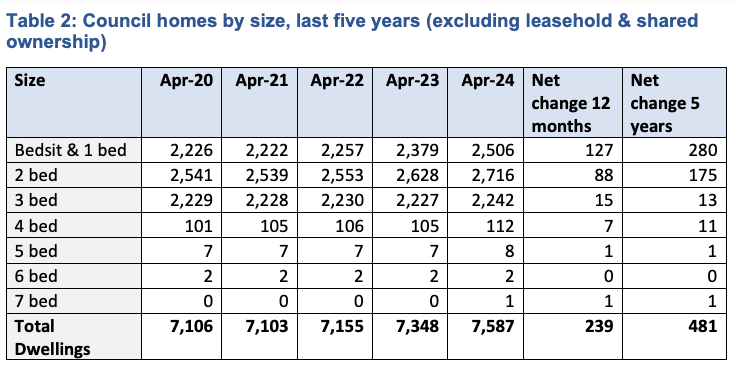
Above – total applicants over the past five years have risen – something outside of the direct control of the city council. Cambridge City Council Housing Key Facts Sept 2024
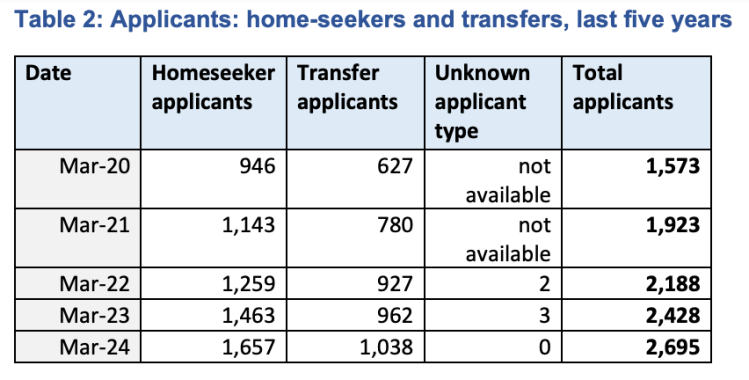
Above – Housing Register Applications 2024, p7
Ultimately ministers had the power to impose the Combined Authority structures (having learnt from John Prescott’s political error of going out to a referendum) so Councillors Price and Herbert took the understandable decision to get the best deal for residents. As I said to Cllr Dave Baigent (Labour – Romsey) that year, while I was (and am still) opposed to the existence of the Combined Authority as is, if I were an elected councillor I could not look residents in housing need in the eye and say they couldn’t have the council housing because of a disagreement on something else that was not going to affect their day-to-day lives.
On the Best Value Notice – the party political divisions
In 2021 quite unexpectedly the Labour candidate in the Mayoral Elections, Dr Nik Johnson, won due to the impact of second preference votes. I can only imagine how much of a challenge this must have been with one of the non-Political senior directors, Paul Raynes, having only been a Conservative County Councillor some three years before – and that was around the time of a series of controversies that saw the resignation of a previous chief executive, and the dismissal of the finance director in 2018. Now the Rev Raynes, he left the CPCA to join the Catholic Church, later being ordained a deacon in 2023.
As has been well-documented, the current Mayor Dr Nik Johnson, who is not restanding for election on medical grounds following a recent operation at Royal Papworth, also had a chief executive resign, and also apologised for his conduct following a review by an independent panel back in 2023. With Cllr Lucy Nethsingha not restanding in her Newnham seat in Cambridge, (and unless she is contesting another county division) it looks like Cambridgeshire County Council and the Combined Authority will have new leaders after the elections on 01 May 2025. Which is less than eight weeks away.
The party-political makeup of the Combined Authority Board
When the CPCA was established in 2017, no one could have anticipated how dramatically the political map would change over the next seven years. Historically the county had been true blue for several decades, with the City of Cambridge being an island of Labour red at the time the CPCA was established. (The Lib Dems’ presence collapsed in Cambridge following Nick Clegg’s decision to lead his party into the Coalition). There were five district-level councils, Peterborough Unitary, and Cambridgeshire County Councils, plus the Mayor represented on the Board. In 2017 only Cambridge City Council was not controlled or led by the Conservatives.
The Conservative collapse
In 2018 South Cambridgeshire the Liberal Democrats crushed their Conservative opponents, gaining 16 seats with the Conservatives losing 25 seats, and losing a further three in 2022 being left with just eight councillors. In 2021 the anti-Conservative alliance, the Joint Administration of Liberal Democrat, Labour, and Independent Councillors joined forces to eject the Conservatives for the first time since the mid-1990s, leaving the CPCA board with a precarious balance of 4 Conservative, and 4 non-Conservative seats.
In 2022 the Conservatives lost to another anti-Tory Coalition in John Major’s old seat of Huntingdon with Huntingdonshire District now being led by its own similar joint administration but with the single Green Party representative Councillor Lara Davenport-Ray joining and chairing the district council’s Climate and Environment Committee.
The problem was that Peterborough and Cambridgeshire both had veto powers over the Mayor’s Local Transport & Connectivity Plan – which he and the CPCA are required to produce by law. The then Conservative Leader of Peterborough City Council wielded his council’s veto until he was ousted in a split in late 2023, with Labour winning minority control following the city council elections in 2024. As a result of the new leadership in late 2023, the Combined Authority’s Board was finally able to approve the Transport Plan.
The final crushing blow was delivered at the General Election in July 2024 when the Conservatives imploded from both tactical voting and the rise of TeamNigel who tore chunks out of the traditional Tory vote. Note the Labour majorities in both Peterborough and NW Cambs are wafer-thin, at 118 and 39 respectively. In the case of Peterborough’s volatile local politics, 25% of the voting electorate voted for parties not represented on the county council. (Over 10,000 votes for TeamNigel, and the Workers’ Party).
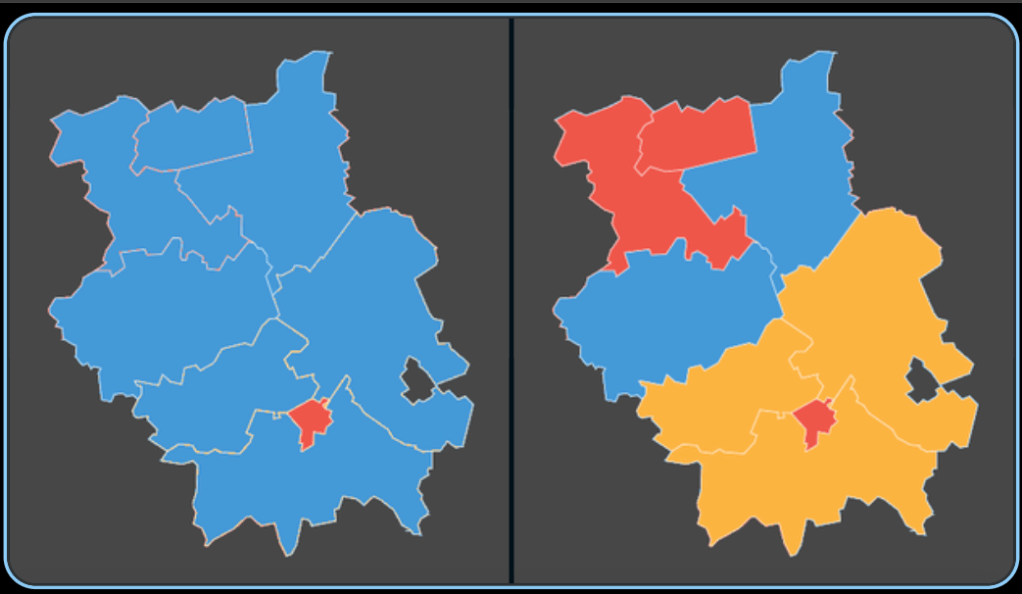
Above – the division of seats in Cambridgeshire & Peterborough (with the extra parliamentary seat of St Neots & Mid-Cambs added due to the population growth in/around Cambridge).
Below – compare the county council elections from May 2021, with the diagram above from the General Election 2024. It will be interesting to see where the parties stand in a couple of months from now.

Above – Cambridgeshire County Council divisions map after the May 2021 elections
Both those maps raise the question of whether it was a good idea to merge two very distinct economic subregions with very different political cultures into a single combined authority.
“I feel exhausted after reading all that”
This explains the recommendation from the Reform Paper to get rid of the vetoes and other barriers that otherwise paralyse the entire system. (See p14). The paper argues that the electorate, having made their choice (and also with the additional preference votes meaning more people got their preference than under First Past The Post) had every right to expect a winning Mayor to be able to have his proposals voted through without being blocked by a single council.
The two other themes that come out strongly in the recommendations are:
- The lack of a competent and high calibre scrutiny function with access to sufficient resource/officer support, and lack of remuneration for the time and expertise needed to carry out the function properly.
- The fragmented officer/permanent staff corps and the lack of interchange between councils, combined authorities, and the civil service.
- The limited ability of mayors to appoint high calibre competent persons to lead what will be increasingly demanding portfolios as ministers devolve more functions, if not more power.
- The creation of local public account committees
For all of the problems we see in American politics, I quite like the principle of the separation of powers. I.e. if you are in a post for an executive function where you allocate resources to provide services, you shouldn’t be in a scrutiny position at the same time. We’re finding this out the hard way in Cambridge with our local MP Daniel Zeichner who is the Minister for Agriculture. The Westminster system relies on 100 or so MPs to be willing to combine constituency MP functions with the demands of ministerial office. Both are more than full-time jobs on their own – which is why I think our system needs to change. Under the current system, the people of Cambridge don’t get to see Daniel speaking about constituency issues on the floor of the House like they used to. But that’s up to MPs collectively to change the system rather than insist a sizeable number of them put their health at risk with such demanding jobs.
Thus I like the idea of mayors being able to nominate high calibre people who would be content to take a pay cut to spend four or so years in roles similar to what the Mayor of London has. So long as the regulations set out the essential competencies needed for the roles, and that it’s the job of confirmation committees of elected councillors to confirm the appointments, it should minimise the risk of some of the things we’ve seen across the big pond recently.
I like the idea of moving between different parts of the public sector – and this should be seen as a routine thing rather than a special thing. Furthermore, the NHS administrative corps should also be brought into such functions. It doesn’t have to be micromanaged or excessively-controlled. It should be possible to develop a series of core systems and processes that are common to all, without being so restrictive that it inhibits people’s ability to do their jobs.
Finally, local public accounts committees are long overdue, and while Labour politicians in opposition have said positive things about them, establishing them and getting them up and running will be a significant task. Furthermore, there will be huge debate over how extensive their powers should be. For example should they be able to cross-examine local business leaders? What if those business leaders are responsible for privatised utilities or essential services such as internet access? I expect that will be thrashed out in the passage of the Devolution Bill through Parliament.
We live in interesting times.
Talking of Cambridge’s future – Cambs Unitaries Campaign
We’re meeting on Sat 08 March 2025 at the Mill Road Community Centre from 11am. (You don’t need to sign up but I created an EB page here) It’s free, all welcome. We’ll have maps and diagrams of the options we think local councils have regarding the proposed restructure amongst other things. More details from Cambs Unitaries Campaign here.
- Follow me on BSky <- A critical mass of public policy people seem to have moved here (and we could do with more local Cambridge/Cambs people on there!)
- Like my Facebook page
- Consider a small donation to help fund my continued research and reporting on local democracy in and around Cambridge.
Below – from the Cambs Unitaries Campaign, population data diagram by Phil Rodgers. While there is some flexibility on numbers, ministers have said to consider a population of 500,000 for new unitary councils to be a minimum.

 The Cambridge Town Owl