
On what two books from the late 1980s/early 1990s tell us about the central-government-imposed decline of local government – and how it was compounded by the central-government-imposed decline in adult education and the removal of civic education in schools.
Image – Adult Education for Democracy (1944) Harold C. Shearman
Sir Harold above, wrote at the start of his book the following:
“As we begin again to turn our minds to the problems of social life in a peace-time world, it cannot be amiss to take stock of our position and ask ourselves what are the fundamental needs in this sphere of a modern democratic society.”
I picked out that book because given the past 14 years, and with the multiple shocks that have hit our economy and society – and a new defence-and-democracy-related one about to hit, what can social history tell us about not just the hard defences, but soft defences as well?
**Margaret Thatcher’s Government destroyed local government and destroyed citizenship learning as we knew it in the 1980s. I read it in some old books so it must be true!**
The publications concerned are these two from 1992 and 1989 respectively. It seems a little unnerving to write about what adults were saying about the society I was growing up in, as well as infuriating knowing that I lived through it and no one was able to stop them.

- Inner city regeneration : the demise of regional and local government (1992) Norman Lewis
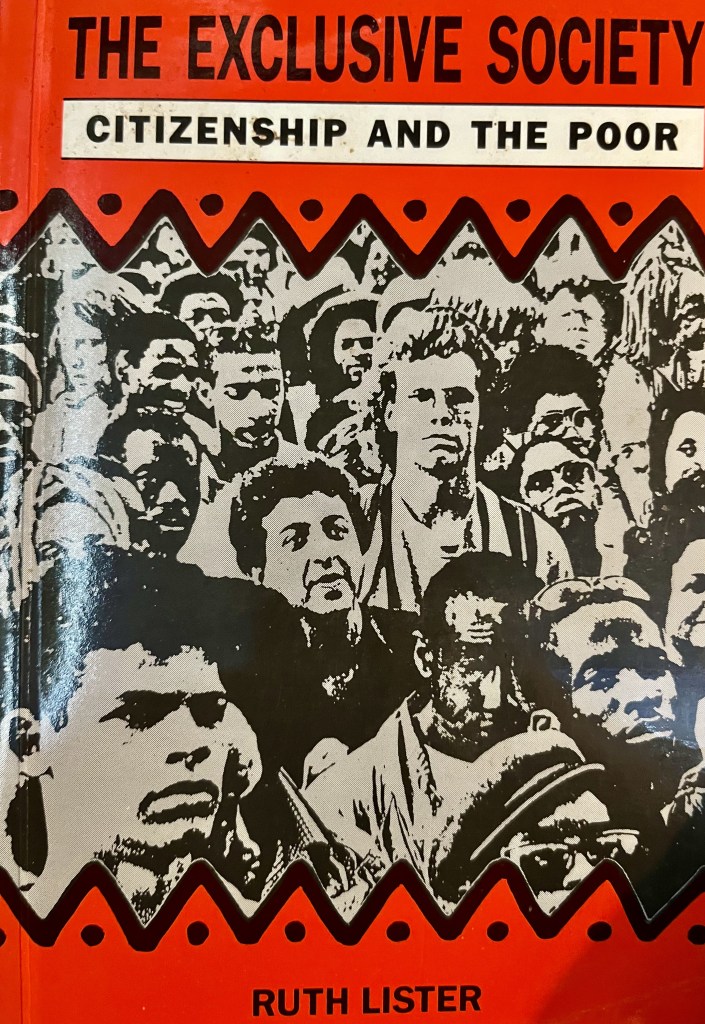
- The exclusive society : citizenship and the poor (1989) Ruth Lister / CPAG
Ruth, now Baroness Lister’s book from 1989 is particularly damning. Furthermore, the Child Poverty Action Group that she headed was a powerhouse of public policy research and writing – you can see some of their published work digitised here. See also Baroness Lister’s deep dive into feminism and citizenship from 2003 here.
The impact of Margaret Thatcher’s Government on local government is summarised here in The Guardian by Prof Tony Travers of the London School of Economic and Political Sciences. Prof Travers lists policies such as:
- Compulsory competitive tendering
- Financial penalties on over-spending councils
- The expansion of powers of new development corporations – especially in East London
- Rate-capping – restricting the increases of local government taxes on residents
- The abolition of the Greater London Council
That last point stands in stark contrast to the creation of combined authority mayors, as well as the creation of the Scottish Parliament and the Welsh Assembly, both of which were strongly opposed by John Major’s Government.
Baroness Lister’s 1989 publication frames the concept of citizenship within the contemporary events happening at the time – the most significant of which was the imposition of the Poll Tax. What I find particularly useful about this book is that it informs readers of a different era – i.e. the 2020s in my case, of a host of things that have either been long forgotten by society, or that are now seen as ‘normal’ because they’ve been around for so long. Such as the concept of ‘welfare dependency’ in the face of rapidly-rising unemployment which themselves were the results of catastrophic economic policies of ministers as much as other long term factors (such as competition from abroad for manufactured consumer goods). It’s easy to forget that Cambridge used to have one of the most well-known manufacturers of electronic goods in the UK in the former PYE Works.
What I’ve also not really considered before is the concept of citizenship in relation to power. In particular towards obligations to the state. This is particularly visible in terms of who gets what benefits. Lister notes the difference between benefits working class people were more likely to benefit from vs middle class people (remember she was writing in 1989 in an era where class divisions by occupation were perhaps much more visible than they are today).
“Part of the sub-text was the public expenditure accounting conventions that treat child benefit – but not tax allowances – as public expenditure. So the switch from child tax allowances to child benefit, in 1979, meant a significant increase in public expenditure on children.”
Lister (2000) The Politics of Child Poverty in Britain from 1965 to 1990, p10
There are a whole host of similar subtle policies that are interpreted in a similar way. So when ministers talk about the high ‘welfare bill’, what is the equivalent that is being spent in the forms of tax breaks? Especially for middle classes and for the wealthiest?
That’s where it can get very messy in terms of political debate because so much depends on your disposition in life towards everyone and everything. Some take a very strong ‘small state’ view and see all taxation as theft. Others take the view that taxation is the membership fee we all pay to live in a civilised society with the cradle-to-grave public services that go with them. This is not the place to thrash that one out.
Universal Basic Income vs Welfare Dependency – a clash of concept and mindsets?
Lister also picks up on the Universal Basic Income debate – something I didn’t expect to see in a publication from that era. She summarises why the Conservative viewpoint in favour of workfare-type policies where the unemployed have ‘to work for their benefits’ (why not employ them properly instead?) is utterly incompatible with the concept of universal basic income. In more recent times as successive governments have tried to roll out workfare-style programmes to deal with the issue of ‘welfare dependency’, the problems faced by firms taking on people on workfare programmes has been made more hassle than its worth for some of them simply because it’s not highly-paid, happy and motivated people who are being employed in socially useful work.
All too often its those on the lowest incomes with multiple other challenges in life working in not great jobs for less than the minimum wage. And before anyone asks ‘What about…?’ Eg the people already in those jobs and struggling to make ends meet, those people should be paid more and have better working conditions – and rogue employers who break the law should be prosecuted. But that requires a whole host of other policies including but not limited to:
- Having a properly-resourced enforcement function to monitor, investigate, and prosecute law-breaking employers
- Having a properly-resourced legal system to process the prosecutions and see justice is done
- Having a system of maximum pay ratios between lowest and highest paid staff so that the wealth is genuinely shared rather than hoarded by senior executives.
- And many, many other policies…
Which also reflects how complex public policy making is
Citizenship and social capital
The comments by Lister in 1989 link to Andy Haldane’s research on social capital for the RSA.
“A key element in the postwar vision of citizenship was participation in the life of a community, of which one is a member. Poverty, which in contrast, spells exclusion from full participation , diminishes the citizenship rights of a significant proportion of the community”
Lister (1989), p66
History repeating itself?
Lister writes:
“We enter the 1990s in an atmosphere of growing public unease about the environment, about public squalor which is tarnishing the increased private affluence enjoyed by many, about widening social divisions, the most extreme manifestation of which is the return of homelessness and begging on a major scale”
Lister (1989) p69
Does the above sound familiar to today? That point about private affluence being ruined by public squalor?
“Cambridge is a city where ministers have given various business sectors the upper hand over the institutions of local governance, the result of which has left us with a city of public squalor and private wealth.”
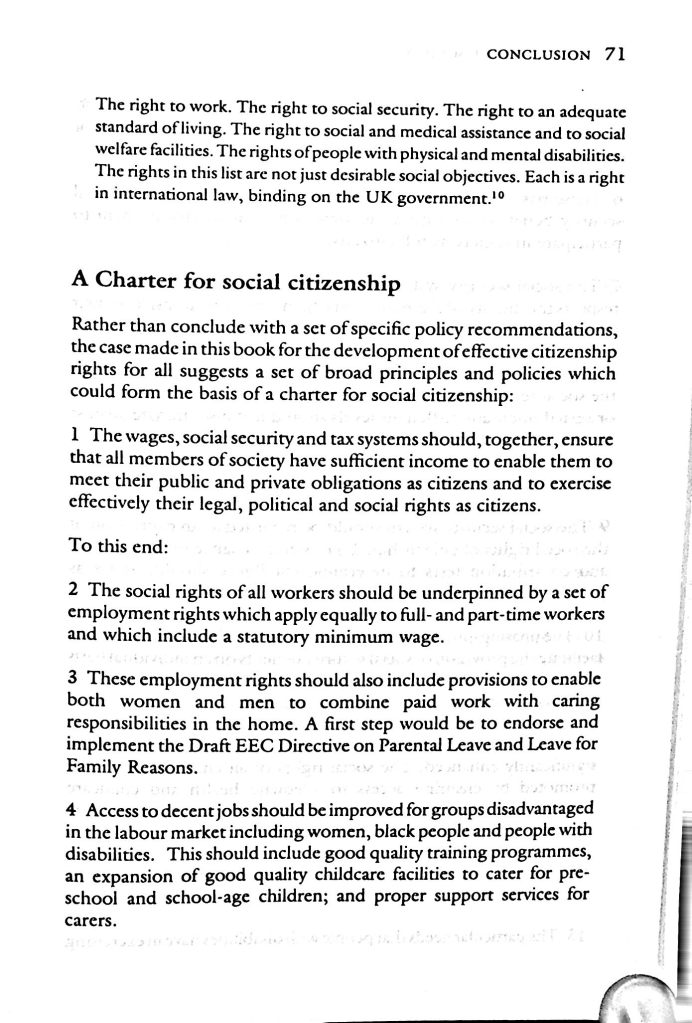
Only Baroness Lister warned everyone what the consequences would be back in 1989. And now that grim vision has been realised. Which makes her proposed Charter for Social Citizenship all the more interesting as policy responses. I’ve added the final three pages to the end of this post for you to browse through. (Or see Lister (1989) p71 here)
Food for thought?
If you are interested in the longer term future of Cambridge, and on what happens at the local democracy meetings where decisions are made, feel free to:
- Follow me on BSky
- Like my Facebook page
- Consider a small donation to help fund my continued research and reporting on local democracy in and around Cambridge.
Below – Baroness Lister’s Charter for Social Citizenship (1989).


 The Cambridge Town Owl