
In Cambridgeshire we’re very lucky to have Form the Future doing great things for nearly a generation of teenagers in spite of the huge barriers that face them.
Image – From the Association of Citizenship Teachers – we could do with more schools offering GCSE Citizenship Studies, and more teachers specialising in citizenship education too
Have a read of this post by Kath Austin, their Chief Programme Officer here. In the course of her work meeting and listening to teenagers and young people across our county, she listed some of the challenges they had told her about.
“Challenges faced by young people include:
⛔ Everything is faceless and online
🚧 Some young people have caring responsibilities taking priority
⛔ There is still a lack of inclusion for diversity (example given was young Muslims working in hospitality but not wishing to serve alcohol)
🚧 Lack of a business network
⛔ Transport (I’m really fed up of this being a barrier)
🚧 Lack of specific opportunities in e.g. creative sector
⛔ Low or no wages”
Above – Kath Austin 11 March 2025
The Cambridge that I had my 1995 work experience in feels like a different world in comparison – not least because my generation of ‘elderly millennials was the last to experience most of their school/college days without the internet. Furthermore, the jobs that I had before I left Cambridge to go to university have largely been made obsolete by technological progress. Supermarket checkouts are dominated by automated machines, and my back-office data-inputting job in an international trade office was inevitably made obsolete by online banking. No need to have teams of data-inputters reading extensive forms filled out by hand.
One of the toughest things for adults charged with solving these problems have is trying to figure out what the teenagers do not know for themselves – knowledge that perhaps we take for granted. I found this out very quickly in a different context – introduction to democracy workshops where I assumed that GCSE-level textbooks would be a suitable starting point for most participants unfamiliar with politics. It has turned out that a book aimed at ten year olds was far, far more popular and accessible because most of them like me were from a generation that was not taught politics, democracy, and citizenship at school or college. (Which makes it all the more harder for ministers telling us we must defend it against a new generation of threats).

Above – Politics for Beginners from the brilliant Usborne beginners series that also features law, philosophy, and will soon have AI added to it
I hope to have more workshops coming up after the May elections, but in the meantime I’m carrying on with the informal meetups on fortnightly Sunday afternoons at The Rock Pub on Cherry Hinton Road.
“Who has got what solutions?”
I’m not going to pretend to have a clue on what the face-to-face solutions should be. These days as a generally house-bound chronically-ill single middle-aged bloke, I take my inspiration from Eglantyne Jebb (Founder of Save the Children who had no children of her own, and who also was an activist in Cambridge in the early 1900s) who focused her attention on getting the institutions to change.
Ms Austin’s ideas include:
💡 “Offer more opportunities that focus on acquiring work-ready skills
👏 Offer more paid opportunities, either internships, part time work or even work experience that is financially supported to reduce barriers to uptake
💡 A centralised website that lists opportunities for students to apply into
👏 More networking and relationship building events, channels, offers…”
There are two big institutional challenges to overcome here:
- Capacity of employers to create work experience opportunities that focus on work-based skills
- Capacity of state schools – especially those serving economically-deprived areas, to meet the employers halfway
What Ms Austin seems to hint at from my perspective is a co-ordinated and co-operative approach on a city-and-district-wide basis. In which case who are the people and institutions that have the legitimacy to do the co-ordinating and the resourcing? How can something be put together in a way that does not involve endless instances of long committee meetings? (Something that in my experience the business sector finds ever so frustrating about the public sector – but then the public sector has to account for taxpayers money). Because if due process isn’t followed, things like this can happen.
The examinations and curriculum review is currently taking place. Expect to see Citizenship Education make a strong comeback
See the Association for Citizenship Teaching here for more. Also, browse through some of the back copies of GCSE Citizenship textbooks on the Internet Archive here. It’s worth employers asking themselves what opportunities there are for them to engage with schools and teenagers – even if they are unable to provide work experience opportunities. The one huge area for potential is with the expansion of Cambridge’s urban footprint with all of the housing growth. How can professional firms engage with teenagers and young people, both enabling them to shape the future of where they live (as they’ll be spending longer living in it than us older people!) and also how can those firms also use their influence within their own circles to influence the policies of institutions and also the cultures and behaviours of the business communities? Because in the construction industry at least, there is a lot of work to be done.
“The 2017 fire that killed 72 people stemmed from a “rotten culture in the construction industry”, where multiple failures occurred across the supply chain, according to Dame Judith Hackitt, an engineer who led a review on building safety after Grenfell.”
Julia Kollewe in The Guardian, 05 Sept 2024
Ms Austin again lists some more useful ideas – these as personal responses:
“Personally, I am committing to:
✅ Meeting with this cohort again to further understand their experiences and shape our activities accordingly
✅ Develop and grow our programmes which directly address these challenges
✅ Create more platforms for young voices to be heard
✅ Create more opportunities for us as a business opportunity to listen“
I’ve put in bold the point about young voices being heard. To be really effective on this, we all as adults collectively need to know how we can make our voices heard in the world of politics and public policy. But how many of us know how to do that? A reminder that at the general election Cambridge’s turnout was a miserable 60.4%. If so many of us can’t be bothered to discharge our civic duty as voters, what chance do our young people have in making their voices heard?
Which is why I go on about adult education and lifelong learning so much
Back in 2020, Qasir Shah of University College London wrote a superb paper on the lack of democracy and citizenship education for resident adults – i.e. not the Home Office’s woeful citizenship tests. If adults are disempowered, what hope future generations? The reasons why we ended up no citizenship education for adults and children in the 1990s was succinctly set out in 1989 by Ruth, now Baroness Lister of the Child Poverty Action Group in her book The Exclusive Society – Citizenship and the Poor (which you can browse online here)
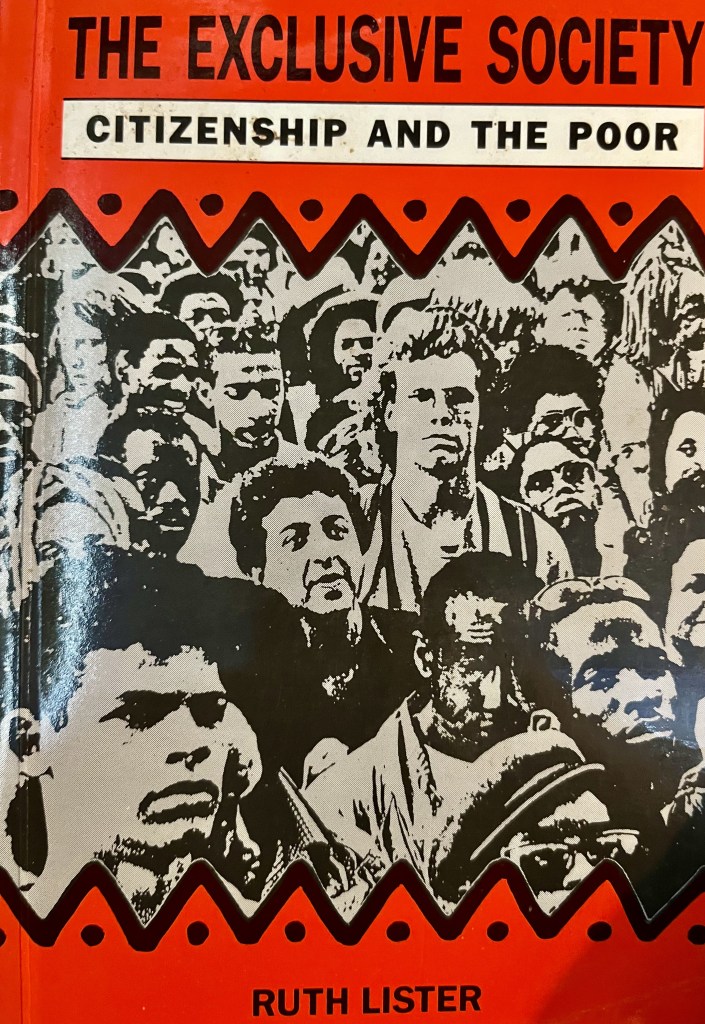

Above – The Exclusive Society – Citizenship and the Poor by Ruth Lister (1989) CPAG – ABEBooks has a number of cheap second hand hard copies available too
I hope Ms Austin’s post can spark some new ideas and activities from organisations across our county
From my perspective, I see the education of a critical mass of people in our workplaces in all things democracy and citizenship as being the pool from which a greater number of resourced and more substantive offers of opportunities for teenagers will be forthcoming. My reasoning being that if you can persuade the adults that our wider society matters to their businesses/employers/organisations, they are more likely to be positively-disposed to appeals from the likes of Form the Future – where it’s not just asking wealthy firms to throw money at something, but building relationships across our city and county – something Ms Austin also mentioned.
And finally
We’ve also got to be upfront about the challenges and the risks. The first series of actions may not be successful. It’s going to involve hard work and investment of time and resources where it may not be obvious what the immediate return is for all those involved. (Which is where we could throw things open to students and researchers at all levels – from further education through to post-graduate) to monitor, evaluate, and feed back the findings into local policy-making processes.
Food for thought?
If you are interested in the longer term future of Cambridge, and on what happens at the local democracy meetings where decisions are made, feel free to:
- Follow me on BSky <- A critical mass of public policy people seem to have moved here (and we could do with more local Cambridge/Cambs people on there!)
- Like my Facebook page
- Consider a small donation to help fund my continued research and reporting on local democracy in and around Cambridge.

 The Cambridge Town Owl