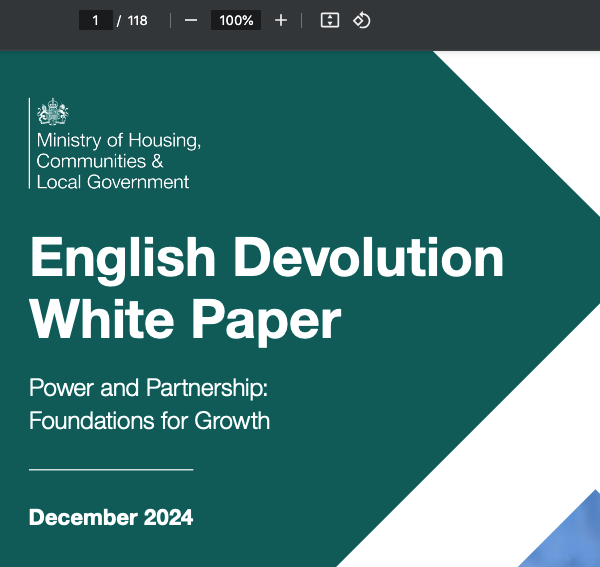
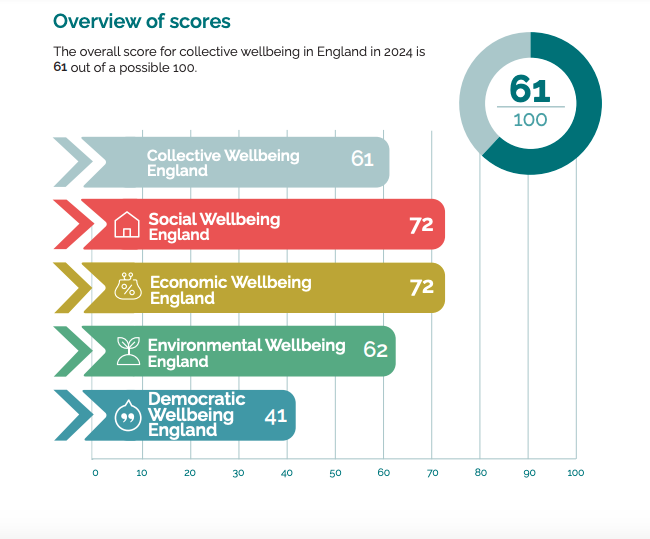
…says the Carnegie Foundation’s report on Life in the UK 2024 for England
You can read the report here. On the four different categories of wellbeing measured – Economic, social, environmental, and democratic, it’s the last of these that England scores the worst
“Everyone had the chance to vote in 2024 – what is wrong with people?!?”
Democracy is about far more than an individual election contest, and involves far, far more than putting a cross in a box once every few years. Unfortunately the concept has been reduced down to a very small number of actions where it now feels like there are a small number of people who are interested in democracy and politics day-to-day at one end, and a much larger group of people who have no interest whatsoever at the other, but very few who have a balanced happier medium. With the continued research being done about ADHD, I wonder which professions are disproportionately more likely to attract people assessed as being ADHD ( as opposed to ‘having an infectious illness’ which you can take medication to help get rid of).
There are a number of statements that the Carnegie report makes
“Wellbeing cannot be ‘done to’ people: it must be done by and with them. Giving people
voice and choice, enhancing transparency and promoting dialogue are all influential
enablers of wellbeing. It is not right that democracy is working better for people with a
higher annual income and those living in more affluent areas.”
The second part in bold above is a value statement – one that I agree with, but a value statement nonetheless. That means it can also be challenged, and also has a number of assumptions attached to it. For example:
If you were privately educated, went to a top university, and made your way into a well-paid profession to enable you to live in an affluent area that wasn’t afflicted by the negatives of urban living (noise, pollution, litter, derelict buildings, fear of crime, for example) and wanted to keep things that way, you might make the case that:
- ‘Better educated people are more likely to get into higher paid jobs’
- ‘People in higher paid jobs worked hard to get to where they are – and deserve their success, including living in the nice parts of town’
- ‘It’s not your fault or responsibility if other people are not prepared to use their democratic rights’
All of the above are also value statements – that can also be unpicked.
The problem is that the decline of civic spaces amongst other things has reduced our collective abilities to have those social discussions about how to improve our local areas and day-to-day lives. As many of us found out the hard way recently, a decision taken far away in Westminster – for example if you work for NHS England, or if like me you are dependent on social security support such as through Personal Independence Payments, can have a devastating impact on an individual’s wellbeing.
“As a matter of urgency, action is required if faith is to be restored in our local and
national leaders and the institutions of our democracy. Participatory and deliberative
democratic initiatives, if designed and delivered properly, have an important role to play
in this.”
The failures of past participatory initiatives in/around Cambridge
The problem Cambridge has is the Greater Cambridge Partnership tried this through their extremely flawed citizens’ assembly. And as far as the GCP is concerned, their attempts to game the process were exposed at the ballot box back in 2023 in a toxic local election campaign where the failure of the GCP Board and Assembly to rein in the senior transport officers of the partnership until it was too late, were clear for all to see (eg CTO 27 Aug 2022).
From where I was watching things, it seemed to me that the GCP senior officers’ corps wanted to bring in a form of road user charging. This has been in the pipeline since the early 1990s – when I was still at school! The problem was that no one was going to vote for it unless there were suitable alternatives to get people out of their cars, and suitable subsidies/support for those on low incomes and/or those whose jobs required them to drive, for whom even a comprehensive integrated public transport system might not be suitable. The cultural mindset of the highways engineering/transport planning profession and the urban planning professions of ‘design and defend’ were reflected by the failure to properly consider the alternatives – even those from their own professions.
Two reasons why the GCP’s Citizens’ Assembly failed as a process:
- The organisers (Involve UK were contracted to run the process) could never have the sort of access, awareness of, or the consent of the entire population of Cambridge and South Cambridgeshire to make for a genuinely random sample of the population from which to work with.
- It felt like the GCP used the results of the process to justify proceeding with unpopular policies that as the political parties found out, did not have consent of the voters at the ballot box in 2023.
Any attempts to use participatory methods in Cambridgeshire must involve an appraisal by elected politicians and permanent staff of the reasons why they failed with the GCP. Because what should have happened is that the findings of the citizens assemblies should have mirrored that of the wider population. But they did not, for a whole host of reasons including the lack of civic literacy of the wider population, and the inability to select a random sample from a population that genuinely reflected the population of the city. And that’s before we even consider (what I see as) the GCP’s aim to get the Assembly to provide it with the conclusions that it wanted to justify its pre-existing policy proposals. With that in mind, there’s lots to be learnt from the Republic of Ireland’s Citizens’ Assemblies.

Why civics matters
Before the First World War, the Department for Education in the United States of America produced a syllabus on citizenship education (digitised here by Cornell University Library). Ironically, it is now being threatened by the Federal Government at a time when democratic institutions are facing its greatest ever threat in modern times.
“Citizenship syllabus : a course of study and syllabus in civic training and naturalization for adult immigrants in evening schools”
It’s civic training, not an education in academic politics
Noting the context of large numbers of migrants from Europe heading to the USA in the late 19th/early 20th Centuries, the difference between what you might find in an academic course vs what you need in day-to-day life is set out superbly early on under the title: What Civic Training Is
“Purpose. It is important to emphasize that civic training does not include so much a knowledge ot the machinery of government as a knowledge of its social and reciprocal relationships to its citizens.”
Citizenship Syllabus (1916) USA-DfE p8
This for me is the fundamental difference between knowing that ministers in say the Department of Health etc are accountable to Parliament, vs the Department for Health being responsible for the NHS which ultimately provides your healthcare. Or that the DWP can make policy changes that directly affect you if you are in receipt of welfare payments that come with strings attached, vs how the DWP gets its funding allocations from The Treasury via approval from Parliament.
“Practical citizenship. Civic training includes the explanation of governmental agencies and how they serve its citizens.”
Citizenship Syllabus (1916) USA-DfE p8
I’m old enough to remember the arguments for *not* educating children at school about such things because the argument was that it would ‘only encourage them to go and live a life on benefits with free council housing, free this, free that…’ It was a mindset that also reflected government policy failures on drugs, alcohol, and sex education. ‘If you tell them about these bad things they will only go out and do it’. So the campaign Just Say No! never involved telling us youngsters what we were meant to say “No!” to.
One of the dreadful side-effects of putting people off from claiming what is theirs by right – because Parliament legislated for it to be so at the request of Government ministers, goes unclaimed.
“Policy in Practice estimates that the total amount of unclaimed income related benefits and social tariffs across Great Britain is now £22.7 billion a year. This represents a 21% increase on earlier estimates, driven by uprating and improved estimates which show more people are missing out.”
Above – Policy in Practice 18 Apr 2024
Which makes me wonder what the Chancellor would be proposing if a far greater share of those unclaimed benefits actually got paid out to those who were eligible, in need, but not claiming. (Hence one of the advantages of universality with Universal Basic Income is that everyone gets the benefit as Ruth Lister of the Child Poverty Action Group explained. No need for swathes of paperwork or costly administration).
The other items highlighted in the 1916 publication include:
- Mutual understanding i.e. accounting for the lives that migrants lived before moving to the USA
- Interest: Featuring issues in the day-to-day lives of the participants
- Community Life: “Every one of your students lives in a community and is part of it. They should know what community life means — where the public schools, the public libraries, and state courts in their community are and what they are for. Civic instruction to be vital must be localized, but state and national government can be taught as they touch the life of every community.”
- Action: “Do not only talk about community life but get your students to think along lines of civic betterment. Suggest to them that they report unsanitary conditions to the health department. Show them the need of keeping their children in school. One principal of an evening school formed a council of immigrants.”
- Personality of the teacher. The effectiveness of instruction in civic training and naturalization for our new citizens depends largely upon the enthusiasm of the teacher.
Above – how many of these feature in local public services irrespective of whom they are aimed at in the UK today?”
Even the outline of the syllabus for basic level civics still reads well today, even accounting for the patriarchal language.
“Outline of Syllabus for Elementary Civics for Immigrants
- The Citizen — How he lives.
- Food
- Clothing,
- Water,
- Home,
- Family
- The Citizen’s Community — What it does for him.
- Fire protection,
- Police protection,
- Health protection,
- Public streets,
- Public signs,
- Recreation
- The Citizen’s Work — Work and citizenship.
- How to secure work,
- How to advance in your work,
- What to do with the money which you earn
- The Citizen’s Country — The United States.
- The country of the United States,
- America’s great men,
- The American flag,
- Holidays and national anniversaries
- Becoming a Citizen — Ideals of American citizenship.
- American citizenship
- How to become a citizen
- The American people.
Citizenship Syllabus (1916) USA-DfE p16
Some of the things included in that syllabus are things that perhaps we take for granted over a hundred years later – but are now coming back because of concerns about environmental impact and the recent food scares. The following are included in the section on food:
- “Show how these articles of food came from all over the world.
- Distance they are brought and the way handled.
- Unlawful to sell spoiled food.
- What the community does to protect its citizens from spoiled or tainted food.
- Reciprocal duties:
- to demand clean food from the milk dealer, grocer, fish dealer, butcher and baker;
- to report to the health department the careless handling of food or the selling of spoiled food ; and
- to report short measures or weights to commissioner of weights and measures.”
Citizenship Syllabus (1916) USA-DfE p18
When you browse through those pages, knowing where the goods you consume are made/produced, how and by whom, are strikingly powerful given the context of the time. i.e. food poisoning could be a matter of life and death.
Furthermore, the civic duty to report law-breakers is prominent – not simply to be ‘a grass’ but because such corner-cutting costs lives. As we heard in the Grenfell Inquiry.
The need for recreation
This reads all the more powerfully in the face of 15 years of austerity.
- “Need for recreation; and why community must provide and supervise recreation.
- Public recreations — parks, band concerts, playgrounds, skating, bathing etc.
- Location of each in community.
- Private recreations — moving pictures, theaters, etc.
- Need for supervision and control of community over private recreations.
- Recreation for children”
“Future welfare of America depends upon its citizens.”
“Show how the greatness of America is due to the loyalty and high principles of its citizens.”
“What does all of the above tell us?”
That if repairing our democracy is going to be at the heart of English devolution as the Carnegie report recommends, it’s going to take more than a handful of evening classes to make it happen.
And we’re not even at the stage where we have the evening classes or the workshops needed in order to deliver on that part of the renewal needed. Which is why the Government’s work on bringing back all things neighbourhood renewal is every so important – and something that today’s generation of policy makers should look back at the work done between 1997-2010 in order not to make the same mistakes. Because browsing through the policy documents I found in Oxfam late last week here, the work on identifying what needs to be rebuilt and brought back has ***already been done***. All that is needed is a refresh, not a re-invention. A tyre change rather than a re-invented wheel so to speak.
One of those all-important evaluation documents was from March 2010
Then get cracking!
Food for thought? (Public policy. Complicated stuff, ain’t it?)
- Follow me on BSky
- Like my Facebook page
- Consider a small donation to help fund my continued research and reporting on local democracy in and around Cambridge.
Below – the Association for Citizenship Teaching. I hope their remit expands to adults sometime soon.

 The Cambridge Town Owl