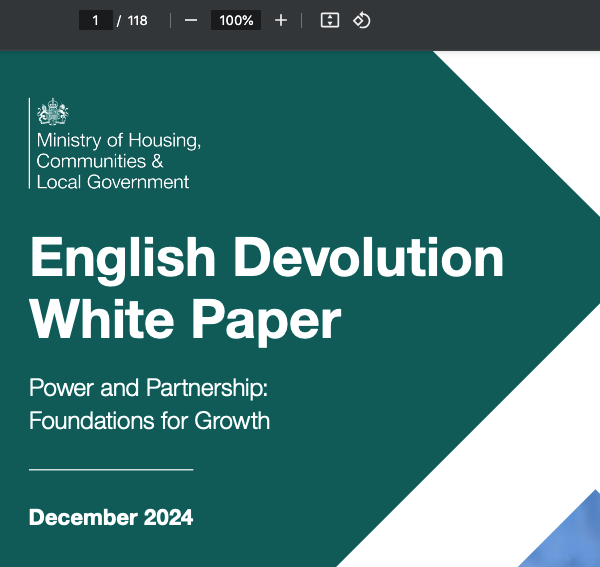
While Labour did not include nationwide reform of local government in their manifesto, there’s nothing to stop them bringing in a new policy so long as Parliament supports them.
You can watch the videos of the debates by the following councils as hyperlinked:
- Cambridge City Council
- Cambridgeshire County Council
- South Cambridgeshire District Council
- Huntingdonshire District Council
- East Cambridgeshire District Council – to follow on 20 March 2025 here.
The joint letter that the above-five councils have co-signed can be found in the meeting papers of each council – they are at item 3 of South Cambridgeshire’s meeting papers.
A rushed job?
Inevitably given the very tight timetable ministers have given. And that’s their call – and the responsibility of MPs to pull them up on it if they so wish. Personally I think ministers should have commissioned a revamp of Redcliffe-Maud’s Royal Commission on Local Government – which was similar to what the Public Administration and Constitutional Affairs Committee of the previous Parliament recommended back in October 2022, only to be ignored by that Conservative Government. Note the responses of the then Secretary of State Michael Gove, and of Sir Keir Starmer for Labour, and Sir Ed Davey for the Liberal Democrats… …and come to your own conclusions.
Councillors and MPs should push back on the lack of thought given to the role of town and parish councils
This came up in one of the replies from the South Cambridgeshire meeting, where the example of Durham was given as a place that regretted not creating new urban parishes as part of their restructure. One for Cambridge councillors to consider: What would a city with urban parishes (with or without a ‘city of Cambridge council’) be like?
Back in August 2024 I wrote The city of Cambridge lacks both a serious regional tier and a hyper-local tier in a blogpost looking at what devolution might look like. In May of 2023 I also had a look at the interaction between unitary councillors, and parish/town councils in rural areas. Those principles might be starting points that Cambridgeshire’s politicians might want to get back to ministers on when discussing the problems of councillors becoming too remote, and some of the benefits of having part-time amateur councillors at a hyper-local level vs ‘full time politicians’ that unitary councils will come under growing pressure to have.
Ministers still need to decide what sort of vision they want for local government if they want something different to what Margaret Thatcher brought in – as William Miller explained in 1988 in his book Irrelevant Elections.
“If local democracy produced the ‘wrong’ decisions by local councils then there were only three options open to central government:
- It could accept that ‘wrong’ local decisions were the essence of local democracy and therefore tolerate them in the interests of a pluralistic national democracy
- It could accept that ‘wrong’ local decisions were the essence of local democracy and abolish local democracy in the interest of ‘correct’ decisions’
- It could reject the view that the ‘wrong’ decisions rose from a well-functioning democracy, treat them as an aberration caused by the defects in the operation of local democracy, and search for ways to remedy those defects’
There were calls from arch-centralists to abolish local government completely in the post-war decades on the grounds that leaps and bounds in technology combined with efficiencies coming from centralisation meant that councils were no longer required. In the case of the Thatcher Government they took the view that the opposition coming from local government to their national policies had to be curtailed – even if that meant at the expense of local government as a sector. Hence spotting a book about post-political society from Edinburgh University Press while dropping books off at Amnesty earlier today.
“[The book] Critically engages with multiple dimensions of contemporary depoliticisation, including multiculturalism, philanthropy, ecology, participatory development, public–private partnerships and the regulation of biotechnology”
Above – The Post Political and its Discontents (2014) EUP
The questions Miller asked in 1988 still apply today:
- Are local elections representative?
- Do local elections offer a choice?
- Do local elections give winners a mandate to govern?
- Do local elections educate the public and politicians about each other’s concerns?
Any structural reforms of local government should at least attempt to address the above – even though in reality there will need to be substantial economic and social reforms to enable people to have the time and capacity to participate in local democracy and civic society.
Talking of economic reforms – the Cambridge Festival is on, and has one event that involves tearing up money
Tearing Up Money: Turning Currency into Collective Art
What would you do with a bank note that had the picture of the South American revolutionary figure Simon Bolivar and the number 1,000,000 on it? This was a question that the event organiser Katherine Hasegawa from Venezuela put to me at Together Culture earlier today – it’s also the venue for the event which will be repeated two more times. The banknote – no longer in circulation having long since been replaced by a new currency, reflected the hyperinflation that Venezuela experienced in the early 21st Century, and the redenomination of the currency needed to help stabilise the economy. Those of you who studied GCSE history may recall a similar policy brought in by Gustav Stresemann in Weimar Germany in 1923 following their hyperinflation crisis brought about by the French occupation of the Ruhr over non-payment of reparations from the First World War. (John Maynard Keynes saw this sort of scenario coming from miles/years away and resigned from The Treasury as their representative at the Versailles peace talks over it). One of the issues likely to come out of the workshops is financial literacy in the context of citizenship and democracy, so do book a place.
Books, books, and more books
It was interesting to see the new additions to the shelves at Amnesty’s bookshop on Mill Road, Cambridge earlier on. (They also sell a small range of new books online here). As expected, Usborne’s Politics for Beginners was nowhere to be seen, but a couple of the more subject-specialist ones were still up. It was here that I spotted The Post Political and its Discontents – which has an article/chapter all about the English planning system changes brought in by Eric Pickles and fellow ministers that resulted in making it easier for planning inspectors to overrule local councils on planning refusals. (Ch.1 by Mike Raco – The Post-Politics of Sustainability Planning: Privatisation and the Demise of Democratic Government – particularly relevant to Cambridge).
For some time I’ve mentioned how we’ve moved from ‘democratic accountability’ to ‘contractual accountability’ where councils are effectively required to contract out public service delivery (because hardly any have the capacity to provide in-house services even if they wanted to). As a result, council meetings on local public services become boring and dull for the general public because there’s nothing they can influence. Turns out it’s not just the UK that has this problem – the Nordic countries have it too.
“Contractualism is feared to depoliticise planning through the acceptance of economic primacy and creation of complex accountability regimes with new political spaces at a remove from the democratic processes”
Will unitarisation simply result in larger councils doing the same thing?
That’s something that we will need to debate – hence the importance of the Cambridge Room
The Cambridge Room – Cambridge’s Urban Room for discussing the future of our city
Their first event is coming up on 26 March from 5.30pm at The Grafton Centre – in their unit opposite Boots. Book your space here.
The following month I’ll be running a quartet of public workshops at lunchtime at the Cambridge Room – most likely 1-2pm on Wednesdays in April, along the lines of my earlier workshops here.
Additional local (to me!) events in South Cambridge (all free):
- Thurs 20 March 2025: A Day in the Life of a Local Councillor – St Paul’s Church, Hills Road, CB2 1JP – part of the Trials of Democracy project.
- Sunday 23 March 2025: I’ll also be hosting another informal gathering of TeaCambs2 at The Rock on Cherry Hinton Road, Cambridge from 2.30pm.
- Monday 24 March 2025: Doughnut Economics facilitated by Sarah Nicmanis (Former Green Party MP-candidate for Cambridge in 2024). It’s a non-party-political event as the concept goes beyond party politics. 6.30pm at Lichfield Hall on Lichfield Road off Cherry Hinton Road.
And finally, more on book titles to browse through
This was the display at Amnesty, Cambridge a few weeks ago.
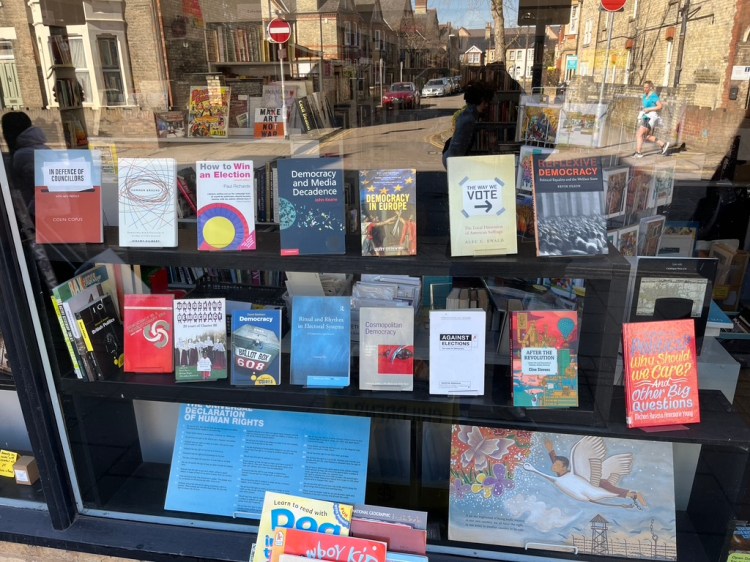
Above – Amnesty Bookshop on Mill Road – the red book at the end is by Michael Rosen with his introduction to politics. He’s back in Cambridge for the Cambridge Festival but tickets went like hotcakes.
Both Oxfam and the RSPCA on Burleigh Street down the road from the Cambridge Room and around the corner from Together Culture have also increased their book selection on democracy and current affairs of late, as has the RSPCA Bookshop (which also has a local history section) at the Romsey Town end of Mill Road. (At the foot of this article I’ve listed some ‘direct from publishers’ links from those that publish books and pamphlets on contemporary political issues)
- Follow me on BSky
- Like my Facebook page
- Consider a small donation to help fund my continued research and reporting on local democracy in and around Cambridge.
Below – by Newsthump which you can get on a t-shirt here. This is me!

Direct from the publishers
For those of you who want to sink your minds into either heavier reading or much shorter policy pamphlets, the latter of which are often produced in response to policy announcements from ministers, have a look at:
- Manchester University Press
- Bristol University Press / Policy Press
- Biteback Publishing (Westminster-based, politics & political history)
- Fabian Society Publications – mainly left/centre left pamphlets
- Pluto Press and also Verso Books (radical and/or international issues)
- Green Alliance – environmentalist online pamphlets
- The White Horse Press – environmental in-depth academic
 The Cambridge Town Owl